Sintered Structural Parts | PM Brackets, Housings & Rings
A sintered structural part is a load-bearing metal part made by pressing iron-copper, iron-copper-nickel-molybdenum or low-alloy steel powder in a die and sintering it – defined by its geometry, not by a single function like a gear or bushing. The category covers brackets, housings, flanges, plates, rings, hubs, counterweights, valve seats, synchronizer rings, clutch hubs, shift forks, ratchets, pawls, levers and latches. The pressing comes out near-net-shape, so material usage is 95-98% and there is almost no machining waste. At volume above about 20,000 pieces a year, a sintered structural part is typically 30-50% cheaper than the same machined part.
In-house PM line at our IATF 16949 factory in Ningbo: 16 compaction presses, 10 sintering furnaces, 3 Zeiss CMMs and a full secondary-treatment line (steam, plating, carbonitriding, case hardening). Fe-Cu, Fe-Cu-Ni-Mo, low-alloy steel and stainless 316L / 17-4 PH. Tooling in about 20 days, first-article samples in 25, DFM review within 48 hours.
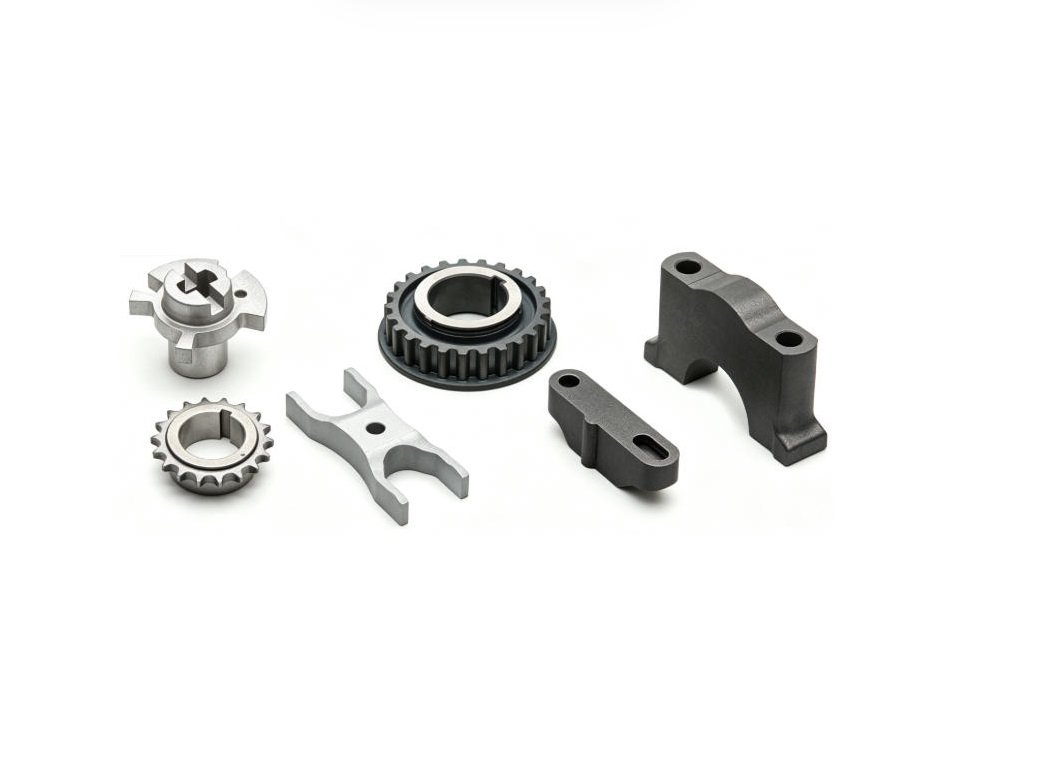
We make – PM is well-suited here
- Brackets, housings and flanges in Fe-Cu and Fe-Cu-Ni-Mo
- Plates, rings and hubs – flat and rotational structural parts
- Counterweights and balance weights for motors and flywheels
- Valve seats (engine valve seat inserts) in sintered high-alloy steel
- Synchronizer rings, clutch hubs and shift forks for automotive transmission
- Ratchets and pawls in case-hardened low-alloy steel
- Levers and latches in Fe-Cu and stainless
- Self-lubricating sintered bushings co-pressed into a structural part
We don’t make – ask a partner shop
- Forged steel structural parts (use a forging house – density 7.85 g/cm³)
- Die-cast aluminium structural housings (use our die-casting line instead)
- Large welded fabrications or weldments (use a fabrication shop)
- Structural parts above about 150 mm projected area (press envelope limit)
- Parts requiring IT5 accuracy without secondary grinding
Need a forged part or an aluminium die-cast housing? Ask us anyway – we run an 8-line aluminium die-casting operation and partner with forging houses in Ningbo, so we can quote the full assembly under one PO. Tell us what you need.
Sintered structural part vs machined structural part vs die-cast structural part
The three most common manufacturing routes for a structural metal part. Pick by accuracy, strength, volume and part size.
| Parameter | Sintered structural part (PM) | Machined structural part | Die-cast structural part (aluminium) |
|---|---|---|---|
| Material | Fe-Cu, Fe-Cu-Ni-Mo, low-alloy steel, stainless 316L / 17-4 PH | Any steel, stainless, aluminium, titanium bar stock | Aluminium alloys (ADC12, A380), zinc alloys |
| Density | 6.4-7.2 g/cm³ (porous) | 7.85 g/cm³ (full-density steel) | 2.7 g/cm³ (aluminium) |
| Tensile strength | 250-750 MPa depending on grade | 400-1,200 MPa depending on material | 180-330 MPa |
| Achievable accuracy | IT7-IT9 as-sintered, IT6-IT7 sized | IT5-IT7 (depends on machine) | IT8-IT10, IT7 on machined features |
| Material usage | 95-98% (near-net-shape) | 40-70% (cuts away stock) | 70-85% (gating + overflow) |
| Cost per part (relative) | Low at volume above 20,000 pcs / yr | Medium-high, scales poorly | Low at volume above 10,000 pcs / yr |
| MOQ for custom | 2,000 pcs at JH PM | 1-50 pcs (prototype-friendly) | 3,000-5,000 pcs (die cost) |
| Best for | High-volume brackets, housings, transmission parts, ratchets, latches | Low-volume, high-accuracy, large parts | Lightweight housings and covers |
| Our recommendation | Default for volume above 20,000 pcs / yr and weight below 2 kg | Use for prototypes, low volume or IT5 accuracy | Use when weight reduction matters more than strength |
Four powder metallurgy structural part families we make
Each cluster below groups the part geometries we run most often. Click through to the part card for typical dimensions, materials and tolerances.
Brackets, Housings & Flanges
Mounting and alignment parts – the workhorse of PM structural parts. Brackets locate a component, housings enclose it, flanges connect two assemblies. Fe-Cu, Fe-Cu-Ni-Mo and stainless.
Rings, Hubs & Counterweights
Rotational and balance parts. Rings are flat circular parts with a bore; hubs carry a shaft or gear; counterweights provide balance mass. Single-level press – the cheapest PM part to tool.
Transmission & Drivetrain Parts
High-strength parts for automotive and gearbox duty: synchronizer rings, clutch hubs, shift forks, ratchets and pawls. Low-alloy steel, often case-hardened. IATF 16949 programs with PPAP.
Levers, Latches, Valve Seats & Bushings
Mechanism parts: levers and latches for locks and appliances, valve seats for engines, and self-lubricating sintered bushings co-pressed into a structural part. One P/N, one MTC.
Brackets, Housings & Flanges – The Mounting and Alignment Parts
Brackets, housings and flanges are the default PM structural parts. A bracket locates and mounts a component; a housing encloses a mechanism or a bearing; a flange connects two assemblies end-to-end. They share the same near-net-shape economics – press to shape, size the critical bores, ship. The value of PM here is the multiple bosses, steps and bores that would each be a separate machining operation if cut from bar stock.
From our quoting desk: the most common reason a bracket or housing RFQ gets returned is a thin wall at a bore. Below 1.5 mm the part cracks on ejection. We flag it in the DFM note and either thicken the wall or add a sizing step – either way, the customer knows before tooling, not after first article.
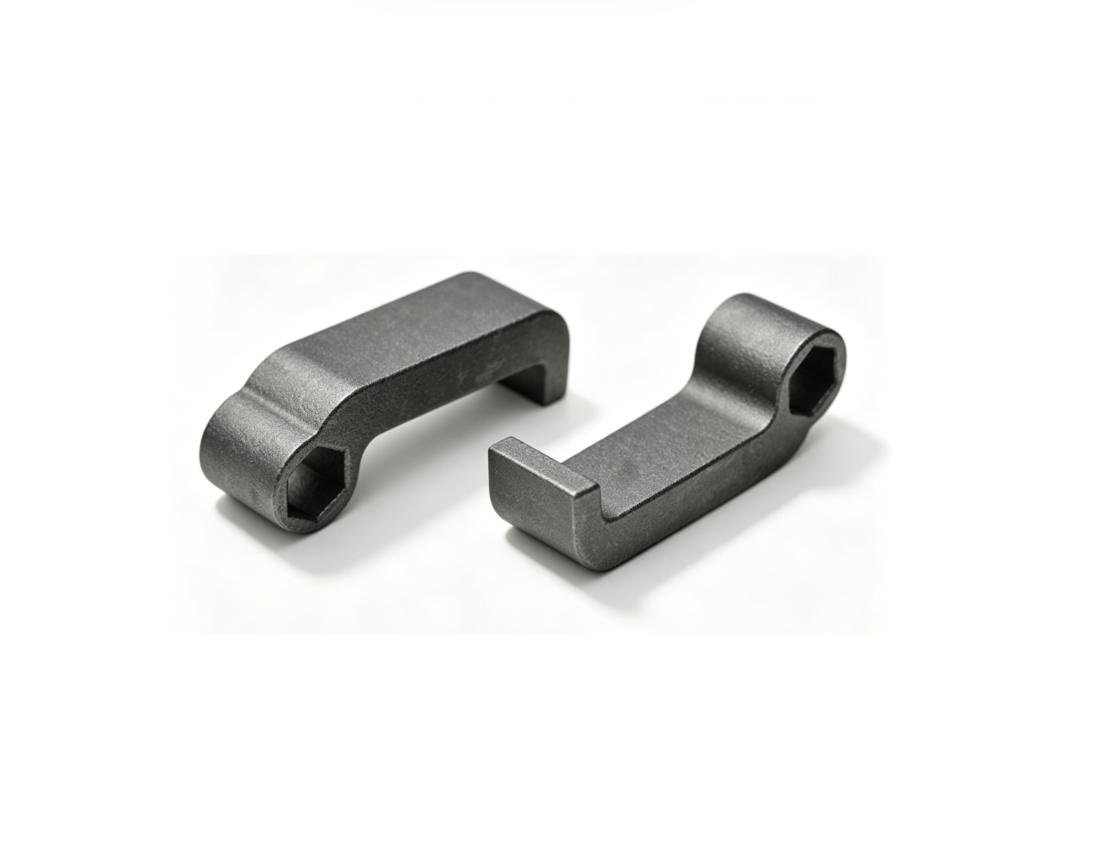 Sintered bracket
Fe-Cu, density 6.4-6.8 g/cm³, tensile 250-450 MPa. Two or three bosses with sized bores. Mounting plate for motors, pumps, sensors.
Sintered bracket
Fe-Cu, density 6.4-6.8 g/cm³, tensile 250-450 MPa. Two or three bosses with sized bores. Mounting plate for motors, pumps, sensors.
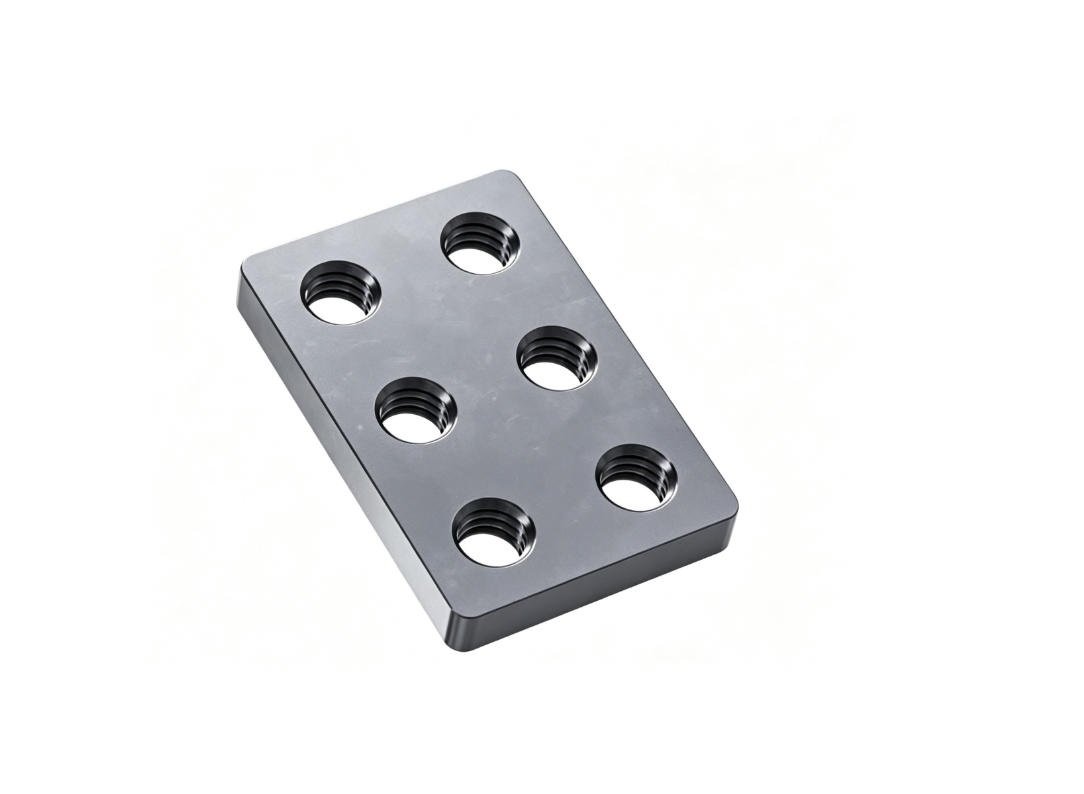 Sintered flange and plate
Fe-Cu, density 6.4-6.8 g/cm³. Flat flange with a bolt circle, or a plain sintered plate. Pressed flat, sized bolt holes. Connects pipe, shaft and motor assemblies.
Sintered flange and plate
Fe-Cu, density 6.4-6.8 g/cm³. Flat flange with a bolt circle, or a plain sintered plate. Pressed flat, sized bolt holes. Connects pipe, shaft and motor assemblies.
Rings, Hubs & Counterweights – The Rotational and Balance Parts
Rings, hubs and counterweights are the simplest PM structural parts to make – mostly single-level pressings, so the tooling is the cheapest and the cycle is the fastest. A ring is a flat circular part with a bore; a hub carries a shaft or gear on a spline or keyway; a counterweight provides balance mass on a rotating assembly. Because they are flat or near-flat, they are also the highest-volume PM parts – the economics scale hard.
On material choice: for a counterweight, material cost is the whole game – we default to plain Fe-Cu at 6.6 g/cm³ because the customer is buying mass, not strength. For a hub that carries torque, we move to Fe-Cu-Ni-Mo at 7.0-7.2 g/cm³ and size the spline. The same geometry, two different materials, two different prices – that is where the DFM conversation saves money.
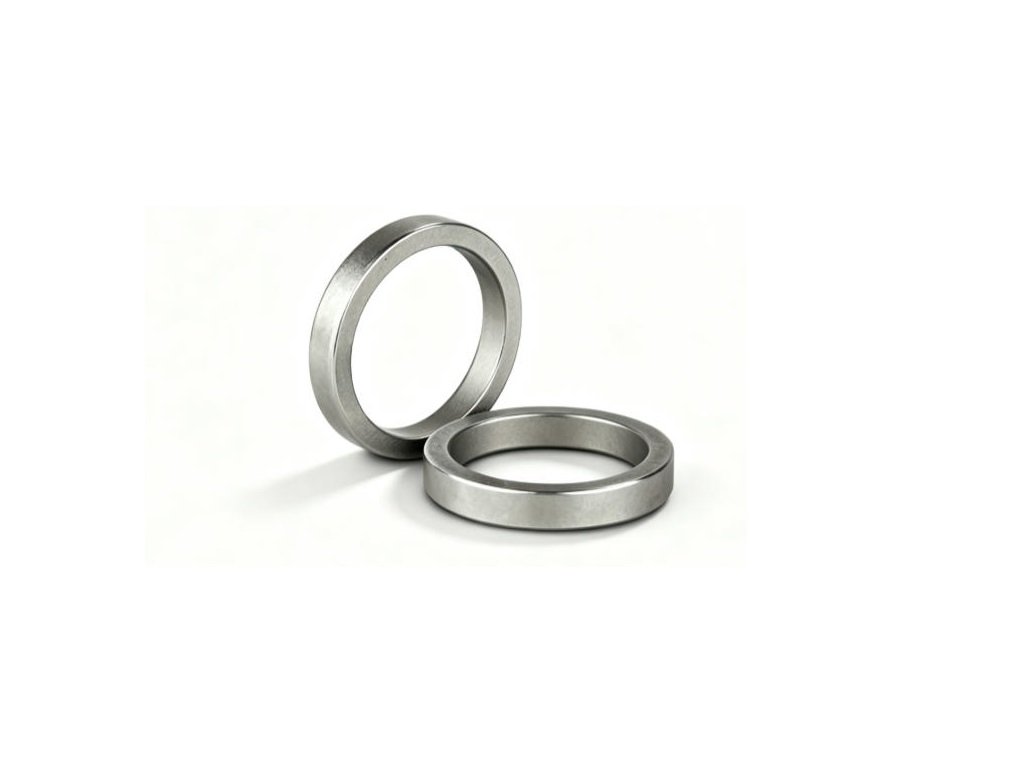 Sintered ring
Fe-Cu, density 6.4-6.8 g/cm³. Flat ring, OD 20-120 mm, bore sized to IT7. Spacer rings, thrust rings, retaining rings. Cheapest PM part to tool.
Sintered ring
Fe-Cu, density 6.4-6.8 g/cm³. Flat ring, OD 20-120 mm, bore sized to IT7. Spacer rings, thrust rings, retaining rings. Cheapest PM part to tool.
Transmission & Drivetrain Parts – Synchronizer Rings, Clutch Hubs, Shift Forks, Ratchets
This cluster is the high-strength end of PM structural parts – automotive transmission and gearbox duty, where the part sees torque, impact and repeated engagement. The materials are low-alloy steel (Fe-Cu-Ni-Mo), the density is pushed to 6.8-7.2 g/cm³, and the surface is case-hardened to HRC 55-62. These are IATF 16949 programs with full PPAP.
Real failure mode we see: a shift fork fails at the fork-rail interface when the part is not case-hardened there. The shift fork slides on the rail thousands of times, so the sliding surface needs HRC 55-62 while the fork arms stay tough at HRC 25-35. We carbonitride selectively on the rail interface. Customers who skip this save 8% on the part and pay for it in warranty returns.
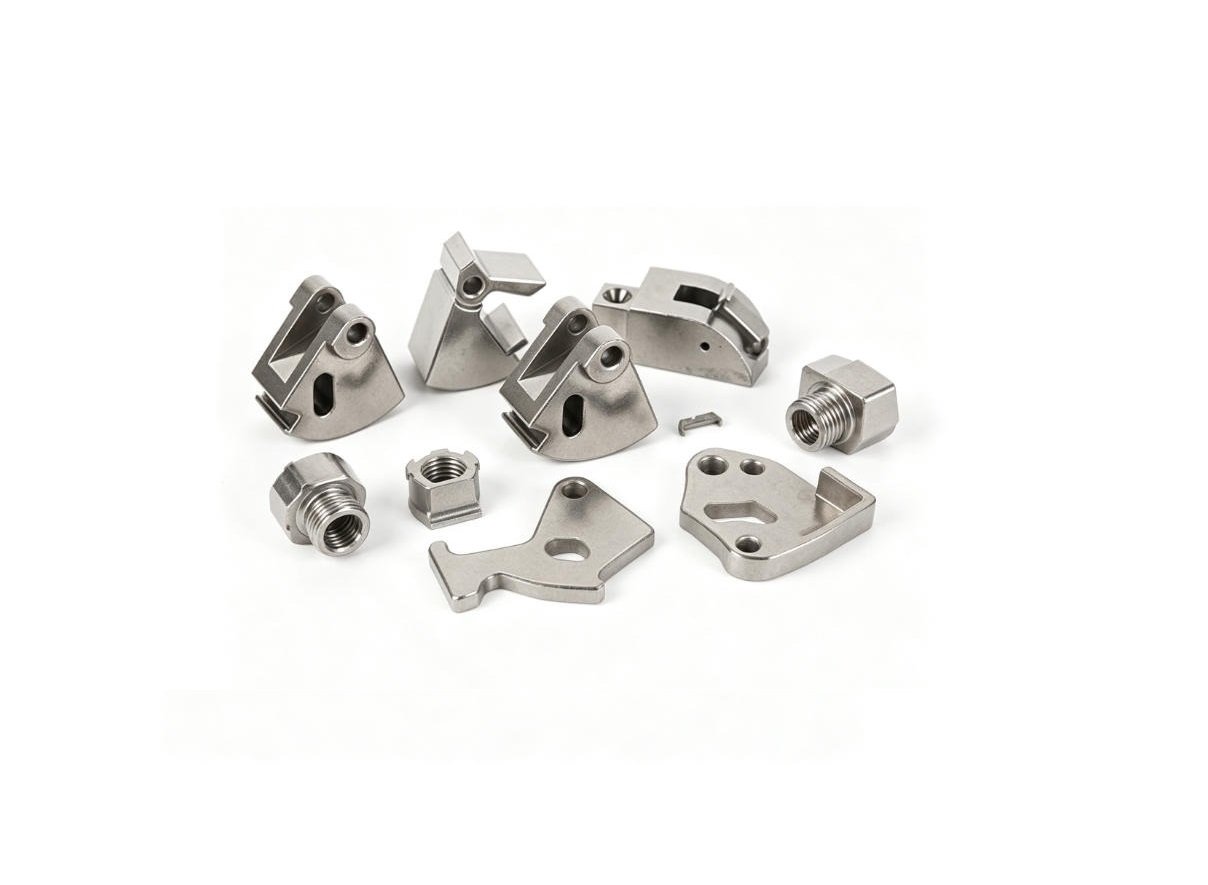 Sintered ratchet and pawl
Low-alloy steel, case-hardened teeth to HRC 55-62. Ratchet wheel + spring-loaded sintered pawl. Impact and wear duty – hand tools, winches, tensioners.
Sintered ratchet and pawl
Low-alloy steel, case-hardened teeth to HRC 55-62. Ratchet wheel + spring-loaded sintered pawl. Impact and wear duty – hand tools, winches, tensioners.
Levers, Latches, Valve Seats & Sintered Bushings – The Mechanism Parts
This cluster covers the mechanism parts – levers and latches for locks, appliances and small mechanisms, valve seats for engines, and the self-lubricating sintered bushings that get co-pressed into a structural part. These are smaller, high-cycle parts where wear resistance and dimensional stability matter more than raw tensile strength.
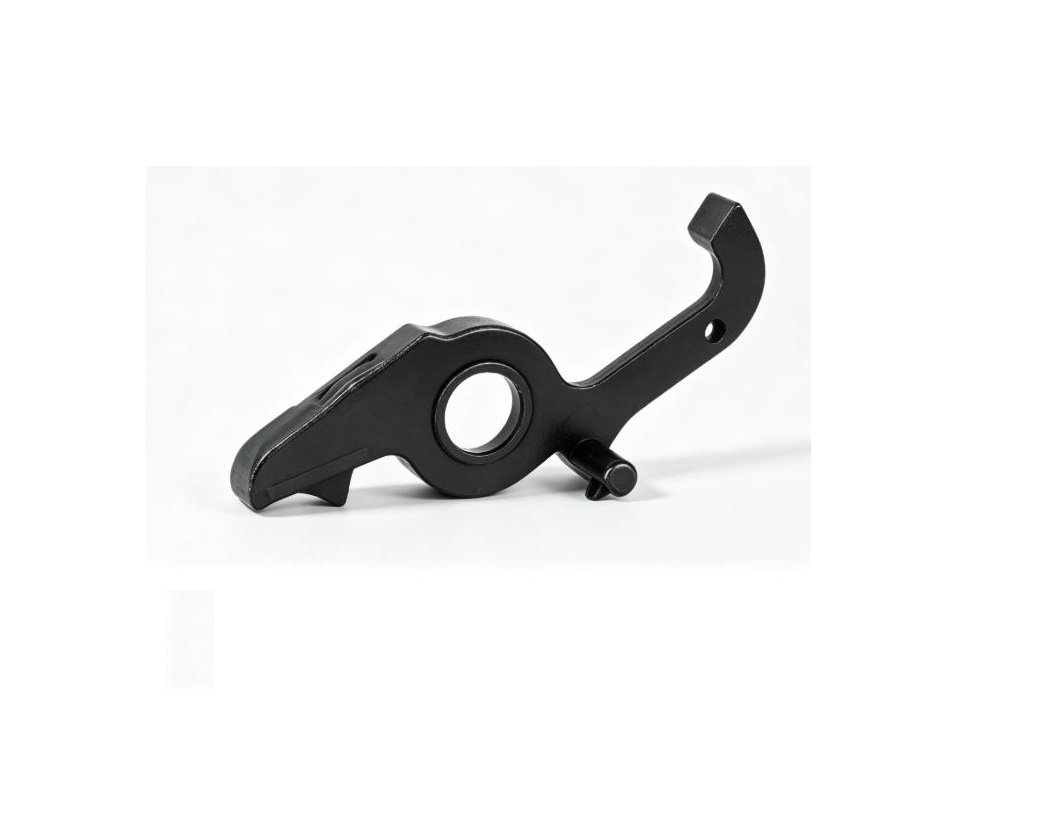 Sintered lever
Fe-Cu or Fe-Cu-Ni-Mo, density 6.4-7.0 g/cm³. Actuating arm with a pivot bore. Door handles, brake levers, appliance controls.
Sintered lever
Fe-Cu or Fe-Cu-Ni-Mo, density 6.4-7.0 g/cm³. Actuating arm with a pivot bore. Door handles, brake levers, appliance controls.
Capabilities for sintered structural parts
What you can ask for in your RFQ. All numbers are in-house, not subcontracted.
What we see in real RFQs: the most common reason a structural part drawing gets re-quoted is a feature that PM cannot press – an undercut, a reverse taper, or a thread. PM pressing only makes features in the direction of the press stroke, so undercuts and side holes need a secondary machining step. We flag every such feature in the DFM note with the added cost, so the customer can decide whether to redesign or pay for the secondary op.
| Parameter | Standard range | Notes |
|---|---|---|
| Materials | Fe-Cu, Fe-Cu-Ni-Mo, low-alloy steel (Fe-Cu-Ni-Mo + C), 316L stainless, 17-4 PH stainless | Material certificate per lot |
| Density (Fe-Cu) | 6.4 – 6.8 g/cm³ | Brackets, housings, plates, rings |
| Density (Fe-Cu-Ni-Mo) | 6.8 – 7.2 g/cm³ | Hubs, shift forks, synchronizer rings, clutch hubs |
| Tensile strength (Fe-Cu) | 250 – 450 MPa | General structural duty |
| Tensile strength (Fe-Cu-Ni-Mo) | 550 – 750 MPa | Transmission and drivetrain duty |
| Surface hardness (case hardened) | HRC 55-62 (case depth 0.4-0.8 mm) | Ratchets, pawls, latches, shift fork rails |
| Accuracy (as-sintered) | IT8-IT9 | Standard production output |
| Accuracy (sized feature) | IT6-IT7 | Bores, bosses, splines, cones |
| Part envelope | projected area up to approx. 150 mm, height up to approx. 80 mm | 500 t PM press envelope |
| Secondary treatments | Steam, black oxide, zinc / zinc-nickel plating, phosphating, carbonitriding, case hardening, oil impregnation | Selected per duty |
| MOQ | 2,000 pcs per P/N | Lower for sampling / replacement lots on request |
| Tooling lead time | approx. 20 days | In-house die + mandrel + sizing tool |
| Sample lead time | approx. 25 days after tooling approval | FAI report included |
| DFM review | 48 hours | Written DFM note with material + density + tolerance recommendation |
| QC | 3 Zeiss CMMs, density meter, hardness tester, tensile tester | Lot-level MES traceability |
| Certifications | IATF 16949:2016, ISO 9001:2015 | Audited annually by SGS |
Common HS code: 7326 (other articles of iron/steel) / 8483 (transmission parts) / 8708 (parts of motor vehicles). Confirm the exact line with your broker before the commercial invoice.
How a sintered structural part is made at JH PM
Six steps from your drawing to a sized, lot-level structural part. Same process we use for our automotive transmission parts and power-tool brackets – just a different die and a different secondary treatment.
On density targets: higher density costs more in press tonnage and cycle time, so we only push density where the part needs it. A bracket at 6.6 g/cm³ costs noticeably less than a clutch hub at 7.2 g/cm³, and both are correct for their duty. If your drawing calls for maximum density everywhere, expect to pay for it – we will tell you where you can drop the density without losing function.
FAQ – Sintered Structural Parts
What are sintered structural parts?
Sintered structural parts (PM structural parts) are load-bearing metal parts pressed from iron-copper, iron-copper-nickel-molybdenum or low-alloy steel powder, then sintered in a furnace. Unlike gears or bushings, they are defined by geometry, not function: brackets, housings, flanges, plates, rings, hubs, counterweights, valve seats, synchronizer rings, clutch hubs, shift forks, ratchets, pawls, levers and latches. Pressing is near-net-shape, so little machining is needed. Structural parts are the largest PM product category by volume.
What PM materials do you use for structural parts, and how strong are they?
We use four families. Fe-Cu (2-5% copper) is the workhorse – 6.4-6.8 g/cm³ and 250-450 MPa – for brackets, housings and plates. Fe-Cu-Ni-Mo reaches 6.8-7.2 g/cm³ and 550-750 MPa for clutch hubs, shift forks and synchronizer rings. Carbonitrided low-alloy steel hits HRC 55-62 for ratchets and pawls. 316L and 17-4 PH cover corrosive duty. The grade depends on load, duty cycle and impact.
What tolerances can you hold on a sintered structural part?
As-sintered we hold IT8-IT9 on most dimensions, IT7 on the compaction axis. Sized bores and bosses come down to IT6-IT7. A sintered part won’t hold IT5 without grinding – if your drawing calls for it, we flag it and add a grinding step. We list the tolerance per feature in the DFM note before tooling, so there are no surprises on first article.
What is the difference between a sintered structural part and a machined structural part?
A sintered part is pressed to near-net shape, so 95-98% of material is used. A machined part starts from bar stock and cuts away 30-60%. Above about 20,000 pieces a year, sintered is usually 30-50% cheaper, with no tool marks to deburr. The trade-off: a lower accuracy ceiling (IT7 vs IT5) and lower density (7.2 vs 7.85 g/cm³). For high-accuracy, low-volume parts, machined steel still wins.
Can you make a sintered structural part with a sintered bushing already pressed into it?
Yes. We co-press or insert an oil-impregnated sintered bushing into a bore – the bushing takes the bearing load, the structural part handles mounting. Because the bushing is made in-house, the assembly ships under one MTC and one P/N, removing a second supplier and a second inspection.
What are sintered synchronizer rings and clutch hubs, and do you make them?
Both are automotive transmission parts. A sintered synchronizer ring is the conical friction ring that matches shaft speeds before gear engagement; a sintered clutch hub is the splined centre the clutch plates ride on. We make both in Fe-Cu-Ni-Mo, sized to IT6, 6.8-7.2 g/cm³, under IATF 16949 with full PPAP. Sprayed friction surfaces go to a certified coating partner.
What surface finish and secondary treatments do you offer on sintered structural parts?
As-sintered is a matte grey, roughly Ra 1.6-3.2 µm. From there we offer steam treatment, black oxide, zinc or zinc-nickel plating, phosphating, carbonitriding or case hardening, and oil impregnation. Cosmetic parts get tumble or vibro-finish first. We match finish to duty – a latch spring gets case hardening, a visible cover plate gets zinc-nickel.
Do you provide PPAP, IMDS and RoHS documentation with sintered structural parts?
Yes. Automotive programs get a full PPAP package – design records, material certificates, dimensional FAI, Cpk data and process flow diagrams – plus IMDS entries for every steel grade. RoHS and REACH statements are issued on request, with SGS test reports where required. Non-automotive lots still ship with an MTC covering material, density, hardness and dimensions.
Send a drawing. Get a DFM review within 48 hours.
Email a 2D drawing, a 3D model or a sample, plus the load case and annual volume. Within 48 hours you get a written DFM note – material, target density, tolerance per feature, and every flagged non-pressable feature – before you commit to tooling.
Send your drawing