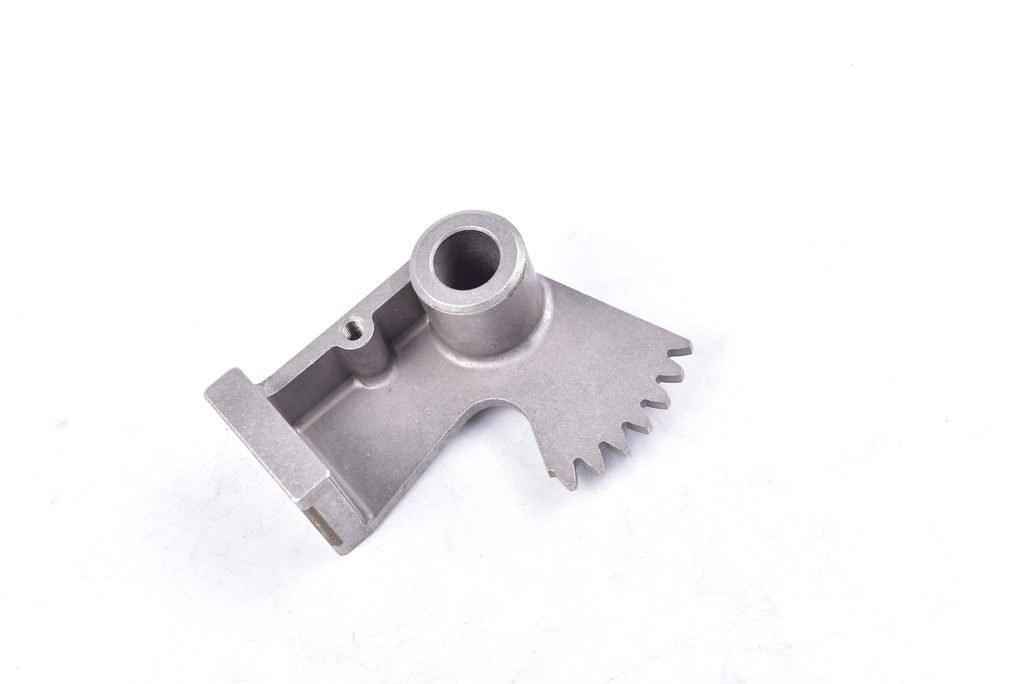
What Is Powder Metallurgy? Process, Advantages, and Design Guidelines
An engineering overview of press-and-sinter powder metallurgy — how it turns raw metal powder into precision, near-net-shape structural parts at automotive-scale volumes.
- Material Efficiency: Utilizes 97%+ of raw material (vs. 30–60% for CNC machining).
- Target Economics: Ideal for annual volumes of 10,000+ units, with per-unit costs of $0.30–$2.00 at high volume.
- Key Capabilities: Holds ±0.025 mm on critical dimensions post-sizing; best for parts up to ~75 mm (gears, bushings, cams, sprockets).
- Process Workflow: Powder Production → Blending → Compaction → Sintering.
What Is Powder Metallurgy?
Powder metallurgy (PM) is a metal-forming process that manufactures parts by compacting metal powder in a die and then heating it — a step called sintering — below its melting point to bond the particles into a solid, near-net-shape component.
Unlike machining, which cuts material away from a solid block, or casting, which pours molten metal into a mold, powder metallurgy builds parts from the ground up. The result is a highly repeatable, material-efficient process that typically uses more than 97% of the raw material in the finished part — making it one of the most cost-effective and sustainable methods for producing medium- to high-volume metal components.
PM vs. MIM: What’s the Difference?
Powder metallurgy in the narrow sense usually refers to press-and-sinter PM: powder is compacted uniaxially in a rigid die, then sintered.
Metal Injection Molding (MIM) is technically a branch of powder metallurgy, but it operates differently: ultra-fine metal powder is mixed with a binder, injection-molded like plastic, debound, and sintered. MIM suits small, extremely complex parts (typically under 100 g); press-and-sinter PM suits larger, simpler geometries at very high production rates.
How Does the Powder Metallurgy Process Work?
The standard press-and-sinter process consists of four main manufacturing stages, followed by optional secondary operations:

Step 1: Powder Production
Metal powders are produced via three primary methods:
- Atomization: High-pressure water or gas jets spray molten metal into fine droplets. Used for carbon steels, stainless steels, and superalloys.
- Chemical Reduction: Metal oxides are reduced with hydrogen or carbon to produce sponge-like powders, common for iron and tungsten.
- Electrolysis: Metal is deposited directly from solution, yielding high-purity copper and iron powders.
Step 2: Mixing and Blending
Base powders are mixed with alloying elements (graphite, nickel, copper) and solid lubricants (such as zinc stearate) to reduce die friction during pressing. Precise dosing controls the final mechanical properties.
Step 3: Compaction (Pressing)
The powder mix is fed into a tool steel or carbide die cavity and pressed uniaxially at 200–700 MPa (up to 1,500 MPa for high-density applications). The machine produces a green compact — a shape-accurate but fragile preform held together by mechanical particle interlocking.

Step 4: Sintering
Green compacts pass through a controlled-atmosphere furnace (nitrogen-hydrogen or vacuum) at temperatures between 750°C and 1,300°C. Particles bond via solid-state diffusion, creating strong metallic bonds and consolidating the part to its final physical strength.
Step 5: Secondary Operations (Optional)
Where tighter tolerances or specific physical properties are required, secondary steps are applied:
- Sizing / Coining: Re-pressing to tighten critical dimensions to ±0.025–0.05 mm and increase local density.
- Heat Treatment: Hardening, tempering, or carburizing for enhanced wear resistance.
- Steam Treatment: Creates an iron oxide surface layer to seal porosity and enhance corrosion resistance.
- Infiltration: Melting copper into internal pores to boost tensile strength and toughness.
- Oil Impregnation: Vacuum-filling connected pores with oil to make self-lubricating sleeve bearings.
- Machining / Tapping: Cutting threads, transverse holes, or undercuts that cannot be pressed.
What Are the Advantages of Powder Metallurgy?
- Exceptional Material Efficiency: Near-net-shape forming means 97%+ of raw powder becomes the final part, compared to CNC machining where 40–70% is lost as swarf.
- Lowest Per-Unit Cost at Scale: Fast press cycle times (measured in seconds) yield unit costs between $0.30–$2.00 once tooling is amortized.
- Part-to-Part Repeatability: Fixed tooling geometry yields consistent dimensional control across runs of millions of units.
- Unique Microstructural Capabilities: Enables controlled porosity (filters, self-lubricating bearings) and refractory metal processing (tungsten, molybdenum) impossible by melting.
- Green Technology: Low scrap generation, high energy efficiency, and compatibility with recycled metal powder support sustainable manufacturing.
What Are the Limitations of Powder Metallurgy?
- Residual Porosity: As-sintered density typically sits between 85–92%. Highly fatigue-critical structural components require secondary densification or forging.
- Tooling Capital: Precision carbide dies cost thousands of dollars, making PM economical primarily above 10,000 parts/year.
- Geometrical Constraints: Uniaxial pressing prohibits perpendicular features (transverse holes, undercuts, internal threads) without secondary machining.
- Size Restrictions: Press force capacity usually restricts economical part sizes to ~75 mm max cross-section.
Powder Metallurgy vs. Alternative Processes
The table below provides MPIF-aligned guidance for evaluating metal-forming processes:
| Factor | Powder Metallurgy | CNC Machining | Die Casting | MIM |
|---|---|---|---|---|
| Best For | High-volume gears, bushings, cams, sprockets | Prototypes, ultra-tight tolerances | Large thin-wall aluminum housings | Small complex parts <100 g |
| Economic Volume | 10,000+ pcs/yr | 1 – 1,000 pcs | 10,000+ pcs | 5,000 – 100,000+ pcs |
| Typical Size | Up to ~75 mm | Nearly unlimited | Medium to large | Small (<100 g) |
| Material Yield | 97%+ | 30–60% | 80–95% | 95%+ |
| As-Made Tolerance | ±0.1 mm (±0.025 mm after sizing) | ±0.005–0.025 mm | ±0.1–0.2 mm | ±0.03 mm (±0.3%) |
| Relative Density | 85–92% (up to 95% densified) | 100% (Wrought) | ~98–100% | 95–98% |
| Tooling Cost | Medium ($5k–$20k) | None | High ($10k–$50k) | High ($5k–$15k) |
| High-Volume Unit Cost | Very Low ($0.30–$2.00) | High ($8–$40) | Low ($1–$5) | Low ($0.50–$3) |
Note: Values are typical industry ranges consistent with MPIF published standards. Always confirm specs against your part drawing.
How Do You Design Parts for Powder Metallurgy?
Core DFM Rules for Press-and-Sinter PM
- Design for Vertical Ejection: Ensure the geometry clears the die vertically. Avoid radial holes, undercuts, and side grooves in the pressed state.
- Maintain Uniform Wall Thickness: Large transitions cause local density gradients and differential shrinkage during sintering.
- Provide Fillets & Radii: Sharp corners cause high stress concentrations on die tooling and lead to green compact cracking.
- Specify Real Tolerances: Use standard as-sintered tolerances (±0.05 to ±0.1 mm) where possible, reserving sizing or machining only for critical functional faces.
What Is Powder Metallurgy Used For?

Automotive production accounts for over 70% of all PM parts (a typical passenger vehicle contains 20–40 lbs of sintered components). Primary application sectors include:
- Automotive Engines & Transmissions: Timing gears, oil pump rotors, valve guides, variable valve timing (VVT) components, sensor rings.
- Power Tools & Hardware: Planetary gearboxes, cams, lock cylinders, drive sprockets.
- Industrial & Hydraulics: Hydraulic pump gears, valve plates, soft magnetic composite (SMC) cores.
- Electrical & Appliances: Self-lubricating bronze sleeve bearings, switch contact materials.
When Is Powder Metallurgy the Right Choice?
Evaluate your candidate part against this 6-point checklist:
- [ ] Annual volume is 10,000 units or greater
- [ ] Largest dimension is ~75 mm or smaller
- [ ] Part features are parallel to the vertical pressing direction
- [ ] High dimensional repeatability is required
- [ ] Material utilization is critical to piece-part cost
- [ ] Porosity can be leveraged functionally (e.g., self-lubrication)
What to Look for in a PM Supplier
When qualifying a powder metallurgy manufacturing partner, confirm these five operational benchmarks:
- Quality Management Systems: IATF 16949 certification for automotive work; ISO 9001 for general industrial parts.
- In-House Tooling Capabilities: Fabrication and maintenance of precision carbide dies in-house cut revision lead times.
- Quality Documentation: Full PPAP Level 3 compliance and complete heat-lot powder traceability.
- Metrology Infrastructure: CMM (e.g., Zeiss) inspection capabilities for 3D profile validation.
- Press Capacity Range: A broad range of mechanical and hydraulic presses (e.g., 6 to 1,000 tons) to match part footprint to optimal press tonnage.
JH PM operational snapshot: Certified IATF 16949 factory with 19 compaction presses ranging from 6 to 1,000 tons, in-house tooling shop, Zeiss CMM inspection, and optional CNC machining holding ±0.01 mm tolerances.
Frequently Asked Questions (FAQ)
Is powder metallurgy stronger than casting?
Not automatically. Standard sintered PM parts retain porosity that can reduce fatigue and impact strength versus fully dense castings. However, densified PM routes (sizing, infiltration, powder forging) can match or exceed cast performance for many applications.
What materials can be used in powder metallurgy?
The most common are iron and low-alloy steels, stainless steels, copper and copper alloys (bronze, brass), and soft magnetic composites. Refractory metals like tungsten and molybdenum are also produced almost exclusively by PM.
How tight can powder metallurgy tolerances be?
As-sintered, the industry-typical tolerance is around ±0.1 mm — JH PM routinely holds ±0.05 mm as-sintered. After sizing, selected critical dimensions can reach ±0.025–0.05 mm, and precision machining can take individual features tighter still.
What is the minimum production volume for powder metallurgy?
As a rule of thumb (industry typical), 10,000 parts per year. Below that, tooling amortization usually favors machining. The exact breakpoint depends on part complexity and material cost.
Is powder metallurgy environmentally friendly?
Yes — relative to competing processes. PM uses over 97% of its raw material, consumes less energy than casting or forging, and supports recycled feedstock. It’s widely promoted as a sustainable manufacturing technology.
What is the difference between powder metallurgy and MIM?
Powder metallurgy (press-and-sinter) compacts powder uniaxially in a rigid die and suits larger, simpler parts at very high volumes. Metal injection molding mixes fine powder with binder, injects it like plastic, then debinds and sinters — suited to small, complex parts under 100 g.
How much does powder metallurgy tooling cost?
Typical PM tooling costs $5,000–$20,000 depending on part complexity and number of levels. Tooling takes several weeks to produce and is amortized into unit price — one reason PM suits volumes of 10,000+ parts per year.
What certifications should a powder metallurgy supplier have?
Look for ISO 9001 as a baseline and IATF 16949 if you supply automotive. Beyond certificates, verify PPAP documentation capability, lot traceability, CMM-based inspection with documented calibration, and in-house tooling design.
Get a PM Feasibility Check on Your Drawing
The fastest way to know whether powder metallurgy works for your part is to have it reviewed by engineers who run PM, MIM, and die casting side by side. Send your STEP file or 2D PDF for a 48-hour DFM report and cost analysis.