Powder Metallurgy Planetary Gear | Sintered Sun/Planet/Ring
A powder metallurgy planetary gear is a set of three or four small gears that orbit a central sun gear, all running inside a fixed internal ring gear, with the assembly held by a planet carrier (spider). The whole set is made by pressing Fe-Cu, Fe-Cu-Ni-Mo or low-alloy steel powder in a die and sintering it. The result is a near-net-shape gear tooth that needs only sizing to reach ISO 7-8 accuracy, and it runs about 1-2 dB quieter than machined steel at the same accuracy class. We make sun, planet, ring and carrier as separate parts, or as a full planetary gearset under one MTC.
In-house PM line at our IATF 16949 factory in Ningbo: 16 compaction presses, 10 sintering furnaces, 3 Zeiss CMMs and a gear-checker. Module 0.4-2.5 on sun and planet, module 0.8-2.0 on ring gears. Sintered bushing for the planet pin is in-house too – one MTC covers the whole gearset. Tooling in about 20-25 days, first-article samples in 25, DFM review within 48 hours.
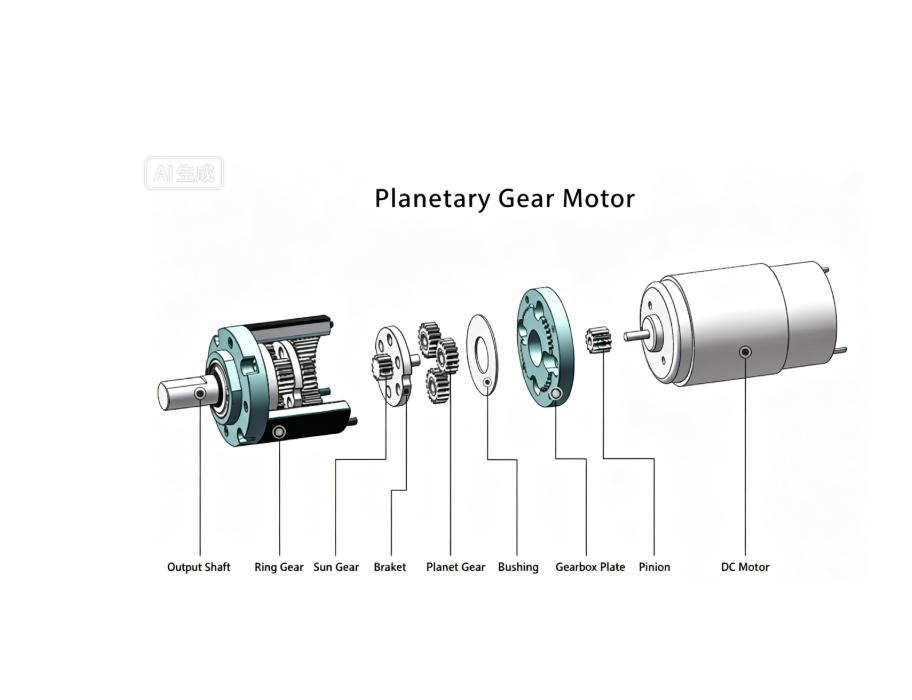
We make – PM is well-suited here
- Sun gears (module 0.4-1.5) in Fe-Cu, Fe-Cu-Ni-Mo, low-alloy steel
- Planet gears (module 0.4-2.5) for power-tool and robotic gearheads
- Ring gears / internal gears (module 0.8-2.0) with retractable-tooth dies
- 3-arm and 4-arm planet carriers (spiders) in Fe-Cu and low-alloy steel
- Sintered bushings for planet pins and sun-gear pilots (ID 3-12 mm)
- Full planetary gearset packaged under one MTC, one packing list
- Optional carbonitriding / case hardening (HRC 55-60 surface, HRC 25-35 core)
We don’t make – ask a partner shop
- Helical-bevel planetary gearsets with a hypoid offset (use a precision gear shop)
- Gear modules above 2.5 in PM (tooling cost dominates – we move to machined steel)
- Gear modules below 0.4 (powder pressing tolerance exceeds the tooth size)
- Plastic planetary gears (POM, PA66 – use an injection moulder)
- Rolling-element bearings inside the gearset (use NSK / SKF / FAG)
Need a hypoid or a very large module? Ask us anyway – we partner with two gear shops in Ningbo and can quote the full planetary stage under one PO. Tell us what you need.
Powder metallurgy planetary gear vs machined steel planetary gear vs hobbed planetary gear
The three most common manufacturing routes for a planetary gearset. Pick by module, accuracy class, torque target and annual volume.
| Parameter | PM planetary gearset (sintered) | Machined steel planetary gearset | Hobbed planetary gearset |
|---|---|---|---|
| Typical module range | 0.4-2.5 (sun/planet), 0.8-2.0 (ring) | 0.5+ (limited by cutter availability) | 0.3-3.0 (limited by hob availability) |
| Achievable accuracy class | ISO 7-8 standard, ISO 7 on sized-tooth | ISO 5-7 (depends on cutter and machine) | ISO 6-7 (after shaving or grinding) |
| Surface hardness range | HRB 60-100 standard, HRC 55-60 after case hardening | HRC 55-62 (depends on material + heat treat) | HRC 55-62 (depends on material + heat treat) |
| Noise level at 2,000 rpm | 1-2 dB lower than machined steel (micro-porosity damps tooth-contact noise) | Standard reference | Comparable to machined steel |
| Cost per gearset (relative) | Low for module 0.5-1.5 in volume above 50,000 / yr | Medium-high for small modules, low for large modules | Lowest for large modules in volume above 100,000 / yr |
| MOQ for custom dimensions | 2,000 pcs at JH PM | 500-1,000 pcs | 5,000-20,000 pcs (hob tooling is expensive) |
| Tooling lead time (custom) | ~20-25 days for a full gearset | ~10-20 days for cutters and fixtures | ~30-45 days for the hob and the gear-cutting machine setup |
| Best for | Power tools, e-bike motors, robotic joint gearheads, automotive transfer cases, small industrial gearboxes | Low-volume, high-accuracy, large-module industrial gearboxes | High-volume automotive and appliance planetary gearsets |
| Our recommendation | Default for power tools, e-bike motors, robotic actuators, transfer cases | Use only for low-volume, high-accuracy or large-module industrial gearboxes | Use when annual volume is above 200,000 pcs and a hob can be amortised |
Four sintered planetary gearset families we make
Each cluster below groups the part geometries we run most often. Click through to the part card for typical dimensions, materials and tolerances.
Sun Gears – The Central Pinion
The central pinion that drives the planet gears. The most geometrically simple PM gear – a short shaft with external involute teeth, module 0.4-1.5. The typical input shaft of a planetary gearbox.
Planet Gears – The Orbital Idlers
Small idler gears that mesh with the sun and the ring simultaneously. They orbit the sun axis on a planet pin (which can carry a sintered bushing). Module 0.4-2.5. The torque-bearing part of the set.
Ring Gears – Internal Tooth Geometry
An internal-tooth gear fixed in the housing. The hardest part to make by PM: the die needs retractable internal teeth to release the part without damage. Module 0.8-2.0. Often flanged for housing retention.
Planet Carriers & Sintered Bushings
The spider that holds the planet pins and provides the output, plus the sintered bushings and needle bearings for the planet pin and sun pilot. 3-arm and 4-arm geometries. The carrier is the structural part of the set.
Sun Gears – The Central Pinion of the Planetary Gearset
The sun gear is the central pinion that drives the planet gears. It is the most geometrically simple part of a planetary gearset – a short shaft with external involute teeth, an integral pilot, and often a toothed input portion for a motor pinion. PM pressing is the default route for module 0.4-1.5 because the part is a single-level press with no internal features.
From our quoting desk: the most common reason a sun gear fails in production is cracked teeth, not a worn-out tooth profile. Cracked teeth come from too-rapid ejection. We slow the ejector stroke on the press when we see thin root sections in the DFM check, and add a warm-press option when the root radius is below 0.3 mm.
Planet Gears – The Orbital Idlers of the Planetary Gearset
Planet gears are small idler gears that mesh with the sun gear on one side and the internal ring gear on the other side. They orbit the sun axis on a planet pin, typically through a sintered bushing. They are the torque-bearing part of a planetary gearset – the tangential force at the sun/planet mesh is carried by the planet-gear teeth, then transferred to the ring, then to the housing. PM pressing is well suited because planet gears are a small, high-volume part with a low module.
What we see in real RFQs: customers often ask for a planet gear with a single material, then complain about pitting after 500 hours. The fix is usually distal carbonitriding – a thin hard layer on the tooth flank, a tough core. We default to distal-hardened Fe-Cu-Ni-Mo for planet gears above module 0.8 in continuous duty.
Ring Gears / Internal Gears – The Internal Tooth Geometry
The ring gear is the part that makes a planetary gearset actually “planetary”. It is an internal-tooth gear – the teeth point inward, toward the centre of the part. The planet gears mesh with the ring from the inside, and the ring is fixed to the housing. The hardest part of the gearset to make by PM: the die needs retractable internal teeth to release the part without damaging the internal teeth, and the part often needs a flange for housing retention.
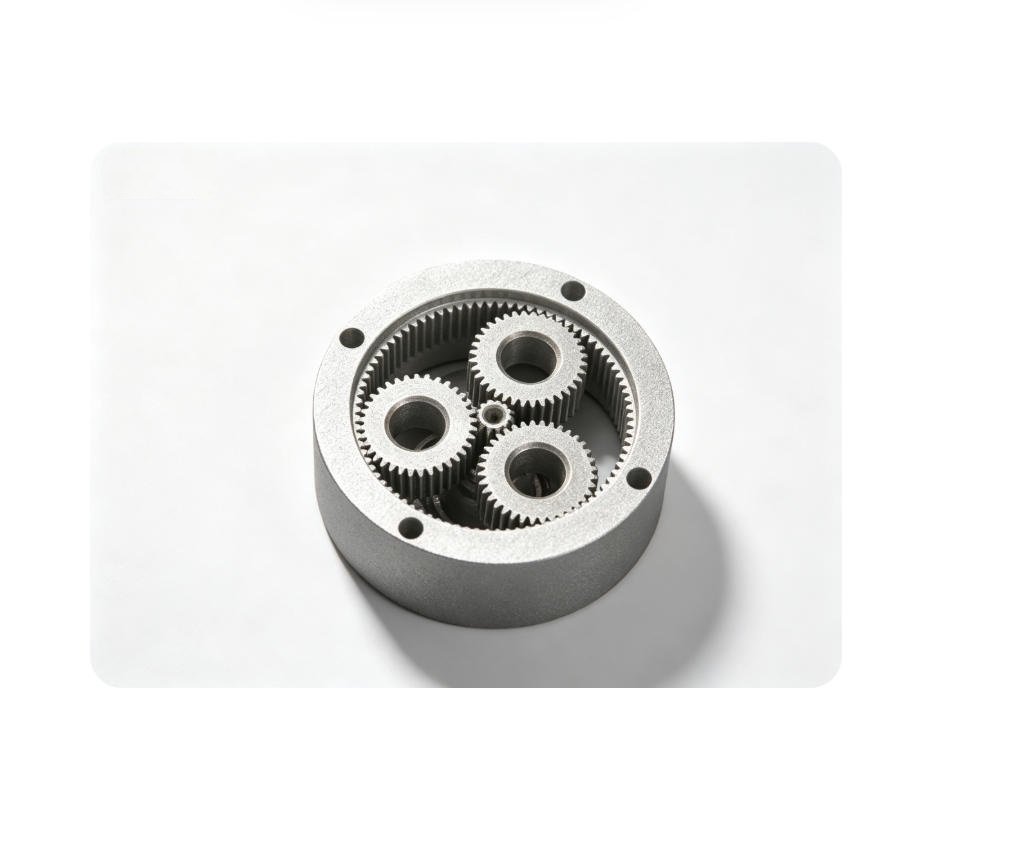 Sintered ring gear (internal straight-cut)
Fe-Cu-Ni-Mo, density 6.6-7.2 g/cm³, surface HRB 85-100. Module 0.8-2.0, OD 30-100 mm, length 8-20 mm. Common in cordless drill and impact driver gearboxes.
Sintered ring gear (internal straight-cut)
Fe-Cu-Ni-Mo, density 6.6-7.2 g/cm³, surface HRB 85-100. Module 0.8-2.0, OD 30-100 mm, length 8-20 mm. Common in cordless drill and impact driver gearboxes.
Planet Carriers (Spiders) and Sintered Bushings for the Gearset
The planet carrier is the structural part of a planetary gearset – it holds the planet pins (typically three or four), and provides the output shaft. The planet pins carry the radial load from the planet gears, usually through a sintered bushing. We make the carrier, the planet-pin bushing, and the sun-gear pilot needle bearing all in-house, so the full gearset ships under one MTC.
Real failure mode we see: planet carriers fail at the arm roots, not at the pin bores. The most common cause is asymmetric arm thickness, which puts ejection stress on the thin arm. We model the carrier before tooling kickoff and re-profile the arms to keep the ejection stress within the green strength of the Fe-Cu grade.
Sintered planet carrier (3-arm spider)
Fe-Cu-Ni-Mo, density 6.6-7.2 g/cm³, surface HRB 85-100. OD 25-80 mm, arm thickness 3-6 mm. Common in cordless drill and impact driver gearheads.
Capabilities for sintered planetary gearsets
What you can ask for in your RFQ. All numbers are in-house, not subcontracted.
On tooth sizing: the standard sintered gear is ISO 8-9 accuracy class. We size the teeth after sintering to bring the tooth-to-tooth and total composite error down to ISO 7. Sizing costs about 8% of the part price and adds 5-7 days. For higher accuracy we finish-grind – ISO 5-6, but that doubles the cost and adds another 8-10 days. Most power-tool and e-bike motor planetary gearsets do not need finish-grinding.
| Parameter | Standard range | Notes |
|---|---|---|
| Materials | Fe-Cu, Fe-Cu-Ni-Mo, low-alloy steel (Fe-Cu-Ni-Mo + 0.5% C), 316L stainless, 17-4 PH stainless | Material certificate per lot |
| Module range (sun / planet) | 0.4 – 2.5 | Below 0.4 – move to machined steel for the sun only |
| Module range (ring / internal) | 0.8 – 2.0 | Retractable-tooth die required above module 0.8 |
| Density (Fe-Cu) | 6.0 – 6.8 g/cm³ | Standard for low-load power-tool gearsets |
| Density (Fe-Cu-Ni-Mo) | 6.6 – 7.2 g/cm³ | High-torque, robotic, automotive |
| Surface hardness (as-sintered) | HRB 60-100 (depends on material) | Higher density = higher as-sintered hardness |
| Surface hardness (case hardened) | HRC 55-62 (case depth 0.4-0.8 mm) | Distal carbonitriding, core stays at HRC 25-35 |
| Accuracy class (as-sintered) | ISO 8-9 | Standard production output |
| Accuracy class (sized-tooth) | ISO 7 | Tooth sizing adds 5-7 days and ~8% to part cost |
| Accuracy class (finish-ground) | ISO 5-6 | Adds 8-10 days and ~100% to part cost – only for premium gearsets |
| Sun gear OD range | approx. 8 – 30 mm | Module 0.4-1.5 standard |
| Planet gear OD range | approx. 10 – 50 mm | Module 0.4-2.5 standard |
| Ring gear OD range | approx. 30 – 120 mm | Module 0.8-2.0 standard |
| Carrier OD range | approx. 25 – 90 mm | 3-arm or 4-arm |
| Planet-pin bushing ID | 3 – 12 mm | Oil-impregnated Cu-Sn or Fe-Cu |
| MOQ | 2,000 pcs per P/N | Lower for sampling / replacement lots on request |
| Tooling lead time | approx. 20-25 days for a full gearset | In-house die + mandrel + sizing tool + EDM |
| Sample lead time | approx. 25-30 days after tooling approval | FAI + gear-checker report included |
| DFM review | 48 hours | Written DFM note with material + accuracy + tooth recommendation |
| QC | 3 Zeiss CMMs, gear checker (module 0.3-3.0), surface hardness, density meter | Lot-level MES traceability |
| Certifications | IATF 16949:2016, ISO 9001:2015 | Audited annually by SGS |
| Common HS code | 8483 (transmission parts – gears and gearing) – confirm with your broker for the specific line on your commercial invoice | For customs declaration |
How a sintered planetary gearset is made at JH PM
Six steps from your gearbox drawing to a sized-tooth, lot-level planetary gearset under one MTC. Same process we use for our automotive and power-tool planetary gearsets – just a different die and a different sizing profile.
On oil choice for the planet-pin bushing: we default to ISO VG 100 mineral oil for the planet-pin bushing in oil-flooded gearboxes at 1,000-3,000 rpm. For an e-bike motor or robotic actuator at 2,000-4,000 rpm we drop to ISO VG 68. For low-temperature duty down to -25 °C, synthetic PAO with a pour point below -30 °C is available. If you have a specific oil specified by your design, send the data sheet with the drawing.
FAQ – Powder Metallurgy Planetary Gear
What is a powder metallurgy planetary gear?
A powder metallurgy planetary gear – also called a PM planetary gear, sintered planetary gear or powder metal planetary gearbox gear – is a family of gears made by compacting iron-copper, iron-copper-nickel-molybdenum or low-alloy steel powder in a die and sintering it in a furnace. A complete planetary gearset has three part types: a central sun gear, three or four planet gears that mesh with the sun, and an internal ring gear that surrounds the planets. A planet carrier (spider) holds the planet pins and transmits the output torque. PM pressing gives a near-net-shape gear tooth, so finishing is limited to tooth-profile sizing and optional case hardening.
What are the four main parts of a planetary gearset and which ones are best made by PM?
The four main parts are the sun gear (the central pinion), the planet gears (small idler gears that orbit the sun), the ring gear (an internal gear fixed in the housing), and the planet carrier (a spider that holds the planet pins and provides the output). All four can be made by PM pressing. The sun and planet gears are the easiest – small modules (0.4-1.5), high volume. The ring gear is the hardest – it is an internal tooth geometry, so it needs a special die with retractable teeth. The planet carrier is medium-difficulty – thin arms, the planet-pin bores need to be sized to tight tolerances.
What module range and accuracy class can you hold on a sintered planetary gear?
We routinely hold module 0.4-2.5 on sun and planet gears, and module 0.8-2.0 on ring gears. Accuracy class is ISO 8-9 standard and ISO 7 on a sized-tooth run. We size the teeth after sintering to bring tooth-to-tooth and total composite error down to ISO 7. For higher accuracy we finish-grind the teeth – that brings ISO 5-6 but doubles the cost and adds 8-10 days. Below module 0.4 the powder pressing tolerance starts to dominate and we usually move to machined steel for the sun gear only.
Can you make the planet carrier (spider) as a sintered part?
Yes. We make 3-arm and 4-arm planet carriers in Fe-Cu and Fe-Cu-Ni-Mo with a typical OD 25-90 mm. The planet-pin bores are sized to ISO JS6 and we run a 100% check on the pin-bore spacing. The thin arms need careful ejection design – the most common reason a carrier cracks in production is asymmetric arm thickness. We model the part before tooling kickoff and adjust the arm profile to keep ejection stress below the green strength of the iron-copper grade.
How quiet is a sintered planetary gearset compared with a machined steel planetary gearset?
At the same accuracy class, a sintered planetary gearset runs about 1-2 dB quieter than a machined steel one in the 1,500-3,000 rpm range. The reason is micro-porosity at the tooth surface: the connected porosity (typically 10-18% by volume on Fe-Cu) damps high-frequency tooth-contact noise. Below 1,000 rpm the difference disappears. Above 3,500 rpm the oil film becomes the dominant noise source and the material of the gear matters less. So PM planetary gears are well suited to power tools, e-bike motors, robotic joint gearheads and similar mid-speed applications where noise is a complaint.
Do you supply the sintered bushing for the planet-gear pin as part of the gearset?
Yes. About 60% of the planetary gearsets we ship have at least one sintered bushing – the planet-pin bushing, the sun-gear pilot needle bearing, or both. We make oil-impregnated Fe-Cu and Cu-Sn bushings specifically sized for planet pins (ID 3-12 mm) and needle-roller-replacement sleeves for sun-gear pilots. Combining the bushing and the gear under one MTC simplifies your incoming inspection – one lot, one material certificate, one traceability record.
What oil viscosity and lubrication setup do you recommend for a sintered planetary gearset?
For an oil-flooded gearbox at 1,000-3,000 rpm we default to ISO VG 100 mineral oil for the ring-gear / planet interface (it carries heat away) and ISO VG 460 grease for the planet-pin bushings. For an e-bike motor or robotic actuator at 2,000-4,000 rpm we drop to ISO VG 68 for the ring/planet and ISO VG 220 grease on the pins. Low-temperature duty (down to -25 °C) needs synthetic PAO with a pour point below -30 °C. If the application is food-grade, food-grade white oil and NSF H1 grease are available.
Do you provide PPAP, IMDS and RoHS documentation with sintered planetary gear shipments?
Yes. For automotive programs we supply a full PPAP package: design records, material certificates, dimensional FAI, Cpk data on critical features, and process flow diagrams. We submit IMDS entries for all Fe-Cu, Fe-Cu-Ni-Mo and low-alloy steel grades. RoHS and REACH compliance statements are issued on request, with test reports from SGS where the customer requires third-party verification. For non-automotive customers we still issue an MTC with material, density, hardness and dimensional data on every lot.
Have a planetary gearset in mind?
Send a drawing, a sample, or your gearbox reduction ratio + duty cycle, and get a DFM review within 48 hours. We make sintered sun gears, planet gears, ring gears, planet carriers, and the planet-pin bushings – all in-house, all under one MTC. For hypoid or very-large-module gearsets, ask us anyway – we partner with two gear shops in Ningbo.
Request a Quote