Powder Metallurgy Advantages and Disadvantages: Cost, Strength, Tolerances & Limits
A process-fit reference from a compaction floor that also runs die-casting lines and forging partners – which means this page includes the cases where we recommend another process, with the reasoning attached.
Quick Summary (Core Engineering Takeaways)
- Material Efficiency: Reaches 95–98% near-net-shape utilization vs. 40–60% for CNC bar stock machining.
- Break-Even Volume: Dependent on eliminated machining ops; typical crossover is 2,000–10,000+ pcs/year to amortize tooling.
- Mechanical Strength: Densities of 6.4–7.2 g/cm³ reach 250–750 MPa tensile strength (MPIF Standard 35); high-fatigue components still require forging.
- Precision Limits: As-sintered holds IT7–IT9; secondary sizing achieves IT6–IT7 (±0.025 mm). IT5 requires post-grinding.
What Are the Advantages of Powder Metallurgy?
The main advantages are high material utilization, near-net-shape production, repeatability, low machining content and material flexibility – each strongest at high production volumes. Where those conditions hold, the advantages compound; where they do not, see the limitations section.
1. High material utilization
Material utilization can reach roughly 95-98% for suitable near-net-shape PM geometries, against 40-60% for machining from bar stock. Actual utilization depends on part geometry, machining allowance left on sized features, and secondary operations – a part that needs heavy post-sinter grinding gives some of it back. On a 200 g part, the utilization gap still means buying roughly half the raw material per piece, and generating chips instead of parts.
2. Lower unit cost at production volume
Where tooling amortizes over sufficient volume, sintered parts commonly price well below machined equivalents – the size of the saving depends on how much machining the PM route actually eliminates, not on volume alone. See the break-even model and the production example below for how the numbers are actually built.
3. Near-net-shape production
Features formed in the die come off the press at or near final dimension: ±0.05 mm as-sintered is a common reference for favorable features, and sizing brings selected features to ±0.025-0.05 mm (IT6-IT7 class). A bore with a keyway and a spline in one press stroke, with no chips and no deburring, is the process working as designed.
4. Repeatable, auditable production
Compaction and sintering are statistically stable. With lot-level MES traceability and density checks per ASTM B962, Cpk on critical features routinely clears 1.33 in our automotive programs – which is why IATF 16949 transmission programs accept the process.
5. Material flexibility inside the part
Pore structure and composition are design variables: self-lubricating bushings holding 12-18% oil by volume, copper-infiltrated valve seats, steam-treated corrosion surfaces. Wrought steel offers none of these levers.
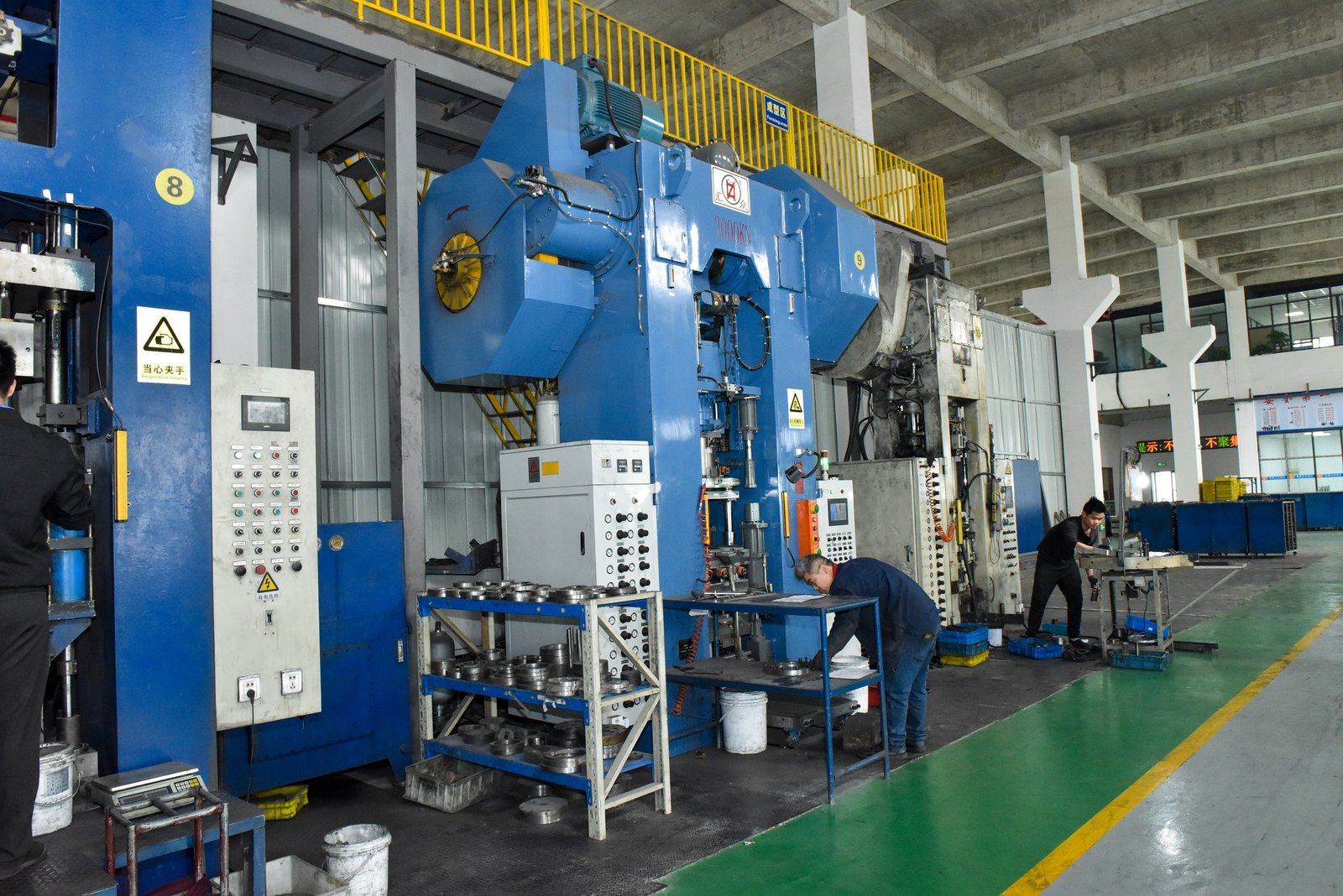
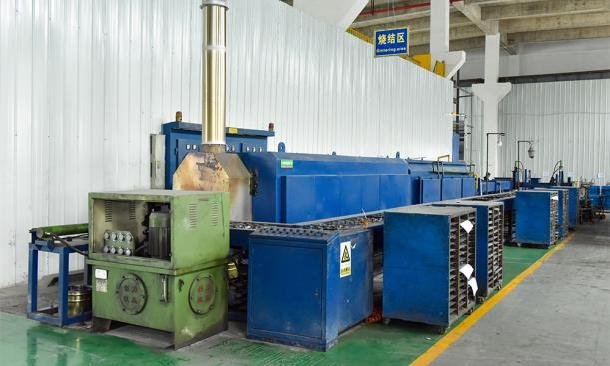
From the press floor
A customer moved a pump flange from machined 1045 steel to Fe-Cu pressing at 120,000 pcs/yr. The drawing had a bolt circle, a D-shaped bore, and two sized bosses – six machining operations disappeared, and the quoted piece price dropped 41%. The same RFQ at 8,000 pcs/yr would have gone back to machining: the die would not have paid for itself. Same part, opposite answers – the economics, not the process, decide.
What Are the Disadvantages of Powder Metallurgy?
The main disadvantages are tooling cost, density/porosity, geometry restrictions, press capacity, and the cost of very tight tolerances. None is absolute – each is a condition that shifts the economics.
- Tooling cost and lead time. A compaction die is real money spent before the first production part exists, with roughly 20 days build time at JH PM depending on complexity. Design changes after kickoff are tooling changes, not CAD edits.
- Density and porosity. Conventional press-and-sinter ferrous parts commonly run below wrought density – for many structural ferrous grades, 6.4-7.2 g/cm³ against 7.87 for wrought. High-density routes (double press-double sinter, warm compaction, infiltration) close part of the gap at added cost. Fatigue strength is the property most affected by residual porosity.
- Tolerance ceiling. As-sintered features commonly hold IT7-IT9 and sized features IT6-IT7; tighter levels generally require a secondary precision operation such as grinding. Whether PM stays economical depends on how many features need that level.
- Geometry restrictions. Undercuts, side holes, threads and large annular grooves cannot be pressed and need post-sinter machining – each one a line item that erodes the cost advantage.
- Press-capacity limits. Part size is constrained by available press force, projected area, die configuration, fill depth and required density. For the press range discussed here, ~150 mm projected area and ~80 mm height are practical reference values – not universal PM limits.
- Powder cost. Powder typically costs several times more per kilogram than bar stock, so the material argument only pays at volume.
Is Powder Metallurgy Cheaper Than Machining?
PM is usually more economical when tooling can be amortized over sufficient volume – but there is no universal break-even quantity. The two processes have different cost structures:
PM unit cost ≈ powder cost + pressing + sintering + secondary machining + (tooling cost ÷ total volume)
Machined unit cost ≈ raw material (incl. wasted stock) + machining time + tooling + finishing
Break-even volume ≈ tooling cost ÷ (machined unit cost − PM variable unit cost). Because the variable-cost difference depends on part weight, powder grade, number of eliminated machining operations and required tolerances, the break-even point moves part by part. As a JH PM production reference, parts that eliminate five or more machining operations commonly cross over at tens of thousands of pieces per year; a part that eliminates one drilling op may never cross over.
How Strong Are Powder Metallurgy Parts?
Per unit of cross-section, conventional PM parts run below wrought steel because of residual porosity; properly specified, they remain strong enough for demanding automotive duty. Tensile strength in common ferrous PM grades spans roughly 250-750 MPa depending on alloy and density grade, and fatigue strength is the property most sensitive to porosity – it rises faster than tensile as density increases. Fe-Cu-Ni-Mo grades at the higher end of the density range (550-750 MPa) carry transmission duty such as clutch hubs and shift forks in daily production. The honest statement is conditional: spec the MPIF Standard 35 density grade the load case needs, and PM is strong enough; leave density unspecified and any strength comparison is guesswork.
What Size Parts Can Powder Metallurgy Make?
Part size is constrained by available press force, projected area, die configuration, fill depth and required density – not by a universal number. Compaction pressure scales with projected area at the target density, so the press tonnage in a supplier’s shop sets the practical envelope. For JH PM’s current production range (6 to 1,000 t presses), structural parts commonly run up to roughly 150 mm projected area and 80 mm height; parts around or above ~2 kg require an individual press-force, fill-depth and density assessment rather than an automatic yes/no. Ask a supplier for their press tonnage list and compaction-pressure math, not for a part-size rule of thumb.
When Should You NOT Use Powder Metallurgy?
PM is usually a poor fit for prototypes, very low volumes, full-density fatigue-critical components, highly undercut geometries, and parts requiring extensive IT5 machining. Specifics:
- Prototypes and very low volumes (often below a few thousand pcs/yr): machine the part, or press a PM blank and machine it – both recognized prototype routes.
- Parts beyond the press envelope: forging or casting takes over; the limit is the supplier’s press list, not the process in theory.
- Large thin-wall housings in light alloys: aluminium die casting is the correct process – lower density, larger envelope.
- Drawings dominated by IT5 faces: grinding exists, but machining from bar is usually cheaper than sinter-and-grind everything.
- Full-density fatigue-critical sections: high-output connecting rods and crankshafts stay forged.
JH PM runs 8 die-casting lines and partners with forging houses in Ningbo, so a “PM is wrong for this” answer comes back with the right-process quote attached.
PM vs Machining vs Die Casting vs Forging
| Parameter | Powder metallurgy | Machining | Die casting (Al) | Forging |
|---|---|---|---|---|
| Volume tendency | Favors higher volumes (tooling amortization) | Favors low volumes, prototypes | High volume (die cost) | High volume (die cost) |
| Material usage | Up to ~95-98% for suitable geometries | ~40-60% typical | ~70-85% (before runner recycling) | ~70-90% |
| Density | Grade-dependent; commonly below wrought for press-and-sinter | Full density | ~2.7 g/cm³ | Full density |
| Tensile strength | ~250-750 MPa by grade & density | ~400-1,200+ MPa by alloy | ~180-330 MPa | ~600-1,200 MPa |
| Accuracy | IT7-IT9 as-sintered; IT6-IT7 sized; tighter with grinding | IT5-IT7 | IT8-IT10 | Machined features after forging |
| Size ceiling | Press-dependent (see section above) | Machine-dependent only | Large thin walls OK | Large parts OK |
| Tooling lead | ~20 days at JH PM (complexity-dependent) | None | 6-10 weeks typical | Die-dependent |
| Typical MOQ | 2,000 pcs at JH PM (part-economics dependent) | 1-50 pcs | 3,000-5,000 pcs | Quote-dependent |
| Send it here when | Ferrous, high volume, near-net-shape geometry, moderate complexity | Low volume, IT5, prototypes, full density | Lightweight housings, thin walls | Maximum strength, full density |
Production Example: Machined 1045 Steel to Fe-Cu PM
From JH PM production records. The conversion eliminated six machining operations; quoted piece cost fell 41%. The result depended on the six eliminated operations, 120,000 pcs/yr volume and tooling amortization – a similar part at 8,000 pcs/yr would not have met the same economics.
| Parameter | Before (machined) | After (Fe-Cu PM) |
|---|---|---|
| Annual volume | 120,000 pcs | 120,000 pcs |
| Material | 1045 steel bar | Fe-Cu powder, MPIF 35 grade |
| Machining operations | 6 (bolt circle, D-bore, bosses, facing) | 0 press-side; sizing on critical bores only |
| Material utilization | ~50% (rest to chips) | ~96% |
| Tooling | None | Compaction die + sizing tool, ~20 days |
| Quoted piece cost | Baseline | -41% |
Case data from JH PM quoting records; unit prices withheld per customer agreement. The percentage is specific to this geometry and volume and should not be generalized.
How to Decide: 5-Step Process-Selection Checklist
Step 1 – Volume vs tooling payback
Estimate break-even: tooling cost ÷ variable-cost saving per part. Below a few thousand pcs/yr, machining usually wins; at tens of thousands, PM often does.
Step 2 – Size vs press envelope
Check projected area against compaction pressure at target density, against the supplier’s actual press list – not against a universal PM limit.
Step 3 – Tolerances vs IT classes
Plan IT7-IT9 as-sintered, IT6-IT7 on sized features, grinding for tighter. Count how many features need it – that count decides whether PM economics survive.
Step 4 – Geometry vs pressability
List undercuts, side holes, threads, grooves. Each is a post-sinter machining line item and a redesign candidate.
Step 5 – Get the DFM note and the alternative
A 48-hour written DFM should give density grade, tolerance per feature, secondary operations – and, when machining, die casting or forging fits better, a quote for that too.
Frequently Asked Questions (FAQ)
Is powder metallurgy cheaper than CNC machining?
Usually at sufficient volume – but there is no universal break-even quantity. The comparison is tooling amortization plus PM variable cost against machining time plus wasted stock. In one JH PM example at 120,000 pcs/yr, converting a machined 1045-steel flange to Fe-Cu PM cut quoted piece cost 41% by eliminating six machining operations; the same part at 8,000 pcs/yr would not have met the same economics.
What is the minimum order quantity for powder metallurgy?
At JH PM the standard MOQ is 2,000 pcs per part number, with lower sampling lots on request. Industry-wide, the practical floor is where tooling amortization stops paying – commonly somewhere below a few thousand pieces per year depending on part complexity.
What size parts can be made by powder metallurgy?
Size is constrained by press force, projected area, die configuration, fill depth and target density – not a universal limit. For JH PM’s press range (6 to 1,000 t), structural parts commonly run to ~150 mm projected area and ~80 mm height; larger presses extend the envelope.
Can powder metallurgy achieve tight tolerances?
Sized features commonly hold IT6-IT7 (±0.025-0.05 mm on selected features at JH PM). Tighter levels, such as IT5, generally require a secondary precision operation like grinding – whether PM stays economical depends on how many features need that level, not on whether it is possible.
Are powder metallurgy parts weaker than forged steel?
Per cross-section, yes – residual porosity costs roughly 10-25% of tensile strength versus the same wrought alloy, and fatigue is more sensitive. Properly specified PM grades reach 550-750 MPa and carry transmission duty daily; full-density fatigue-critical sections remain forging territory.
Is powder metallurgy environmentally friendly?
Yes, highly so at production volume. Powder metallurgy produces over 95% material utilization compared to machining scrap, uses significantly less total energy per kilogram of finished component by eliminating melting steps during forming, and generates almost zero hazardous liquid waste or heavy coolant runoff.
Not Sure Which Process Fits Your Part?
Send us your STEP model or 2D PDF along with target annual volume and key tolerances. We deliver a written DFM assessment within 48 hours covering pressability, density class, secondary operations, and an honest process comparison.
Engineering References
- MPIF Standard 35: Materials Standards for PM Structural Parts (Metal Powder Industries Federation).
- ASTM B962: Standard Test Methods for Density of Compacted or Sintered Powder Metallurgy (PM) Products.
- ISO 286-1: Geometrical product specifications (GPS) – ISO code system for tolerances on linear sizes.