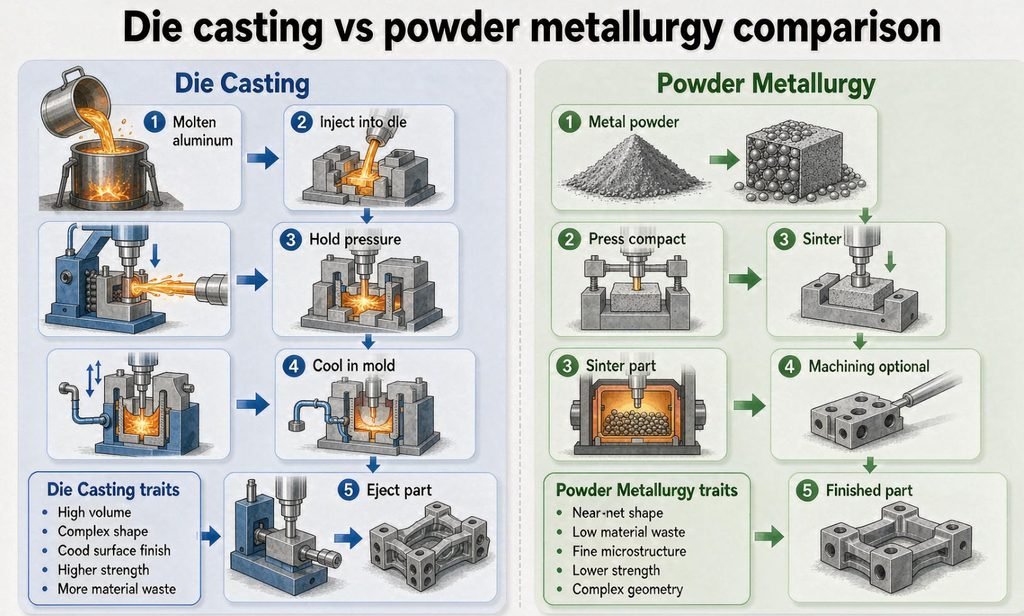
Die Casting vs. Powder Metallurgy: Which Process Should You Choose?
A side-by-side engineering comparison of liquid-state die casting and solid-state powder compaction — covering material limits, tensile strength, tooling amortization, and geometry constraints.
- Material Capability: Die casting is strictly for non-ferrous alloys. Iron, carbon steel, and stainless steel require Powder Metallurgy.
- Tensile Performance: PM sintered steels exceed 800 MPa UTS versus ~320 MPa for standard A380 die-cast aluminum.
- Tooling Economics: PM tooling ($1k–$10k) is significantly lower cost than die-casting dies ($10k–$50k+) due to lack of thermal shock.
- Best Applications: Die casting for large, thin-wall structural housings; PM for small (<75 mm) gears, bushings, cams, and magnetic components.
Quick Comparison: Die Casting vs. Powder Metallurgy
The table below provides a direct operational comparison between high-pressure die casting and conventional press-and-sinter powder metallurgy:
| Process Feature | Die Casting | Powder Metallurgy (Press & Sinter) |
|---|---|---|
| Primary State | Molten metal (Liquid) | Metal powder (Solid state) |
| Common Materials | Aluminum (A380, ADC12), Zinc, Magnesium | Iron/Steel alloys, Copper-steel, Stainless steel, Bronze |
| Target Geometry | Thin walls (>1.5 mm), housings, large structural frames | Gears, bushings, cams, structural components (<75 mm) |
| Material Utilization | 80–95% (runners/gates remelted) | 97%+ (Near-net shape) |
| Porosity & Density | Internal gas porosity common (85–95% sound area) | Controlled interconnected porosity (85–92% standard density) |
| As-Made Tolerance | ±0.1 mm to ±0.2 mm | ±0.1 mm general (±0.025 mm on critical features after sizing) |
| Tensile Strength | ~320 MPa (Standard A380 Aluminum) | 350–850+ MPa (Sintered alloy steel) |
| Tooling Cost | High ($10,000 – $50,000+) | Medium ($1,000 – $10,000) |
| Economic Volume | 10,000+ pcs / year | 10,000+ pcs / year |
1. Process Fundamentals: How They Work
What Is Die Casting?
Die casting forces molten metal under high pressure (10 to 175 MPa) into reusable steel molds (dies). The metal solidifies rapidly, and the mold opens to eject the part. Because it uses liquid metal, die casting can form complex internal cavities and thin-walled structural geometries.
What Is Powder Metallurgy?
Powder metallurgy (conventional press-and-sinter PM) compacts fine metal powder uniaxially in a rigid die at ambient temperature using 200–700 MPa of pressure. The compacted “green part” is then heated (sintered) in a controlled-atmosphere furnace below the primary metal’s melting point, bonding the powder particles solid through atomic diffusion.
2. Key Technical Differences
Mechanical Strength & Material Properties
Die casting relies on lightweight non-ferrous alloys. Aluminum die castings offer great strength-to-weight ratios but lower absolute tensile properties compared to ferrous alloys.
Powder metallurgy operates primarily with iron and steel alloys, allowing heat treatments that achieve tensile strengths exceeding 800 MPa. Furthermore, PM allows custom material blending (e.g., adding copper or nickel directly to the iron matrix) to tailor magnetic, wear, or mechanical properties.
Precision & Tolerance Control
Die casting suffers from thermal shrinkage and potential thermal distortion as liquid metal solidifies. Standard tolerances run ±0.1 mm to ±0.2 mm.
PM operates without melting, drastically reducing thermal distortion. As-sintered tolerances achieve ±0.1 mm, and secondary sizing/coining operations can tighten critical dimensions down to ±0.025 mm without machining.
Material Efficiency & Sustainability
While die casting runners, sprue gates, and overflows can be remelted, oxidation and slag generation result in a net material utilization of 80–95%.
Powder metallurgy is a true near-net-shape process. Metal powder flows directly into the die cavity with zero runners or sprues, achieving over 97% material utilization.
3. Tooling and Unit Cost Analysis
Manufacturing Cost Formula
Total Part Cost = (Tooling Investment / Production Volume) + Unit Part Cost
- Tooling Investment: Die casting molds must withstand extreme thermal shock and high hydraulic injection pressures, requiring massive premium tool steel blocks ($10,000–$50,000+). PM tooling faces high mechanical friction but low thermal stress, keeping tooling costs lower ($1,000–$10,000).
- Production Rate: Both processes are highly automated. Die casting cycle times range from 10 to 60 seconds. PM automatic compaction presses run at 10 to 30 strokes per minute, producing parts rapidly in multi-cavity setups.
4. Decision Tree: Which Process Fits Your Part?
                    [ Part Design Evaluation ]
                                |
       ---------------------------------------------------
       |                                                 |
[ Is the part ferrous/magnetic? ]        [ Is the part thin-walled (>75mm)? ]
       |                                                 |
     (YES)                                             (YES)
       |                                                 |
       v                                                 v
(Powder Metallurgy)                                (Die Casting)
       |                                                 |
  * High Strength (>500 MPa)                       * Lightweight Aluminum/Zinc
  * Gears, Bushings, Cams                          * Housings, Covers, Enclosures
  * Self-lubricating oil pores                     * Complex 3D Thin-Wall Shells
Choose Die Casting when:
- You need lightweight aluminum, zinc, or magnesium components.
- The geometry spans larger dimensions (>75 mm) with thin walls (<2 mm).
- The part serves as an enclosure, housing, or structural bracket.
Choose Powder Metallurgy when:
- The application demands structural iron, steel, or stainless steel strength.
- The part geometry features constant cross-sections (gears, sprockets, bushings, flanges).
- You require self-lubrication (controlled oil-impregnated porosity).
- Minimizing post-machining is critical for unit cost control.
FAQ: Frequently Asked Questions
Is powder metallurgy cheaper than die casting?
For structural iron/steel parts under 75 mm, powder metallurgy is generally cheaper due to lower tooling costs ($1k–$10k vs $10k–$50k) and higher material utilization (97%+ vs 80–95%). However, for large lightweight housings, die casting in aluminum remains more cost-effective.
Can powder metallurgy replace aluminum die casting?
Not directly. PM primarily uses iron/steel powders for high-density structural components, whereas die casting uses non-ferrous alloys (aluminum, zinc) for lightweight, thin-walled enclosures.
Does powder metallurgy produce porous parts?
Standard press-and-sinter PM produces parts with 85–92% theoretical density, leaving controlled microscopic porosity. This porosity can be oil-impregnated for self-lubricating bearings or sealed via resin impregnation if pressure tightness is needed.
Related Guides
- What Is Powder Metallurgy? — Complete process guide for press-and-sinter PM manufacturing.
- What Is Metal Injection Molding (MIM)? — Detailed guide for small, highly complex 3D metal components.
Get a 48-Hour Feasibility & Cost Evaluation
Not sure whether Die Casting or Powder Metallurgy fits your drawing? Have your design reviewed by engineers who operate both processes under one roof.
JH PM operates 19 automated PM pressing lines alongside complete die casting facilities, providing unbiased manufacturing advice based strictly on your tolerances, material specs, and annual volume.