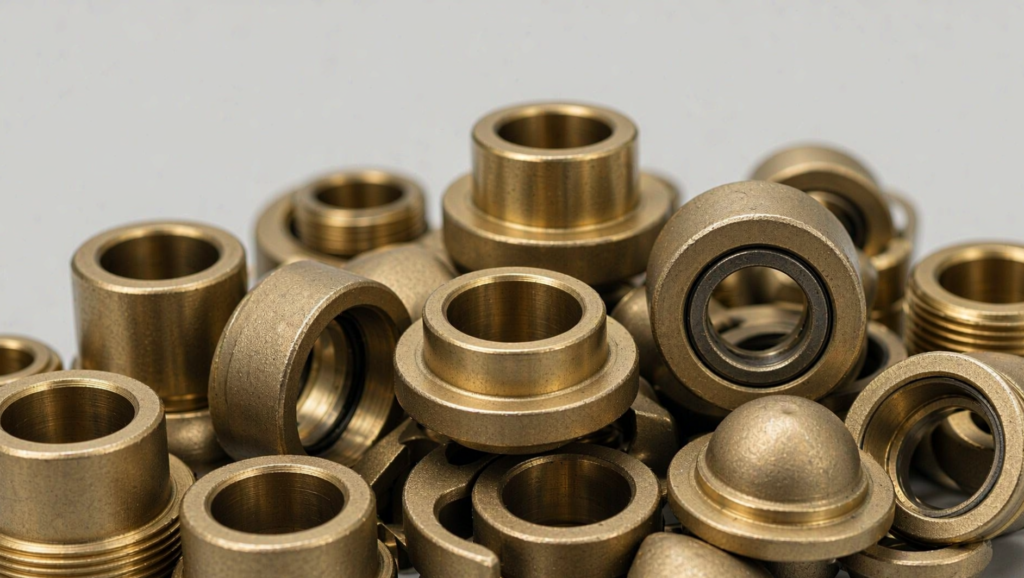
Brass Corrosion: Causes, Types, Dezincification, Prevention & Material Selection
An engineering guide to brass degradation mechanisms: how water chemistry, zinc content, residual tensile stress, and powder metallurgy porosity govern corrosion, and how to specify materials, testing, and surface treatments to prevent field failures.
- Dezincification (Selective Leaching): Zinc leaches out of copper-zinc solid solutions, leaving a brittle, porous copper layer that can compromise structural integrity or cause weeping in fluid fittings.
- Stress-Corrosion Cracking (SCC): The combination of sustained tensile or residual stress, moisture, and specific contaminants, primarily ammonia, amines, or sulfur dioxide, can cause sudden brittle cracking.
- Testing & Specification: Dezincification resistance is evaluated per ISO 6509-1 and assessed per ISO 6509-2. Accelerated SCC susceptibility in ammonia vapor is tested using ASTM B858 or ISO 25018:2026.
- Powder Metallurgy Context: In sintered brass components, open interconnected porosity can accelerate corrosion if fluid penetrates and becomes stagnant. Achieving high density (≥7.8 g/cm³) or sealing pores eliminates this differential aeration risk[cite: 1].
Key Takeaways
- Zinc Content Sets the Baseline: Alloys with under 15% Zn are generally resistant to dezincification; alloys with over 15% Zn require inhibitors (arsenic, phosphorus, or tin), and duplex alloys (>37% Zn) face significant risk in warm, stagnant, or saline waters.
- Tarnishing vs. Functional Corrosion: Superficial tarnish films and green/brown patinas are cosmetic or protective (Cu2O), whereas porous pink dezincification or stress cracks indicate structural section loss or pending mechanical failure.
- Stress Relief Mitigates SCC: Low-temperature annealing (250°C to 300°C) relieves internal forming and sizing stresses without softening the alloy, removing a primary trigger for stress-corrosion cracking.
- Standards Are Not Universal Pass/Fail Limits: ISO 6509-1 defines the test method and ISO 6509-2 gives assessment guidance, but component drawings must specify the maximum allowable dezincification depth (typically ≤100 to 200 μm) for the application.
Does Brass Rust or Corrode? (Tarnishing vs. Functional Failure)
In technical documentation and failure analysis, engineering terminology must be precise. A common baseline question from buyers is whether brass rusts. Brass cannot rust. Rust specifically describes the reddish-brown oxidation products ($Fe_2O_3\cdot nH_2O$) formed when iron and carbon steels oxidize in the presence of water and oxygen. Because brass is a non-ferrous alloy composed primarily of copper and zinc, iron oxide rust cannot form.
However, brass does corrode. When exposed to oxygen, clean brass naturally oxidizes to form cuprous oxide, which appears as a dull brown or dark tarnish film. In outdoor atmospheric conditions containing sulfur and carbon dioxide, it gradually forms a greenish patina of basic copper carbonate or basic copper sulfate. For engineers, the critical distinction is separating superficial, cosmetic surface oxidation from functional corrosion that compromises mechanical properties or fluid retention:
| Surface Condition | Visual Appearance | Depth | Engineering Significance |
|---|---|---|---|
| Tarnishing | Dull brown, light gray, or dark golden haze | Nanometer to sub-micron | Cosmetic only; thin Cu2O layer serves as mild passive barrier. |
| Patina Formation | Green, blue-green, or dark brown film | 1 to 5 μm superficial | Generally stable atmospheric protection; does not reduce load-bearing section. |
| Dezincification | Dull pink, reddish porous copper surface, white zinc salts | 0.1 mm to through-wall | Functional: causes loss of tensile strength, brittle porous layers, fluid leakage. |
| Pitting / Crevice Attack | Localized dark cavities, pinholes under deposits | Deep localized penetration | High risk: creates stress concentration points and wall breaches. |
| Stress-Corrosion Cracking | Fine hairline cracks, abrupt brittle fractures | Intergranular or transgranular | Severe: leads to sudden mechanical rupture under static loads. |
What Causes Brass to Corrode? Environmental Drivers
Rather than treating corrosion as a random event, engineers evaluate degradation using the Environment → Mechanism → Result framework. Brass corrosion requires an electrolyte and specific environmental accelerators:
Water Chemistry and Moisture
Brass resists clean, neutral, flowing fresh water by maintaining its protective cuprous oxide film. Corrosion accelerates in soft waters with high dissolved carbon dioxide, acidic waters (pH < 6.5), or warm stagnant water. Wet-and-dry cycling causes dissolved salts to concentrate on the surface, breaking down protective films.
Chlorides and Saline Exposure
It is inaccurate to say brass either “handles chlorides well” or “fails in saltwater.” Performance depends heavily on the alloy, water aeration, temperature, and flow velocity. Chlorides disrupt copper oxide passivity, accelerating uniform dissolution and selective zinc leaching. While standard yellow brass degrades in marine environments, specialized naval brasses containing tin resist chloride attack in low-velocity seawater.
Ammonia and Amine Compounds
Ammonia, ammonium ions, and organic amines are particularly aggressive toward copper-zinc alloys. They react with copper to form soluble complex cuprammonium ions, removing protective patina layers and concentrating chemical attack at grain boundaries under tensile stress.
pH and Chemical Exposure
Brass exhibits good stability across neutral to moderately alkaline environments (roughly pH 7.0 to 10.0 in the absence of ammonia). In strongly acidic solutions (pH < 5.0), the cuprous oxide film dissolves, accelerating uniform corrosion and dezincification. In strongly caustic solutions (pH > 12.0), zinc exhibits amphoteric behavior, dissolving as zincate ions
Temperature and Thermal Acceleration
Electrochemical reaction rates roughly double with every 10°C rise in temperature. In domestic hot water systems or industrial heat exchangers, elevated temperatures (60°C to 90°C) accelerate dezincification and promote deposit attack beneath accumulated scale.
Residual and Applied Tensile Stress
Mechanical stress does not cause uniform corrosion, but tensile stress, whether from external operational loads, interference press fits, assembly torque, or cold working, supplies the mechanical energy required to propagate stress-corrosion cracks.
Contact with Dissimilar Metals
When brass comes into direct electrical contact with another conductive material in the presence of an electrolyte, galvanic potential differences govern whether brass acts as the protected cathode or the corroding anode.
What Are the Main Types of Brass Corrosion?
Failure analysis of brass components typically identifies six distinct corrosion modes:
- General (Uniform) Corrosion: Even metal loss across all exposed surfaces, common in strong acids or aggressive industrial atmospheres. It is predictable and accounted for via standard corrosion allowances.
- Dezincification: Selective leaching of zinc from alloys containing more than 15% Zn, common in plumbing fittings, marine hardware, and heat exchanger tubes.
- Stress-Corrosion Cracking (SCC): Environmental crack propagation under combined tensile stress and ammoniacal chemical exposure.
- Galvanic Corrosion: Accelerated dissolution resulting from direct metallic coupling to more noble materials in a conductive electrolyte.
- Crevice and Localized Corrosion: Intense attack occurring within stagnant, oxygen-depleted gaps under O-rings, pipe threads, gaskets, or mineral scale deposits.
- Porosity-Related Corrosion in Sintered Brass: Accelerated oxidation or internal galvanic attack occurring when interconnected pore networks in powder metallurgy components draw in and trap unwashed acidic fluids or ambient moisture[cite: 1, 4].
Why Does Brass Undergo Dezincification? (Mechanism & Testing)
Dezincification represents the most common structural failure mode in water distribution and fluid handling systems. It can manifest as localized “plug-type” attack, which creates deep pits that penetrate pipe walls, or “layer-type” attack, which thins broad surface sections.
Mechanism and Phase Metallurgy
Dezincification operates as a dissolution-redeposition electrochemical process. At the metal-fluid interface, both copper and zinc atoms dissolve into solution: plate back onto the brass substrate as an uncompacted, porous copper mass. This porous layer retains the original component shape but loses tensile strength and ductility.
Microstructural Phase Influence
Susceptibility to dezincification depends on microstructural phases, processing history, and environment rather than a single zinc percentage cutoff:
- Single-Phase α Brass (≤35% Zn): Consists of a uniform face-centered cubic (FCC) structure. While uninhibited α-brass can experience slow layer-type dezincification in aggressive waters, adding 0.02% to 0.06% arsenic (As) or phosphorus (P) suppresses copper redeposition, making the alloy dezincification-resistant (DZR).
- Duplex α+β Brass (>37% Zn, e.g., C36000, C37700): Contains a body-centered cubic (BCC) β-phase alongside the α-phase. The zinc-rich β-phase acts as an internal anode relative to the adjacent α-phase. Under corrosive conditions, the β-phase dissolves preferentially, creating interconnected porous failure paths through the wall thickness.
Testing Standards: ISO 6509-1 vs. ISO 6509-2
Specifying dezincification resistance on an engineering drawing requires clear reference to international standards:
- ISO 6509-1 (Test Method): Specifies the laboratory procedure. Polished cross-sections are submerged in a 1% copper chloride ($CuCl_2$) solution at 75°C ± 2°C for 24 hours. The resulting cross-section is examined under an optical microscope at 100× to 200× magnification to measure the maximum depth of dezincification.
- ISO 6509-2 (Assessment Criteria): Provides guidance for evaluating test results against specific applications. It emphasizes that acceptable penetration limits depend on component wall thickness and operating duty, noting that the standard does not apply to certain complex products like flow meters or pump impellers without tailored engineering agreements.
What Is Stress-Corrosion Cracking in Brass? (Ammonia & Stress)
Stress-corrosion cracking (SCC) causes abrupt, brittle mechanical fracture in brass components operating well below their nominal tensile yield strength. Three conditions must coincide to trigger SCC:
- Susceptible Material: Copper-zinc alloys containing more than 15% to 20% zinc (e.g., 70/30 Cartridge Brass C26000). Susceptibility increases with higher zinc content.
- Sustained Tensile Stress: Operating stresses or residual stresses from cold drawing, crimping, thread machining, or press-fit assembly.
- Specific Corrosive Agents: Moist atmospheres containing ammonia, ammonium salts, amines, or sulfur dioxide. Common sources include agricultural fertilizers, domestic cleaning agents, decomposing organic matter, and amine-cured sealants.
Testing SCC Susceptibility: ASTM B858 and ISO 25018:2026
Historical quality-control methods like the mercurous nitrate test (ASTM B154) are increasingly restricted due to mercury toxicity and environmental regulations. Modern engineering specifications mandate accelerated ammonia-vapor testing:
- ASTM B858 (Standard Test Method for Ammonia Vapor Test): Test specimens, under residual or applied stress, are exposed to ammonia vapor over an ammonium chloride solution at controlled pH levels (typically pH 9.5 to 10.5) for 24 hours. Parts are subsequently examined at 10× to 30× magnification for surface cracks.
- ISO 25018:2026 (SCC Resistance in Ammonia Vapor): Published in February 2026, this dedicated standard defines testing parameters, test atmospheres, and crack interpretation guidelines specifically for copper and copper-zinc alloys. Engineering Note: ISO 25018 applies directly to wrought copper and copper-zinc alloy products; it should not be applied casually to porous powder metallurgy parts without modified acceptance criteria for pore boundaries.
Does Brass Corrode When It Contacts Other Metals?
Galvanic corrosion occurs when brass is mechanically joined to a dissimilar metal in the presence of an electrolyte. Sintering and design engineers assess galvanic compatibility based on relative positions in the galvanic series, electrolyte conductivity, and surface area ratios:
| Metal Pairing | Anode (Corroding) | Cathode (Protected) | Considerations & Risk Level |
|---|---|---|---|
| Brass + Carbon Steel | Carbon Steel | Brass | Steel corrodes sacrificially. Common in closed de-aerated heating systems; steel fasteners degrade rapidly in outdoor/marine environments. |
| Brass + Stainless Steel | Brass | Passive SS (304/316) | Low risk dry indoor. In saline/marine electrolytes, the large noble SS cathode accelerates dezincification of adjacent brass. |
| Brass + Aluminum | Aluminum | Brass | Severe risk. Potential difference >0.5 V. Aluminum corrodes rapidly. Direct coupling in outdoor/marine must be avoided without isolators. |
| Brass + Copper / Bronze | Brass (slight) | Copper / Bronze | Minimal risk. Potentials closely matched. Galvanic currents low under typical industrial and potable water conditions. |
Area Ratio Guideline: A small brass valve installed in a large stainless steel piping loop creates an unfavorable area ratio ($Area_{\text{cathode}} \gg Area_{\text{anode}}$), accelerating galvanic attack on the brass. Conversely, a large brass body containing small stainless steel internal fasteners presents minimal galvanic risk.
Does Powder Metallurgy Make Brass More Susceptible to Corrosion?
A common inquiry among sourcing teams is whether sintered brass components inherently corrode faster than machined wrought brass parts[cite: 1, 4]. Powder metallurgy is not inherently a corrosion failure mechanism. Corrosion performance depends on density, pore structure, alloy chemistry, sintering atmosphere, and post-sinter sealing[cite: 1, 4].
Density and Interconnected Porosity
Conventional press-and-sinter non-ferrous parts (such as MPIF CZ-1000 70Cu-30Zn or CZ-2000 80Cu-20Zn-1.5Pb) typically achieve sintered densities between 7.4 and 8.0 g/cm³, representing 88% to 94% of theoretical density[cite: 1, 4]. Sintered parts with densities below ~7.6 g/cm³ retain interconnected surface porosity[cite: 1]. These microscopic pores can draw in fluids via capillary action:
- Fluid Entrapment: Machining coolants, acidic wash residues, or moist atmospheric condensation trapped within internal pores create stagnant, oxygen-depleted micro-environments.
- Differential Aeration Cells: An electrochemical potential develops between the oxygenated external face (cathode) and the oxygen-starved pore interior (anode), accelerating subsurface localized corrosion.
Sintering Atmospheres and Surface Passivation
Sintering brass requires precise atmospheric control[cite: 1]. Because zinc has a high vapor pressure (boiling point 907°C), sintering near 820°C to 860°C can cause zinc vaporization (“zinc boil”) if the furnace atmosphere dew point and carrier gas flow are uncontrolled[cite: 4]. Operating with a dry nitrogen-hydrogen protective atmosphere (dew point <-40°C) preserves alloy composition and uniform surface chemistry[cite: 1, 2].
Porous Bearings vs. Structural Components
In self-lubricating sleeve bushings, interconnected porosity (18% to 25% by volume) is a deliberate design feature[cite: 3, 4]. When vacuum-impregnated with lubricating oil per ISO 2738, the oil occupies the internal void space, shielding internal pore walls from atmospheric moisture and oxygen[cite: 4]. Sintered brass parts intended for dry structural applications in corrosive environments require either compaction to high densities (≥7.8 g/cm³) or secondary anaerobic resin impregnation to hermetically seal surface pores[cite: 1].
How Do You Select Brass for Corrosion Resistance?
Selecting an alloy requires matching environmental exposures against metallurgical trade-offs rather than assuming a single grade works across all applications:
| Alloy Family | Nominal Composition | Corrosion Characteristic | Service Environment | Limitations |
|---|---|---|---|---|
| DZR Brass | Cu ≥62%, Zn ~35%, Pb ≤2%, As 0.02 to 0.06% (CW602N, C35330) | Resists selective leaching; complies with ISO 6509 limits. | Municipal potable water, hot water loops, plumbing valves. | Requires controlled post-machining heat treatment to stabilize phases. |
| Naval Brass | 60% Cu, 39.2% Zn, 0.8% Sn (C46400) | Tin inhibits dezincification in seawater and saline atmospheres. | Marine shafting, heat exchanger tube sheets, marine hardware. | Duplex structure susceptible to SCC if heavily cold-worked un-annealed. |
| Admiralty Brass | 70% Cu, 29% Zn, 1% Sn, + As/P inhibitor (C44300) | Single-phase alpha with tin and arsenic; resists freshwater and saline. | Power generation condensers, petrochemical heat exchangers. | Lower tensile strength and machinability than duplex free-cutting brasses. |
| High-Copper / Red Brass | 85% Cu, 15% Zn (C23000) | Naturally resistant to dezincification and SCC due to low zinc. | Underground water service lines, commercial conduit, industrial piping. | Higher raw metal cost; lower yield strength than duplex alloys. |
| Sintered Lead-Free Brass | 70% Cu, 30% Zn (MPIF CZ-1000 P/M)[cite: 4] | Homogeneous single-phase structure; free from macro-segregation[cite: 1, 4]. | Precision lock components, mechanical linkages, instrument brackets[cite: 1, 4]. | Requires density ≥7.8 g/cm³ or resin impregnation for wet service[cite: 1]. |
How Can Brass Corrosion Be Prevented? (Engineering Hierarchy)
Preventing corrosion in brass assemblies requires addressing design and manufacturing factors systematically:
1. Select the Appropriate Alloy
Match zinc content and inhibitor chemistry to the fluid medium. Avoid uninhibited free-cutting duplex brass (such as C36000) in hot, soft, or saline water applications where DZR or Naval brass is required.
2. Control Part Geometry
Design components to shed fluids naturally. Avoid horizontal ledges, sharp internal corners, and undrained recesses where moisture, dirt, or sediment can collect to form localized crevice cells.
3. Manage Manufacturing and Sintering Conditions
For powder metallurgy parts, specify a minimum core density of 7.8 g/cm³ for structural applications in humid or fluid environments[cite: 1]. Use neutral or synthetic water-soluble machining coolants, thoroughly degrease parts before storage, and eliminate chlorinated cutting fluids that leave corrosive chloride residues.
4. Mitigate Stress-Corrosion Cracking via Stress Relief
Mandate a stress-relief anneal (250°C to 300°C for 30 to 60 minutes) after intensive cold working, sizing, crimping, or thread forming. This thermal treatment relieves internal residual stresses without reducing tensile temper or hardness.
5. Break Galvanic Couples
Electrically isolate brass from active metals (aluminum, structural carbon steel) using non-conductive PTFE, nylon, or EPDM dielectric gaskets and isolation sleeves on bolt shanks.
6. Apply Protective Surface Coatings
Apply clear acrylic/polyurethane lacquers for decorative indoor hardware. For aggressive environments, specify electroless nickel plating (ENP, 10 to 25 μm) or electroplated tin. Sintered Note: Porous PM components must undergo resin impregnation prior to electroplating to prevent plating acid entrapment within surface pores[cite: 1].
How Is Brass Corrosion Tested? (Standards & Metrology)
Because corrosion involves multiple physical mechanisms, no single test method can qualify a brass component for all applications. Capable manufacturing facilities utilize targeted test procedures:
| Corrosion Mode | Standard Method | Test Procedure | Acceptance Criteria |
|---|---|---|---|
| Dezincification Resistance | ISO 6509-1 / ISO 6509-2 | Sample in 1% CuCl2 solution at 75°C ± 2°C for 24 h. | Microscopic cross-section; penetration typically ≤100 to 200 μm. |
| Residual Stress / SCC | ASTM B858 | Ammonia vapor over NH4Cl solution (pH 9.5 to 10.5) for 24 h. | Visual/microscopic at 10× to 30×; zero cracking allowed. |
| Wrought Alloy SCC | ISO 25018:2026 | Dedicated ammonia-vapor exposure with controlled humidity and loading. | Absence of intergranular or transgranular crack propagation. |
| Sintered Density | ASTM B962 | Archimedes water displacement balance[cite: 1, 2, 4]. | Bulk density ≥7.8 g/cm³ for fluid exposure; 6.4 to 6.8 g/cm³ for bearings[cite: 1, 4]. |
| Phase Analysis | ASTM E3 / MPIF Std. 51 | Polished and etched metallographic mount under optical microscopy. | Evaluates α/β phase distribution, grain size, lead dispersion. |
When Should You NOT Use Brass?
Engineering competence requires identifying where an alloy family reaches its practical limits. Brass should be excluded or replaced with an alternative material under the following conditions:
- Environments Containing Ammonia or Amines: Agricultural chemical equipment, livestock facilities, and chemical processing lines where ammonia exposure cannot be eliminated. Choose 316L stainless steel or titanium instead.
- Severe Marine Flow Velocities: High-velocity seawater cooling loops or marine propellers where fluid velocities exceed 1.5 to 2.0 m/s. Erosion-corrosion strips the protective film off brass. Specify Nickel-Aluminum Bronze (NAB, C95800) or Cupronickel (90/10 or 70/30).
- Strong Mineral Acids: Handling hydrochloric, hydrofluoric, or nitric acids. Choose hastelloys, PVDF, or PTFE.
- High-Temperature Steam Systems: Continuous steam duty exceeding 200°C to 250°C. Elevated temperatures promote grain growth, creep, and accelerated dezincification.
- Porous Sintered Components under Direct Hydraulic Pressure: Sintered PM brass parts with open porosity should not be used as pressurized fluid containment walls without full resin impregnation or secondary copper infiltration[cite: 1, 4].
How to Specify a Corrosion-Resistant Brass Component (RFQ Rules)
Generic drawing notes such as “Material: Brass” or “Part must resist corrosion” lead to misaligned quotations and field failures. An actionable engineering drawing or RFQ package should state:
- Specific Alloy Designation: State the exact UNS, EN, or MPIF standard (e.g.,
Material: DZR Brass CW602N / C35330 per EN 12164orSintered Brass MPIF CZ-1000-11 per MPIF Standard 35)[cite: 4]. - Dezincification Depth Limit:
Dezincification resistance per ISO 6509-1; maximum penetration depth ≤ 100 μm across all fluid-contact surfaces evaluated per ISO 6509-2. - Mandatory Stress Relief:
Stress-relief anneal at 260°C ± 10°C for 60 minutes after final sizing/machining. Must pass ASTM B858 ammonia vapor test without micro-cracking at 20× magnification. - Powder Metallurgy Density and Sealing: If specifying sintered brass:
Sintered density ≥ 7.80 g/cm³ per ASTM B962. Interconnected surface pores to be hermetically sealed via vacuum anaerobic resin impregnation.[cite: 1, 4] - Surface Protection Requirements: Specify plating type, thickness, and pre-bake requirements (e.g.,
Electroless Nickel Plating 12 to 15 μm per ISO 4527, followed by hydrogen embrittlement relief bake).
Brass vs. Bronze vs. Copper vs. Stainless Steel
Selecting an alloy often requires evaluating brass against other common industrial metals:
| Material Class | Corrosion Characteristics | Mechanical & Process Strengths | Selection Context |
|---|---|---|---|
| Brass (Cu-Zn) | Forms protective patina; susceptible to dezincification (>15% Zn) and ammonia SCC. | High machinability, good electrical/thermal properties, cost-effective net-shape PM pressing[cite: 1, 4]. | Fittings, valves, architectural hardware, lock cylinders, decorative actuators[cite: 1, 4]. |
| Bronze (Cu-Sn / Cu-Al) | Superior resistance to seawater, chlorides, and cavitation; immune to dezincification. | High wear resistance, low sliding friction, high fatigue strength. Retains 18 to 25% oil in PM[cite: 3, 4]. | Marine sleeve bushings, marine running gear, high-load worm drives[cite: 1, 3, 4]. |
| Pure Copper (OFE / ETP) | High resistance to atmospheric and freshwater corrosion; susceptible to oxidizing acids. | Maximum electrical (≥100% IACS) and thermal conductivity; ductile, lower strength[cite: 4]. | Electrical busbars, heat sink bases, motor commutators, resistance welding tips[cite: 4]. |
| Austenitic Stainless (304/316) | Self-passivating Cr2O3 film; immune to dezincification and ammonia SCC; susceptible to chloride pitting. | High tensile and yield strength, elevated temperature capability, food-contact hygiene. | Chemical processing, pharmaceutical equipment, marine fasteners, aggressive washdown. |
Custom Sintered Brass Capabilities at JH PM
Located in Shaoxing, Zhejiang, JH PM (Ningbo Jiehuang Chiyang Electronic Tech) manufactures custom sintered non-ferrous and ferrous structural components under certified automotive quality management systems[cite: 1, 2]:
- Pressing Machinery Fleet: 19 automated mechanical and hydraulic PM compaction presses ranging from 6 to 1,000 tons[cite: 1, 2].
- Thermal Sintering Controls: 10 industrial sintering furnaces, including 2 continuous mesh-belt protective atmosphere furnaces equipped with multi-zone temperature controls and real-time hydrogen-nitrogen dew-point monitoring (maintained <-40°C) to prevent zinc boil and surface oxidation[cite: 1, 2].
- Metrology & Inspection: 3 German Zeiss CMMs, analytical Archimedes density balances (ASTM B962), and optical metallographic image analyzers[cite: 1, 2, 4].
- Quality Registrations: Dual-certified to IATF 16949:2016 and ISO 9001:2015 with full MES barcode lot traceability[cite: 1, 2].
- Commercial Production Terms: MOQ of 2,000 pieces; tooling in 20 working days; T0 trial samples in 25 working days; DFM reviews within 48 hours[cite: 1, 2].
- Operational Boundary: Industrial hardware, power tools, automotive sensors, and non-implantable surgical device hardware (explicitly NO ISO 13485)[cite: 1, 2].
Frequently Asked Questions
Validate Your Brass Component Design for Corrosive Environments
Prevent premature field failures from dezincification, stress cracking, and pore-related corrosion. Send your 2D drawings and 3D CAD files to the JH PM engineering team. Our metallurgical specialists will review your alloy callouts, stress profiles, and density requirements, providing an actionable DFM feasibility assessment within 48 hours.