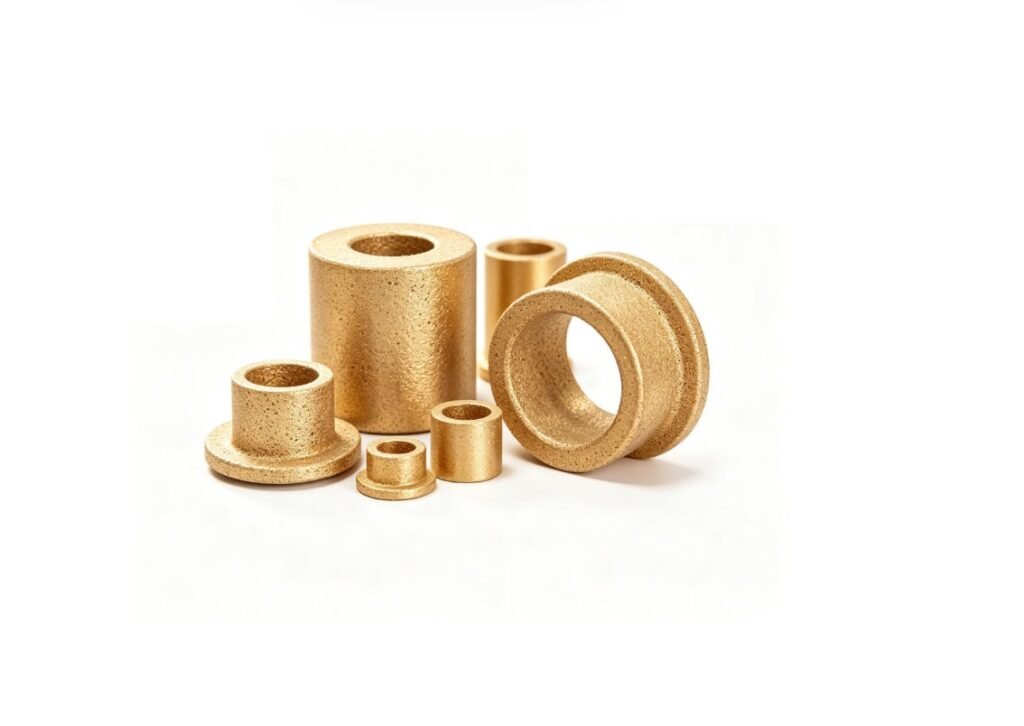
Copper-Based PM Parts: Materials, Properties, Applications & Manufacturing
An engineering guide to copper-based powder metallurgy. Learn how pure copper, bronze, brass, and copper-iron PM alloys deliver tailored electrical conductivity, thermal management, self-lubricating wear performance, and net-shape precision—and how to source them from JH PM.
Quick Summary (Core Engineering Takeaways)
- Material Coverage: Pure Copper (high-conductivity per ASTM B823), Bronze (Cu-Sn 90/10 for self-lubricating bearings), Brass (Cu-Zn for hardware), and Copper-Iron systems.
- Functional Highlights: Up to 85–95% IACS electrical conductivity in dense copper; 10–25% controlled interconnected porosity for oil-impregnated sleeve bushings.
- Compliance Standards: Evaluated under ASTM B823 (structural copper PM), ASTM B962 (density), and ISO 2738:2026 (porous metal bearings, density, oil content, and open porosity).
- Plant Capability: Comprehensive PM infrastructure including 19 compaction presses (6–1,000 tons), 2 continuous sintering lines, and 3 ZEISS 3D CMMs operating under IATF 16949 certification.
What Is Copper-Based PM?
Copper-based powder metallurgy (copper-based PM) is a specialized branch of powder metallurgy focused on compacting and sintering copper and copper-alloy powder systems. Unlike iron-based PM, which prioritizes structural strength and hardness, copper-based PM is specified when designs demand superior electrical conductivity, thermal dissipation, corrosion resistance, or tribological (sliding wear) properties.
Because copper raw material carries a higher cost per kilogram than iron, the material utilization advantage of PM (>90% net-shape powder yield) is economically significant. Furthermore, copper’s lower melting point and high powder plasticity allow unique alloy blending, ranging from soft high-conductivity contacts to porous bronze bearings engineered with controlled oil retention.
Copper-Based PM Materials Family
Copper-based PM encompasses four distinct powder material systems, each engineered for specific operational demands:
| Material Family | Key Characteristics | Typical Applications |
|---|---|---|
| Pure Copper | High electrical and thermal conductivity (up to 85–95% IACS at high density), ductile, excellent arc erosion resistance | Electrical contacts, switchgear terminals, spot welding electrodes, heat-dissipating heatsinks |
| Bronze Alloys (Cu-Sn) | Exceptional wear resistance, low coefficient of friction, high self-lubricating potential via controlled porosity (Cu-Sn 90/10) | Oil-impregnated bushings, porous sleeve bearings, thrust washers, wear plates |
| Brass Alloys (Cu-Zn) | Good mechanical strength, excellent machinability, pleasing aesthetics, fair corrosion resistance | Lock hardware, decorative fittings, small mechanical levers, fluid fittings |
| Copper-Iron Systems (Fe-Cu / Cu-Fe) | Balanced mechanical strength, high hardness, intermediate conductivity, cost-effective structural performance | Heavy-duty bushings, starter motor gears, high-load structural wear components |
| Specialized Copper Alloys | Custom alloy additions (e.g., Cu-Ni, Cu-C, Cu-W) for application-specific arc resistance or elevated temperature strength | High-voltage breaker contacts, EDM electrodes, specialized heat spreaders |
Properties of Copper-Based PM Parts
The mechanical and physical performance of copper-based PM components depends on final density, grain structure, and alloy composition:
Electrical Conductivity
High-density pure copper PM parts reach 85–95% IACS (International Annealed Copper Standard) conductivity. Electrical properties are strictly governed by ASTM B823 structural specifications.
Thermal Conductivity
Dense copper PM structures excel in heat dissipation, making them effective for thermal management spreaders and heat sink bases where high shape complexity is required.
Tribological & Wear Resistance
Sintered bronze creates a low-friction sliding surface. When paired with steel shafts, bronze PM components prevent galling and wear under boundary lubrication.
Self-Lubricating Behavior
In porous bronze bearings, interconnected pore networks (10–25% volume) act as a built-in oil reservoir, delivering hydrodynamic lubrication during shaft rotation.
Corrosion Resistance
Brass and bronze PM formulations resist atmospheric oxide formation, freshwater degradation, and chemical oxidation far better than unplated iron PM steels.
Dimensional Repeatability
Stable sintering behavior allows tight dimensional tolerances, with precision sizing operations achieving ±0.025 mm on critical inner and outer diameters.
Copper-Based PM vs. Machining Copper Alloys
Because copper alloy bar stock (brass/bronze rod) is expensive, traditional CNC turning or milling generates costly scrap swarf. PM eliminates material waste while enabling complex internal profiles.
| Factor | Copper-Based PM Parts | Machined Copper Alloy Bar Stock |
|---|---|---|
| Material Utilization | High (>90–95%) – Powder is pressed directly into shape, minimizing costly copper scrap. | Lower (30–60%) – High copper metal loss as turnings and chips, reducing yield efficiency. |
| Controlled Porosity | Possible (10–25% vol) – Essential for oil-impregnated self-lubricating bearings. | Impossible – Wrought bar stock is fully dense and cannot hold internal oil reservoirs. |
| Production Suitability | High-Volume Repeatability – Press cycles produce 15–50 parts/min consistently. | Lower Volumes / Prototypes – Cycle time depends on tool cuts and spindle index speed. |
| Integrated Features | Integrated Flanges & Keyways – Molded directly in press tools without extra setups. | Requires Multi-Axis Milling – Secondary milling or broaching required for non-round features. |
| Tooling Investment | Hardened Tooling Required – Initial mold investment amortized across production runs. | Minimal Tooling – Low initial cost using standard CNC fixtures and cutting inserts. |
Note: Copper-based PM is not automatically more economical than machining for all geometries. Its advantage depends on part geometry, annual production volume, raw material cost, machining complexity, and whether controlled porosity or high conductivity is required.
Copper-Based PM Applications
Copper-based PM components serve demanding roles across electrical hardware, automotive assemblies, motion control, and industrial equipment:
Electrical & Electro-Mechanical Components
High-conductivity pure copper and copper-tungsten electrical contacts, switchgear terminals, circuit breaker armatures, battery connectors, and brush holders.
Bushings & Self-Lubricating Bearings
Oil-impregnated bronze sleeve bearings, flanged bushings, spherical motor bearings, thrust washers, and automotive starter motor guides.
Automotive Components
Transmission thrust washers, fuel pump bushings, windshield wiper gear bushings, VVT actuator plates, and EGR valve guide bushings.
Thermal Management Parts
Heat sink bases, semiconductor heat spreaders, LED thermal pads, and heat-transfer plates requiring high thermal conductivity and precise mounting tabs.
Industrial Machinery & Hydraulics
Wear-resistant hydraulic valve plates, pump piston shoes, pneumatic fittings, corrosion-resistant lock hardware, and marine brass fittings.
Power Tool & Appliance Hardware
Planetary gear thrust washers, lawn equipment sleeve bushings, blender motor bearings, and power tool spindle guides.
Why Use Copper-Based PM?
Designers choose copper-based powder metallurgy for six primary functional reasons:
- High Material Utilization: Preserves high-cost copper raw material by molding powder directly to net shape with >90% efficiency.
- High Electrical Conductivity: Achieves up to 85–95% IACS in dense copper parts per ASTM B823 guidelines.
- Superior Thermal Dissipation: Transfers heat efficiently in power electronics and industrial equipment.
- Controlled Porosity: Enables self-lubricating oil impregnation (12–18% oil content by volume) per ISO 2738:2026.
- Low Friction & Wear Resistance: Sintered bronze sliding surfaces prevent galling against mating steel shafts.
- High-Volume Cost Efficiency: Rapid press production cycles lower unit costs on high-volume production runs.
The right copper-based PM material depends on the required balance of conductivity, strength, density, wear resistance, dimensional accuracy, and cost.
Copper-Based PM Manufacturing Process
Compacting copper powders requires specialized press settings and furnace atmospheres due to copper’s high ductility and thermal oxidation characteristics:
1. Powder Selection & Blending
Electrolytic or atomized copper powders are blended with tin, zinc, graphite, or organic lubricants. Particle size distribution is tuned for target flowability and compressibility.
2. Precision Compaction
Powder is pressed inside carbide dies under 200–500 MPa. Lower pressures are applied for porous bearings; higher pressures are used for dense electrical contacts.
3. Atmosphere Sintering
Green compacts pass through continuous belt furnaces at 750–900 °C (bronze/brass) or 950–1,050 °C (pure copper) under a protective nitrogen-hydrogen or dissociated ammonia atmosphere.
4. Sizing & Oil Impregnation
Porous bearings undergo secondary re-pressing (sizing) to establish precise ID/OD dimensions, followed by vacuum oil impregnation with synthetic or mineral lubricants.
To learn more about general powder conditioning and thermal sintering cycles, review our guides on What Is Sintering? and the Powder Metallurgy Process.
Copper-Based PM Density, Porosity & Quality Control
Quality control for copper-based PM focuses heavily on physical density, interconnected pore volume, electrical conductivity, and structural crushing strength.
International Standards for Copper-Based PM
ASTM B823 provides a specification framework for copper-base PM structural materials, including high-conductivity grades. ASTM B962 covers density measurement for compacted and sintered PM products using Archimedes’ principle, while ISO 2738:2026 defines procedures for determining density, oil content, and open porosity in permeable sintered metal materials.
| Quality Parameter | Standard Test Method | Control Benchmark |
|---|---|---|
| Dry & Wet Density | ASTM B962 / ISO 2738:2026 | Structural Cu: 7.8–8.5 g/cm³; Porous Bronze: 6.0–6.8 g/cm³ |
| Open Porosity / Oil Content | ISO 2738:2026 Vacuum Impregnation | 10–25% open porosity; 12–18% oil volume for bearings |
| Electrical Conductivity | Eddy Current / 4-Point Probe | Pure Cu: 80–95% IACS; Bronze/Brass: Material specific |
| Radial Crushing Strength | MPIF Standard 35 / ISO 2739 | Ensures structural resistance to press-fit installation forces |
| Dimensional Inspection | ZEISS 3D CMM / Optical Comparator | Verification of critical wall thickness, concentricity, and ID/OD |
For additional details on metallurgical metrology and lot inspection protocols, visit our guide on Powder Metallurgy Quality Control.
Copper-Based PM Tolerances & Sizing
Dimensional control in copper-based PM is dictated by thermal shrinkage during sintering and the application of secondary sizing operations.
- As-Sintered Tolerances: Typical radial tolerances range from ±0.04 mm to ±0.08 mm depending on part diameter and wall thickness.
- Sized Tolerances (Re-pressing): Secondary calibration on automatic sizing presses achieves ±0.025 mm on critical inner diameters (ID) and outer diameters (OD).
- Concentricity & Runout: Sized bushings maintain tight concentricity (<0.03 mm), ensuring smooth shaft insertion and uniform running clearance.
Read our in-depth technical analysis on Powder Metallurgy Tolerances and Sintered Part Density & Porosity.
Copper-Based PM Parts at JH PM
As an IATF 16949 certified manufacturer, **JH PM (Ningbo Jiehuang Chiyang Electronic Tech)** provides complete tooling, pressing, sintering, sizing, and vacuum oil impregnation capabilities for custom copper-based PM components.
Compaction Press Infrastructure
19 automatic PM compaction presses ranging from 6 tons to 1,000 tons, accommodating tiny electrical contact buttons up to large flanged bronze bushings.
Controlled Atmosphere Sintering
2 continuous belt sintering furnaces equipped with precise nitrogen-hydrogen atmosphere control to prevent oxidation and maintain high electrical conductivity.
ZEISS CMM Metrology Lab
3 ZEISS 3D Coordinate Measuring Machines, optical gear profile testers, and density/porosity testing apparatus ensuring full lot compliance.
Vacuum Impregnation & Sizing
Dedicated secondary sizing presses and fully automated vacuum oil impregnation lines for self-lubricating bronze bearing production.
Lead Times & MOQ
Minimum Order Quantity (MOQ) starts at 2,000 pcs. Rapid tooling turnaround in 25 days, with initial T0 trial samples delivered in 35 days.
Automotive & Industrial Certified
IATF 16949 certified quality system guarantees full raw material traceability, PPAP Level 3 documentation, and lot-to-lot consistency.
Copper-Based PM: When Is It a Good Choice?
Evaluating whether copper-based PM fits your application requires assessing performance requirements against manufacturing limits:
Copper-Based PM is ideal when:
- Electrical conductivity or thermal dissipation is required.
- Controlled interconnected porosity is needed for oil-impregnated self-lubricating bearings.
- Annual production volume exceeds 2,000 to 10,000+ pieces.
- Geometry is suitable for axial press compaction (e.g., bushings, contacts, gears).
- Material utilization is critical to avoid copper turning waste.
- Machining complex copper features (splines, flanges, blind keyways) would be expensive.
Copper-Based PM may not be ideal when:
- Production volume is extremely low (<500 pieces total).
- Part dimensions exceed max compaction limits (>150 mm diameter).
- Fully dense wrought copper mechanical properties are strictly mandatory without compromise.
- Geometric complexity includes multi-directional cross-holes that exceed press capabilities.
Frequently Asked Questions
What is copper-based PM?
Copper-based PM refers to powder metallurgy components manufactured from pure copper, bronze, brass, or copper-iron powder compositions. It enables net-shape production of components requiring high electrical/thermal conductivity, wear resistance, or controlled porosity.
What materials are used in copper-based powder metallurgy?
Core formulations include pure copper (high conductivity per ASTM B823), bronze alloys (Cu-Sn 90/10 for oil-impregnated porous bearings per ISO 2738:2026), brass alloys (Cu-Zn for structural hardware), copper-iron compositions (for high-strength wear parts), and specialized dispersion-strengthened copper.
What are copper-based PM parts used for?
Primary applications include electrical contacts, switchgear terminals, self-lubricating bushings, oil-impregnated sleeve bearings, heat-transfer components, automotive starter motor bushings, pump rotors, and corrosion-resistant industrial hardware.
Are copper-based PM parts electrically conductive?
Yes, high-density pure copper PM parts can achieve up to 85–95% IACS (International Annealed Copper Standard) electrical conductivity, as specified under ASTM B823 frameworks for high-conductivity structural materials.
Can copper-based PM parts be used for bearings?
Extremely well. Sintered bronze (Cu-Sn 90/10) is the standard material for self-lubricating bearings. Controlled interconnected porosity (10–25% by volume) allows oil impregnation (12–18% oil volume), creating maintenance-free sliding surfaces.
What is the difference between copper PM and machined copper?
Copper PM produces near-net shape parts directly with >90% material utilization, reduces machining scrap (especially valuable given high copper raw material prices), and allows controlled interconnected porosity. Machining cuts solid wrought stock, generating high scrap and longer cycle times.
How is density measured in copper-based PM parts?
Density is measured via Archimedes’ water displacement method per ASTM B962. For permeable sintered bronze bearings, ISO 2738:2026 defines standardized procedures for measuring wet/dry density, oil content, and open porosity.
What production volume is suitable for copper-based PM?
Copper PM is most cost-effective for medium to high-volume production, starting at 2,000 pieces per batch up to multi-million piece annual automotive or electrical appliance runs.
Request a DFM Review for Your Copper-Based PM Components
Send us your 2D drawings (PDF) or 3D STEP models along with your target volume, conductivity requirements, or bearing specs. JH PM’s engineering team will provide a formal DFM feedback report and a competitive quote within 48 hours.