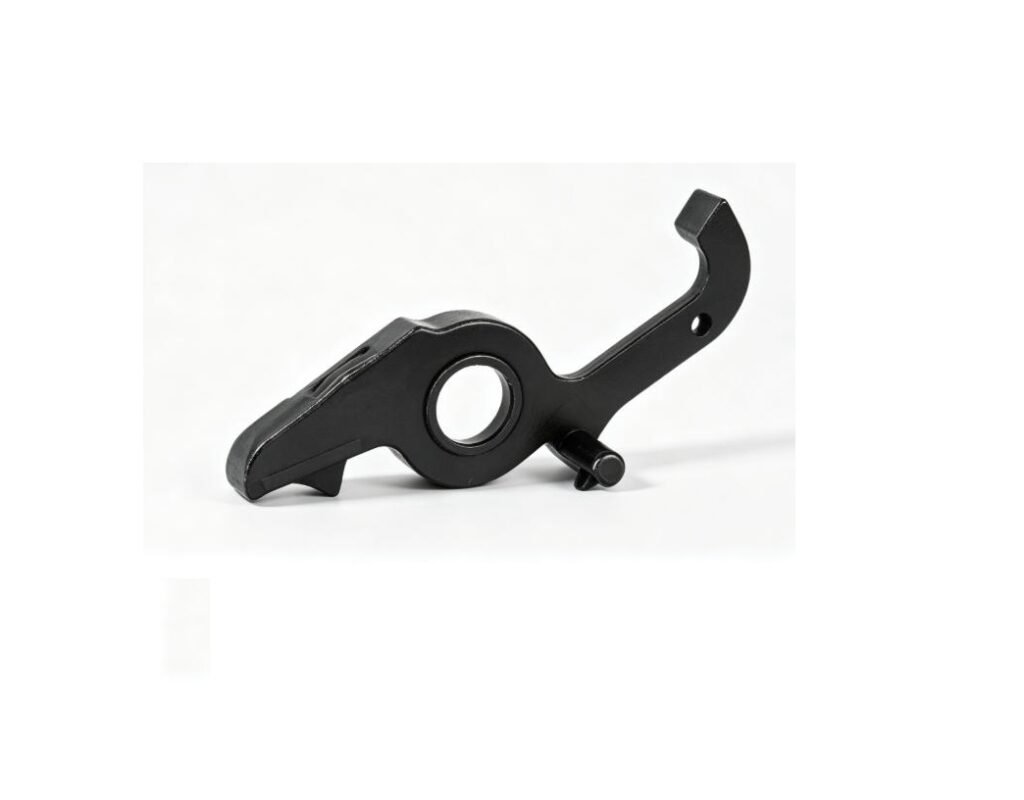
Powder Metallurgy Uses: What It Makes, and Where It Wins
A factory-side answer to a straightforward question – what is powder metallurgy actually used for? Here is where it earns its keep: high-volume metal parts made near net shape, with controlled porosity where you want it and die-set repeatability you can measure. Mapped by industry and part type, and honest about where PM stops being the right answer.
Quick Summary (Core Engineering Takeaways)
- Dominant Market: Automotive is the largest conventional PM sector; parts span engines, transmissions, and chassis systems.
- Core Part Families: Precision gears, self-lubricating bearings, sprockets, soft magnetic cores, and wear plates.
- Functional Porosity: Interconnected porosity (10–25%) is an engineered feature in self-lubricating bushings, not a structural defect.
- High Efficiency: Reaches ~97% material utilization versus 30–60% for traditional CNC machining from bar stock.
- Process Limits: PM is not universal; geometry, density requirements, part size, tolerances, and batch volume determine process viability.
What is powder metallurgy, in one breath
Powder metallurgy is a family of processes that turn fine metal powder into solid parts without fully melting the base metal. In conventional press-and-sinter PM, the powder is blended with a small amount of lubricant and graphite, compacted inside a high-tonnage die at 400-800 MPa, then sintered in a controlled-atmosphere furnace just below the metal’s melting point. The powder particles bond into a solid, and the part shrinks by a predictable amount that the die was already sized to absorb.
The defining feature is near-net-shape forming. The shape is put into the die, so almost none of the material is cut away, and critical features often need no secondary machining at all. That is what creates the cost and speed advantages the rest of this page explains.
Is powder metallurgy the same as MIM?
No – MIM is a sibling process in the same powder family, but it runs under different boundaries.
- Press-and-sinter PM compacts dry powder in a rigid tool set. It favors two-dimensional or 2.5D structural shapes pressed along one axis – gears, bushings, step plates and the like.
- Metal injection molding (MIM) mixes fine powder with a polymer binder and molds it like plastic, then debinds and sinters. It is made for small, complex 3D parts, typically under 100 grams.
- Hot isostatic pressing and binder jetting cover aerospace superalloy consolidation and additive low-volume prototyping, respectively.
The full sequence – blending, compaction, sintering and the furnace behavior behind it – is covered on our what-is-sintering and how-PM-works pages. The point here is what all of it is for.
What are the main powder metallurgy uses, industry by industry
1. Automotive
Automotive is the largest single market for conventional PM, and it is not close. A modern passenger car carries roughly 20 to 40 pounds of sintered parts, because mass production punishes any process that reworks a part or wastes material.
- Common parts: transmission gears, engine timing sprockets, oil-pump rotors, VVT components, synchronizer hubs, valve-seat inserts, ABS sensor rings.
- Typical materials: iron-copper steels (MPIF FC-0208) and nickel-steel alloys (MPIF FN-0205).
- Why PM: high-volume repeatability, tight tooth-profile tolerance, sinter-hardening in the same furnace step, and it skips gear hobbing entirely.
At JH PM, automotive work concentrates where die compaction and tight tolerance pay off – timing gears, injector components and seat-belt lock parts, produced under IATF 16949 automotive sintered parts control.
2. Industrial machinery, pumps and hydraulics
Fluid-power systems rely on high-density PM parts to hold a seal under continuous hydraulic pressure.
- Common parts: hydraulic pump gears, gerotor sets, valve wear plates, distributor cams, heavy-duty bronze bushings.
- Typical materials: sinter-hardened alloy steels and SAE 841 bronze.
- Why PM: consistent wear resistance and controlled surface porosity, which is exactly what a self-lubricating or fluid-containing part wants.
3. Power tools, locks and consumer products
Durable goods lean on PM parts to take mechanical shock at a unit cost that keeps retail assembly competitive.
- Common parts: planetary gearboxes for cordless drills, door-lock deadbolts, drive ratchets, lawnmower gears, appliance bearings.
- Typical materials: diffusion-alloyed steel powders, sintered brass, copper-steels.
- Why PM: one press stroke can consolidate several features – a gear pressed directly onto a cam profile – into a single part.
4. Electrical and magnetic components
PM lets an engineer tune permeability, conductivity and resistivity through the powder formulation itself.
- Common parts: soft magnetic composite (SMC) stator cores, heat sinks, relay armatures, solenoid cores, electrical contact tips.
- Typical materials: pure iron powder, iron-silicon alloys, high-purity copper.
- Why PM: it suppresses eddy-current loss at high frequency and processes near-pure copper parts efficiently.
5. Medical devices and surgical instruments
Medical OEMs use powder processing for small, high-strength stainless and titanium parts without multi-axis CNC setups. A clear boundary applies: JH PM supports non-implant, instrument-class medical work – surgical handles, stapler components, endoscopic parts – not implants.
- Common parts: endoscopic grippers, surgical scissors and stapler components, dental brackets, orthopedic instrument housings.
- Typical materials: 316L stainless, 17-4PH stainless.
- Why PM: biocompatibility and corrosion resistance combined with complex contour capability, often via the MIM route for the smallest parts.
6. Aerospace, defense and energy
In high-stress environments, PM refines microstructures in nickel superalloys that cannot be reliably cast or turned from solid bar.
- Common parts: high-temperature actuator bushings, turbine stator brackets, jet-engine disc preforms, specialized fasteners.
- Typical materials: Inconel 718 and related nickel superalloys, high-purity titanium.
- Why PM: it removes the segregation defects inherent in large ingots and wastes far less of a very expensive raw material.
7. Cutting tools and wear-resistant inserts
Hard metals and cemented carbides depend on powder consolidation almost by definition – they cannot be melted and poured.
- Common parts: indexable CNC inserts, mining button bits, wire-drawing dies, cold-heading punches.
- Typical materials: cemented tungsten carbide (WC-Co), tool steels.
- Why PM: for materials whose hardness or melting point rules out casting and turning, PM is the only viable route.
What parts are commonly made by powder metallurgy
A short field guide to the recurring geometries, the materials they are made from, and the PM edge on each.
| PM part type | Common applications | Typical materials | Core PM advantage |
|---|---|---|---|
| Gears & sprockets | Automotive transmissions, power tools | FC-0208 copper-steel, FN-0205 nickel-steel | Near-net tooth geometry; skips hobbing, cuts scrap. |
| Bushings & bearings | Electric motors, pumps, fans | SAE 841 bronze, iron-bronze | Interconnected porosity (about 10-25%) holds oil for self-lubrication. |
| Cams & ratchets | Lock assemblies, actuators, appliances | Sinter- and case-hardened steels | Complex 2D profiles in a single press stroke. |
| Structural brackets | Chassis mounts, appliance frames | Carbon and alloy steels | High strength-to-weight with close to zero removal scrap. |
| Cutting inserts | CNC tooling, mining drills | Cemented tungsten carbide (WC-Co) | Forms ultra-hard compounds that casting cannot touch. |
What materials are used in powder metallurgy
- Iron and steel powders – over 80% of structural PM output. Pure iron, carbon steels, copper-steels, nickel-steels and pre-alloyed steels cover most structural and drive work.
- Stainless steel powders – 300-series for corrosion, 400-series for magnetic and hardenable duty, in medical, exhaust and marine parts.
- Copper, bronze and brass – electrical contacts, heat sinks and the self-lubricating porous sleeve bearings.
- Titanium and nickel alloys – strength-to-weight and high-temperature duty in aerospace and defense.
- Tungsten and cemented carbide – extreme wear resistance for mining bits and heavy metalworking tools.
Why powder metallurgy is used, and where it stops
The advantages
- Near-net-shape forming. Metal is compacted straight into the finished contour, so most milling disappears.
- Material efficiency. Roughly 97% of the raw powder ends up in the part, against 30-60% for the same part machined from bar stock.
- Self-lubrication. Controlled porosity can be vacuum-filled with oil for a bearing that runs maintenance-free for thousands of hours.
- Mass-production consistency. The die – not an operator’s hand – holds the size, so part-to-part and batch-to-batch repeatability is a given.
The limits
- Pressing rules. Deep undercuts, transverse cross-holes and threads cannot be pressed directly; they need a secondary operation.
- Residual porosity. As-sintered parts hold 8-15% porosity. High-fatigue duty needs sizing, copper infiltration or powder forging.
- Upfront tooling. Steel and carbide dies are a real one-time investment, so PM earns its keep when amortized over annual volume.
Powder metallurgy vs. CNC machining vs. MIM
The right process is a function of volume, geometry, material and tolerance – not a single winner. Here is the honest comparison on the variables that decide it.
| Variable | Press-and-sinter PM | CNC machining | Metal injection molding (MIM) |
|---|---|---|---|
| Feedstock | Dry powder blend | Solid bar / plate | Powder + polymer binder |
| Material utilization | ~97%+ | 30-60% (high scrap) | 95%+ |
| Best volume | Thousands to millions/yr | 1 to 1,000 units | Tens of thousands+/yr |
| Geometric complexity | Die-compatible 2D / 2.5D | Highly flexible 3D | Extreme complex miniature 3D |
| Typical part size | Up to roughly 75 mm across | Unrestricted | Under 100 grams |
The crossover point against machining depends on the part. From a few thousand pieces a year upward, PM usually wins on total landed cost; below that, MIM or CNC is often the cheaper honest answer.
How to choose a powder metallurgy manufacturer
A reliable PM partner should be auditable on three things: in-house tooling, press and furnace capacity, and a quality system that survives a real audit – not a certificate on the wall.
JH PM in-house capabilities
JH PM runs one integrated press-and-sinter line, so tooling, compaction, sintering, sizing and the most-used secondaries stay under one roof.
- Press and furnace: 19 compaction presses from about 6 to 1,000 tons, feeding 2 continuous sintering furnaces.
- Quality system: IATF 16949:2016 and ISO 9001:2015, with 3 Zeiss CMMs, gear-measurement equipment, and PPAP lot documentation.
- Working terms: MOQ from 2,000 pieces, tooling in about 25 days, and T0 first-article samples within 35 days.
How to Tell Whether Powder Metallurgy Fits Your Part
Six systematic evaluation steps to determine if your component belongs in powder metallurgy:
Step 1 – Pressing Direction & Features
Identify the die axis, holes, steps, thin sections and undercuts. Features that cannot fill or eject cleanly indicate where secondary machining is required.
Step 2 – Part Size vs. Press Window
Confirm dimensions and mass fit press tonnage and furnace capacity. JH PM operates presses from 6 to 1,000 tons to cover a practical envelope.
Step 3 – Material Selection by Duty
Match duty requirements (strength, wear, corrosion, temperature). Iron and low-alloy steel fit structural tasks; stainless or bronze suit specific environments.
Step 4 – Annual Volume Estimation
Tooling amortizes over volume. Beyond a few thousand pieces annually, PM typically delivers cost savings; below that threshold, evaluate CNC or MIM.
Step 5 – Tolerance Classification
Expect ±0.05 mm as-sintered and ±0.025 mm after sizing on die-formed features. Limit ultra-tight tolerance callouts to critical mating surfaces.
Step 6 – Total Landed Cost Analysis
Calculate tooling, secondary steps, material scrap, and freight across total annual production to evaluate landed cost against alternative processes.
FAQ – Powder Metallurgy Uses
What are the main uses of powder metallurgy?
Powder metallurgy is mainly used to mass-produce precision structural and drive parts: automotive gears and sprockets, self-lubricating bushings and bearings, oil-pump and hydraulic components, soft magnetic cores, power-tool transmission parts, and cemented carbide cutting tips. Near-net-shape forming, high material utilization and die-controlled repeatability are what make it the right call for these families.
Is powder metallurgy better than CNC machining?
Neither is universally better. PM reaches roughly 97% material utilization and a lower unit cost on repeat production past the break-even volume, while turning near-net shapes in a single press stroke. CNC wins on freedom for prototypes, low runs, deep 3D undercuts and oversized parts. The honest answer is total landed cost per part across the annual volume.
What economic volume makes powder metallurgy worthwhile?
Conventional press-and-sinter PM usually pays off past a few thousand parts a year, once tooling amortizes. Industry reference points often cite 10,000+ units for a comfortable crossover against machining. At JH PM, custom programs start at an MOQ of 2,000 pieces, so you can qualify a part without a full automotive-size volume first.
Can powder metallurgy parts be machined or heat-treated after sintering?
Yes. Secondary CNC adds cross-holes, threads or faces a die cannot form, and sinter-hardening, carburizing or induction hardening pushes iron-steel parts to tensile strengths above 800 MPa. Sizing also tightens selected dimensions to ±0.025 mm without cutting.
What tolerances can powder metallurgy hold?
As-sintered critical dimensions typically hold ±0.05 mm. A secondary sizing operation tightens die-formed bores, faces and tooth forms to about ±0.025 mm with almost no added cost. Tighter features need machining or grinding – the DFM review tells you which surfaces actually need it.
What is powder metallurgy used for in my industry?
Automotive uses PM for gears, sprockets, oil-pump and VVT parts; industrial and hydraulic work for pump gears, gerotor sets and bronze bushings; power tools and appliances for planetary gearboxes and bearings; electrical work for magnetic cores and contacts. Send a drawing and we map it to the process that fits – PM, MIM or CNC.
Not Sure Whether Your Part Belongs in Powder Metallurgy?
Send the 2D/3D model, the material requirement, annual volume and the critical tolerances. Within 48 hours you get a written DFM note – process route, tolerance prediction, tooling and per-piece price – and an honest read on whether PM, MIM or CNC wins. IATF 16949:2016, 19 presses, 2 continuous sintering furnaces, 3 Zeiss CMMs.