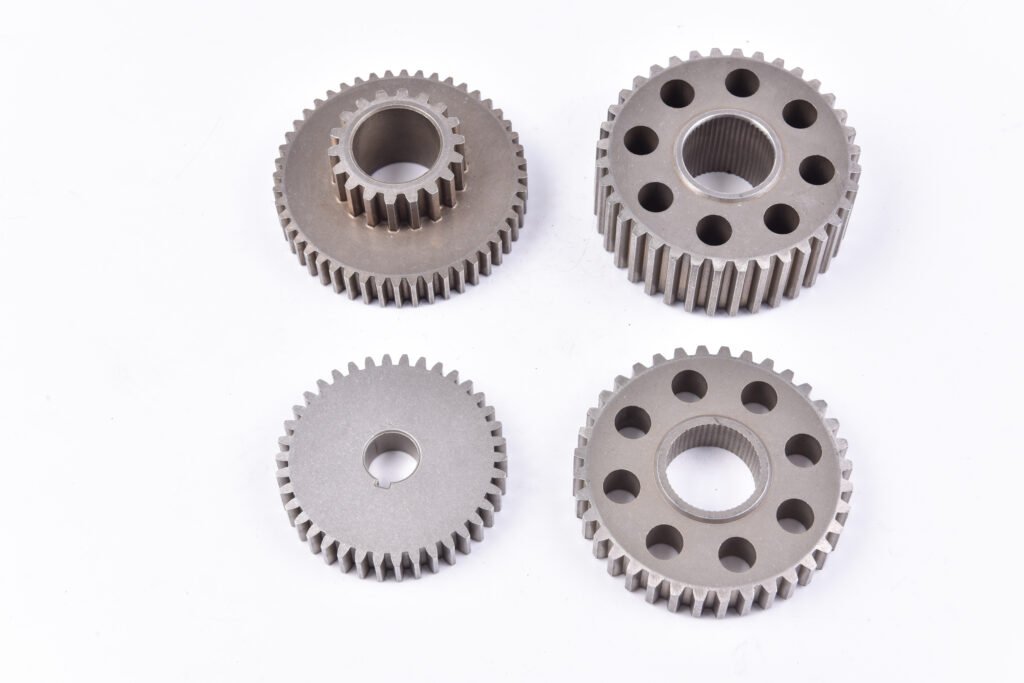
FC-0208 Powder Metallurgy Material: Properties, Density, Applications and Specifications
Iron-copper-carbon PM material with nominally 2% copper and 0.8% combined carbon. Used for pressed-and-sintered structural components where strength, hardness, wear resistance, and near-net-shape production must be balanced.
- FC-0208 is an iron-copper-carbon PM material with nominally 2% Cu and 0.8% combined carbon
- The MPIF designation can include a minimum-strength suffix, such as FC-0208-60
- Density is one of the most important variables affecting mechanical performance
- As-sintered and heat-treated FC-0208 should not be treated as having the same property range
- Commonly considered for gears, sprockets, cams, hubs, and other structural PM components
- A drawing should specify material designation, density, heat-treatment condition, hardness, and critical dimensions
- MPIF Standard 35-SP should be used as the governing reference for formal specifications
What Is FC-0208?
FC-0208 is a copper-containing ferrous powder metallurgy material used to manufacture structural PM parts through compaction and sintering.
The designation describes the basic alloy chemistry:
- F = ferrous, or iron-base material
- C = copper-containing material
- 02 = approximately 2% nominal copper
- 08 = approximately 0.8% nominal combined carbon
FC-0208 vs. FC-0208-HT
As-sintered FC-0208 is evaluated directly after the normal PM sintering operation.
FC-0208-HT refers to a heat-treated condition. Its properties cannot simply be substituted into a drawing designed around the as-sintered material.
The current MPIF Standard 35-SP includes revised typical property values for FC-0208-HT, which is another reason older property tables should not automatically be treated as current design data.
FC-0208 Chemical Composition
The nominal chemistry of FC-0208 is straightforward:
| Iron (Fe) | Balance (main structural matrix) |
|---|---|
| Copper (Cu) | ~2.0 wt% (alloying addition and sintering behavior) |
| Combined carbon | ~0.8 wt% (strengthening and microstructure control) |
The actual chemistry used for production should be verified against the specific material standard, powder premix specification, supplier documentation, and purchase requirements. A material designation should not be interpreted as permission to substitute an arbitrary powder mixture.
MPIF states that purchasers and manufacturers should agree on minimum strength, grade selection, chemistry, proof testing, typical property values, and relevant processes before manufacturing a PM part.
How FC-0208 Gets Its Mechanical Properties
One of the most important differences between PM steel and wrought steel is that the final component contains controlled porosity.
This means the nominal alloy composition is only one part of the engineering specification. Two FC-0208 components with the same nominal chemistry can have different strength, hardness, elongation, fatigue behavior, and dimensional performance if their density, cooling history, geometry, or thermal condition differs.
FC-0208 Material Properties
4.1 Density
Density is one of the most important variables in FC-0208 component design. Increasing sintered density generally reduces porosity and increases the effective metallic load-bearing area. This normally improves tensile strength, yield strength, fatigue performance, stiffness, apparent hardness, and dimensional consistency.
The relationship is not simply linear. Pore size, pore shape, density gradients, local section thickness, and microstructure also influence performance.
4.2 Tensile and Yield Strength
FC-0208 does not have one universal tensile-strength value. Mechanical properties should be interpreted according to:
- Material designation
- Sintered density
- As-sintered or heat-treated condition
- Test specimen geometry
- Test method
- Processing history
For production design, the relevant question is not simply “What is the tensile strength of FC-0208?” but rather: What minimum strength is required at the specified density and material condition? That approach produces a much more useful material specification.
FC-0208 Hardness
Hardness is another property that must be interpreted in relation to material condition.
As-sintered condition
The pearlitic matrix produced by the carbon addition gives FC-0208 useful as-sintered hardness for many mechanical applications.
Heat-treated condition
Heat treatment can substantially increase hardness and strength by changing the matrix microstructure. However, apparent hardness and matrix microhardness are not equivalent measurements. PM materials contain pores, so a conventional hardness indentation interacts with both the metallic matrix and the porous structure.
For this reason, a drawing should specify hardness scale, test method, measurement location, and as-sintered or heat-treated condition, rather than simply stating “FC-0208, 70 HRB” without additional context.
Wear Resistance
FC-0208 can be a practical material choice for components exposed to sliding or moderate contact wear. Typical applications include gears, sprockets, cams, mechanical hubs, and other moving PM components.
Wear behavior depends on more than carbon content. Important variables include:
- Sintered density
- Pore morphology
- Surface condition
- Counterface material
- Lubrication
- Contact pressure and sliding speed
- Heat treatment and surface treatment
FC-0208 for sprockets
A motorcycle transmission sprocket produced from FC-0208 at relatively high density and subsequently steam treated demonstrates the broader PM design principle: material selection + density + geometry + surface treatment must be considered as one system.
Ductility and Impact Resistance
Porosity is important when FC-0208 is exposed to tensile, bending, impact, or fatigue loading. The pores can act as local stress concentrators, reducing ductility compared with a fully dense wrought steel of similar chemical composition.
FC-0208 should be evaluated carefully for:
- Severe shock loading
- High-impact applications
- Highly stressed gear teeth
- Critical fatigue applications
- Large deformation requirements
- Applications requiring substantial post-sinter forming
This does not mean FC-0208 cannot be used under dynamic loading. It means the design should be based on validated PM material data at the required density and condition, rather than comparing only nominal alloy chemistry with a wrought steel.
Dimensional Behavior During Sintering
Dimensional change is a major consideration in PM tooling design. Copper additions, carbon content, powder characteristics, compaction conditions, sintering atmosphere, temperature profile, and component geometry all influence dimensional change.
FC-0208 is often attractive because its dimensional behavior can be engineered through material formulation and process control. However, it is not appropriate to assume that every FC-0208 component will experience “near-zero” dimensional change.
For a production part, the manufacturer normally establishes the actual dimensional response through:
This is particularly important for gears, precision bores, and multi-level components.
Machinability of FC-0208
PM manufacturing reduces the amount of material that needs to be removed compared with a fully machined component, but secondary machining may still be necessary. Typical secondary operations can include drilling, tapping, reaming, turning, grinding, sizing, and machining of features that cannot be formed directly in the die.
The machinability of FC-0208 depends on density, microstructure, cutting conditions, tooling, and the exact operation. Machining a porous PM component is not identical to machining wrought steel because the cutting edge interacts with a heterogeneous metal-and-pore structure.
For that reason, machining parameters should be developed against the actual production material rather than copied directly from a wrought-steel datasheet.
FC-0208 Heat Treatment
FC-0208 can be supplied in an as-sintered or heat-treated condition. Heat treatment can increase hardness and strength by transforming the steel matrix. However, there is no single heat-treatment recipe that should be presented as universally correct for every FC-0208 component.
The appropriate cycle depends on:
- Density
- Component geometry and section thickness
- Furnace atmosphere and cooling rate
- Required hardness and dimensional stability
- Subsequent finishing operations
MPIF’s current Standard 35-SP contains updated typical data for FC-0208-HT, reflecting the fact that heat-treated material properties have been re-evaluated over time.
FC-0208 vs. FC-0205
FC-0205 and FC-0208 belong to the same general iron-copper-carbon PM material family. The key chemistry difference is the nominal combined carbon level:
| Characteristic | FC-0205 | FC-0208 |
|---|---|---|
| Nominal combined carbon | ~0.5% | ~0.8% |
| Copper | Copper-containing | Copper-containing |
| General matrix tendency | Lower-carbon ferrous structure | Higher-carbon, more pearlitic |
| Hardness | Generally lower | Generally higher |
| Ductility | Generally higher | Generally lower |
| Wear resistance | Application dependent | Often attractive for moderate wear |
| Typical design focus | Strength/ductility balance | Higher hardness and strength balance |
The exact performance difference depends on density and processing condition. A statement such as “FC-0208 is always 20% stronger than FC-0205” is not an appropriate general engineering rule. For a real component, compare the actual MPIF grade, density, thermal condition, and required property.
FC-0208 vs. FN-0208
FC-0208 and FN-0208 use different alloying strategies. FC-0208 is a copper-containing PM steel, while FN-0208 belongs to the nickel-containing PM material family.
Nickel-containing materials can provide different combinations of hardenability, toughness, ductility, and fatigue behavior, depending on the alloy system and heat-treatment condition.
The selection should therefore be based on the actual application requirements rather than simply choosing the material with the higher nominal alloying-element content. Consider:
- Bending stress and impact loading
- Fatigue requirements
- Density and heat treatment
- Dimensional requirements and corrosion environment
- Material cost and production volume
FC-0208 vs. Machined Wrought Steel
A PM material should not be compared with wrought steel on chemistry alone. The manufacturing economics are fundamentally different.
PM advantages
Pressed-and-sintered FC-0208 can provide:
- Near-net-shape production
- High material utilization
- Reduced machining requirements
- Repeatable high-volume production
- The ability to form certain features directly in the compacting die
Wrought-steel advantages
A wrought steel such as AISI 1045 provides:
- Essentially fully dense material
- Higher ductility
- No PM-type internal porosity
- Broader machining and forming options
- Established behavior for many high-load applications
The appropriate choice depends on part geometry, annual demand, dimensional requirements, mechanical loads, tolerances, tooling cost, and secondary operations. There is no universal rule that FC-0208 is cheaper or stronger than a machined steel part. The manufacturing route should be evaluated as a complete process.
Main Advantages of FC-0208
FC-0208 can be attractive when the application matches the capabilities of conventional press-and-sinter PM.
Good strength-to-cost balance
The iron-copper-carbon system provides a practical combination of strength and hardness without requiring a highly alloyed powder system.
Near-net-shape manufacturing
Features such as gear teeth, hubs, steps, holes, and other suitable geometries can often be incorporated directly into the compacting tool, reducing the amount of downstream machining.
Useful as-sintered hardness
The carbon-containing ferrous matrix can provide useful hardness without automatically requiring a separate heat-treatment operation.
Suitable for secondary processing
Depending on the design, FC-0208 parts can undergo sizing, machining, steam treatment, heat treatment, grinding, and other surface-finishing processes. The exact combination should be selected according to the component’s functional requirements.
Applications of FC-0208
Gears
Potential applications include spur gears, planetary gears, actuator gears, reduction gears, and motor gears. For gears, the material decision cannot be separated from tooth-root bending stress, contact stress, density distribution, tooth accuracy, heat treatment, surface treatment, and lubrication. FC-0208 may be appropriate for moderate-duty gear applications, while higher-load gear designs may require another PM material, additional densification, heat treatment, or a wrought-steel route.
Sprockets
Sprockets are a useful FC-0208 application because the manufacturing process can produce repeated tooth geometry with relatively high material utilization. Density and surface treatment should be evaluated against chain load, tooth contact pressure, impact, wear, and expected service life.
Cams and motion components
FC-0208 can be considered for cams and similar components where moderate sliding wear and structural strength are required.
Hubs and structural components
Other possible applications include hubs, flanges, mechanical levers, actuator components, retaining components, and structural PM parts. The final selection should always be based on the actual load and manufacturing requirements.
When Should You Choose FC-0208?
FC-0208 is worth evaluating when several of the following conditions apply:
- The part is suitable for press-and-sinter manufacturing
- Production volume is sufficient to justify PM tooling
- The geometry benefits from near-net-shape forming
- Moderate strength and hardness are required
- Sliding wear is part of the application
- The design can tolerate the mechanical effects of PM porosity
- The required density and material condition can be achieved consistently
- Secondary machining can be minimized
- The component does not require the ductility of a fully dense wrought alloy
The final decision should be based on the complete component specification rather than production volume alone.
When FC-0208 May Not Be the Right Choice
FC-0208 may not be the appropriate starting point when the application requires properties that are difficult to obtain economically with conventional press-and-sinter PM.
Severe impact or shock resistance
If the component experiences substantial impact loading, compare FC-0208 with materials and processes that provide higher ductility and toughness.
Severe contact fatigue
Highly loaded gear teeth and rolling-contact surfaces may require higher-density PM materials, surface densification, sinter-hardening alloys, carburizing or other surface treatments, or wrought alloy steel.
Corrosion resistance
FC-0208 is not a stainless steel. If the operating environment requires inherent corrosion resistance, a stainless PM grade may be more appropriate.
Extensive plastic deformation
If the part must undergo substantial staking, crimping, riveting, or other post-sinter deformation, a material with higher ductility may be preferable.
FC-0208 Manufacturing Process
A typical press-and-sinter route:
Iron powder, copper-containing additions, carbon, and processing additives are blended into the required premix. The objective is consistent chemical distribution and predictable compaction behavior.
The powder is compacted in a precision die. The tooling determines green geometry, density distribution, ejection behavior, and dimensional capability. For complex components, density gradients must be considered during tool and process design.
Typical controls include part weight, green dimensions, visual defects, and green density or related process indicators.
The compact is heated in a controlled atmosphere. Particles develop metallurgical bonds, copper participates in the sintering process, carbon interacts with the iron matrix, the final microstructure develops, and dimensional change occurs. Exact furnace conditions should be established for the actual powder system and component.
Depending on the component, inspection may include density, dimensions, hardness, metallography, strength testing, gear measurement, and surface condition.
Depending on the design: sizing, machining, grinding, steam treatment, heat treatment, or other finishing operations may be used.
The final inspection plan should focus on the characteristics that determine functional performance. For a gear: tooth dimensions, runout, profile, lead, hardness, and density. For a structural hub: dimensional accuracy, density, hardness, and critical interfaces.
How Density Changes FC-0208 Performance
A useful engineering model: Higher density → lower porosity → greater effective metallic cross-section → generally higher strength and stiffness.
But density alone is not enough. Two parts with the same average density can perform differently if they have different pore morphology, density distribution, microstructure, cooling history, surface condition, or local geometry.
This is why critical PM components should sometimes be specified using minimum density at a functional region rather than only an average density value.
| Property | General effect of increasing density |
|---|---|
| Tensile strength | Generally increases |
| Yield strength | Generally increases |
| Young’s modulus | Generally increases |
| Fatigue resistance | Generally improves |
| Apparent hardness | Generally increases |
| Ductility | Generally improves, although microstructure also matters |
| Porosity | Decreases |
| Stress concentration from pores | Generally decreases |
These are engineering trends, not universal numerical conversion rules. For a safety-critical application, use material data generated under the relevant density and processing conditions.
What Should Buyers Specify on the Drawing?
A material callout such as “FC-0208” may not provide enough information for production control. A stronger drawing or RFQ should define the important variables.
| Material | MPIF material designation |
|---|---|
| Strength class | Minimum strength requirement where applicable |
| Density | Minimum density and measurement location |
| Material condition | As-sintered, heat-treated, or other defined condition |
| Hardness | Scale, range, and test location |
| Critical dimensions | Tolerances and datums |
| Surface treatment | Steam treatment, grinding, coating, etc. |
| Testing | Applicable ASTM, MPIF, ISO, or customer method |
| Functional regions | Critical gear teeth, bores, bearing surfaces, etc. |
| Traceability | Lot and material documentation requirements |
Example drawing callout
Instead of simply “Material: FC-0208”, consider a more complete requirement such as:
Material: PM copper steel, MPIF FC-0208 series; minimum density and strength requirements to be defined for the critical functional region; as-sintered condition unless otherwise specified.
The exact callout should be agreed between the designer and PM manufacturer. MPIF specifically recommends that the purchaser and manufacturer agree on minimum strength, grade, chemistry, proof testing, typical property values, and processes before production.
FC-0208 Property Data: How to Read It Correctly
Property tables are useful, but they can also be misleading when they remove the conditions under which the data were generated. When reviewing FC-0208 data, check:
- Material designation
- Density
- Material condition
- Test specimen
- Test method
- Typical or minimum value
- Heat-treatment condition
- Whether the data represent laboratory specimens or production parts
This is especially important because MPIF Standard 35-SP has been revised over time. The 2024 edition superseded the 2020 edition and included revised typical values for FC-0205-HT and FC-0208-HT. An old table copied from a PM website should not automatically be treated as the current MPIF specification.
Have a part in mind? Send a drawing and get a DFM review within 48 hours.
Request a quote →