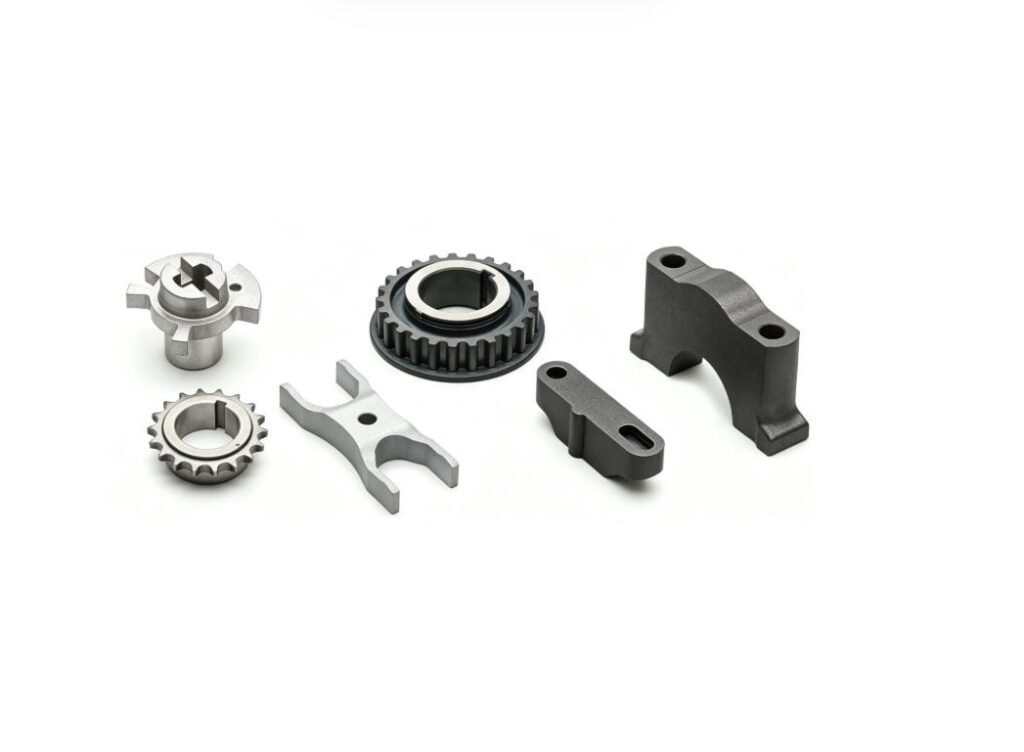
Sintered Part Density: What 85–92% Actually Means for Your Design
For design engineers who need to know what porosity does to their part, process engineers who control it, and buyers comparing quotes where one price includes infiltration and the other does not. Numbers from the compaction floor at JH PM’s IATF 16949 plant.
Quick Summary (Core Engineering Takeaways)
- Density Standard: Press-and-sinter steel targets 6.4–7.2 g/cm³ (85–92% of wrought steel) under standard compaction pressures.
- Functional Dualism: Porosity provides self-lubrication (12–18% oil volume) and acoustic damping, but reduces tensile/fatigue strength by 30–40% compared to dense structures.
- Post-Processing Routes: Porosity can be closed via Sizing (+3-8% cost), Steam Treatment (+5-10%), Resin Impregnation (+5-10%), or Copper Infiltration (+15-25% cost, up to 7.4 g/cm³).
- Plant Capability: JH PM operates 16 presses (6–1000 tons) and 10 Shimadzu continuous sintering furnaces under IATF 16949 certification, with 20-day tooling / 25-day sample turnaround and ±0.025 mm sizing precision.
Where the 8–15% Comes From – Compaction Physics, Not Process Error
Powder is not a liquid. Fill a die with iron powder, press it at 400-600 MPa, and the particles rearrange and deform but never fully merge – 15-25 million contact points per cubic millimeter, and between them, voids. Sintering at 1,120-1,180 °C bonds particle to particle and shrinks the void network by a fraction (linear shrinkage typically stays within 0.2% – 0.5%), but it does not eliminate it. What is left is the 8-15% porosity that defines the process.
That porosity is mostly open and interconnected – a channel network from surface to interior. On a self-lubricating bushing that network is the lubrication system. On a part that must hold pressure or take plating, the same network is the problem. One process, two opposite readings – which is why “porosity” appears in both the capability table and the defect list of every serious PM conversation.
What Porosity Buys – and What It Costs
What it buys
- Self-lubrication. 10-25% interconnected porosity in a Cu-Sn 90/10 or Fe-Cu bushing holds 12-18% oil by volume; shaft heat expands the oil into the running clearance, cooling draws it back. Millions of bushings run with no greasing point at all.
- Damping. Pores dissipate vibration energy. Sintered iron is measurably quieter than wrought steel of the same grade – useful in gear housings and appliance components, useless in a fatigue-critical bracket.
- Weight. At 6.6 g/cm³ a part weighs about 16% less than the same geometry in wrought steel. For counterweights that is irrelevant (you are buying mass), but for a carrier plate it can be the difference between two bracket designs.
- Filterability and controlled flow – the extreme end of the same property, where porous PM parts are the product.
What it costs
- Strength. Porosity is missing load-bearing section. Rule-of-thumb: tensile strength scales steeply with density – going 6.8 → 7.2 g/cm³ on Fe-Cu-Ni-Mo buys roughly 30-40% more tensile. MPIF Standard 35 publishes properties per density grade for exactly this reason.
- Fatigue. Cracks initiate at the largest near-surface pores. A fatigue-loaded part wants density pushed up and wants the surface pore structure closed – steam treatment does both at once.
- Plating bleed-out. Zinc or zinc-nickel into an open-pored surface drags electrolyte back out after the bath – blistering, staining, and rejects. Plated PM parts need resin impregnation first, and the quote needs to say so.
- Pressure-tightness. Hydraulic and pneumatic parts leak through the interconnected network unless it is sealed – impregnation, steam treatment, or infiltration.
From the press floor
An appliance customer plated a batch of Fe-Cu latch housings without impregnation. Zinc went into the surface pores, came back out as efflorescence inside the customer’s assembly line, and 3,000 pieces came home in two crates. The fix was not better plating – it was resin impregnation before the bath, flagged in DFM the second time around. Porosity failures rarely show up at sintering; they show up two suppliers downstream.
Oil-Impregnated Bushings vs. Structural Parts: Same Process, Opposite Targets
The clearest way to see porosity as a design variable is to put the two extremes side by side:
| Parameter | Oil-impregnated bushing | Structural sintered part |
|---|---|---|
| Material | Cu-Sn 90/10 or Fe-Cu | Fe-Cu, Fe-Cu-Ni-Mo, low-alloy steel |
| Density target | 6.0-6.8 g/cm³ | 6.4-7.2 g/cm³, higher for load path |
| Porosity intent | Maximize interconnected – 10-25% | Minimize where load runs; control elsewhere |
| Oil content | 12-18% by volume, measured per lot | None (or resin-impregnated for plating) |
| What porosity does | Lubricant reservoir feeding the shaft | Reduces section; fatigue initiation sites |
| After-sinter step | Vacuum oil impregnation | Sizing / steam / infiltration as function demands |
| Failure mode if wrong | Under-oiled: shaft scoring. Over-dense: no oil, same result | Under-dense: fatigue crack at pore. Over-dense: paid for strength the part never uses |
One process, one powder family, two opposite density targets. The material name on the drawing carries almost none of this information – the density callout carries all of it.
Closing Porosity: Four Routes, Four Costs
| Method | Density / pore effect | Cost impact | Use when |
|---|---|---|---|
| Sizing (re-press) | Raises density locally where tool contacts; closes surface-connected pores on sized faces (holds ±0.025 mm) | ~3-8% piece price | Tolerance and surface on specific features; moderate density gain |
| Steam treatment | Fe₃O₄ oxide grows inside surface pores; part gains ~2% weight, corrosion resistance, no strength gain in core | ~5-10% | Corrosion resistance, plating prep, damping, mild wear faces |
| Copper infiltration | Molten copper wicks into the pore network; 7.0 → ~7.4 g/cm³ | ~15-25% | Pressure-tight parts, high-strength fatigue sections, plating without resin |
| Resin impregnation | Seals interconnected pores; density unchanged | ~5-10% | Plating prep, leak-tightness – cheapest fix when strength is not the issue |
Density and Porosity by Part Class: What to Put on the Drawing
| Part family | Typical density | Porosity condition | QC per lot |
|---|---|---|---|
| Self-lubricating bushing (Cu-Sn 90/10) | 6.0-6.8 g/cm³ | 10-25% interconnected; 12-18% oil | Density (ASTM B962) + oil content by extraction |
| Bracket, housing, plate (Fe-Cu) | 6.4-6.8 g/cm³ | 8-15% mixed open/closed | Density per lot; tensile per MPIF 35 grade |
| Gear, ring, counterweight (Fe-Cu) | 6.6-7.0 g/cm³ | 5-12% | Density + dimensional FAI |
| Clutch hub, shift fork, synchro ring (Fe-Cu-Ni-Mo) | 6.8-7.2 g/cm³ | 3-8%, case-hardened surface | Density + hardness (HRC 55-62 case) + Cpk on spline |
| Valve seat (high-alloy + Cu infiltrated) | ~7.2-7.4 g/cm³ after infiltration | Closed at function surface | Infiltration completeness + hardness |
| Plated / pressure-tight part | Per function | Sealed by resin or infiltration first | Leak test or plating adhesion per lot |
Designer’s Checklist: Density on a PM Drawing (5 Steps)
Step 1 – Assign density by function
Mass part: lowest density that hits the weight. Load-path part: density from the MPIF 35 strength grade you need. Bushing: porosity range, not density.
Step 2 – Reference MPIF Standard 35
Cite material code + density grade. The grade carries guaranteed tensile and yield values, so acceptance is defined by the spec itself.
Step 3 – Separate mean and minimum
Pressing variation runs 0.05-0.15 g/cm³ within a part. A bare number forces over-pressing and raises price; two numbers define the real window.
Step 4 – Fix the measurement method
ASTM B962 water displacement, sample location stated. For bushings: oil content by extraction. Removes the most common incoming-inspection dispute.
Step 5 – Name the pore-closing function, not the process
“Pressure-tight to 5 bar” or “plating-ready” tells the supplier which route (steam / resin / infiltration) actually fits. Priced in the 48-hour DFM note.
FAQ – Sintered Part Density and Porosity
How does sintered density compare to wrought steel?
Typical press-and-sinter steel parts run 6.4-7.2 g/cm³ against 7.87 g/cm³ for wrought steel – 85-92%. The missing 8-15% is porosity, mostly open and interconnected. MPIF Standard 35 lists properties by density grade because strength follows density, not just alloy.
Is porosity in sintered parts a defect?
Usually it is a design feature. In self-lubricating sintered bushings the 10-25% interconnected porosity is deliberately oil-impregnated (12-18% by volume) so the part carries its own lubricant reservoir for life. Porosity also dampens vibration and reduces weight. It becomes a defect only where the drawing did not ask for it – a hydraulic face, a plating line item, or a fatigue-loaded section that was never specified for density.
What does porosity do to strength and fatigue?
Pores are missing load-bearing section and crack-initiation sites. Moving 6.8 → 7.2 g/cm³ on Fe-Cu-Ni-Mo buys roughly 30-40% more tensile strength, and fatigue gains more because cracks start at the largest near-surface pores. This is why transmission parts run at the top of the range and brackets do not.
How is porosity measured on sintered parts?
Density by water displacement per ASTM B962 on every lot; porosity percent follows directly. Oil-impregnated parts add oil content by extraction, typically 12-18% vol for Cu-Sn 90/10. Metallography shows pore size and whether the network is open or closed – relevant before plating or impregnation.
Can porosity be closed or reduced after sintering?
Four routes: sizing (local densification, ~3-8% on price), steam treatment (oxide closes surface-connected pores, ~5-10%), copper infiltration (7.0 → ~7.4 g/cm³, ~15-25%), and resin impregnation (seals for plating or leak-tightness, ~5-10%). Pick by function, not by habit – the DFM note prices the honest one.
Why do oil-impregnated sintered bushings need porosity while a structural part tries to limit it?
Because they are opposite design intents on the same process. A bushing maximizes interconnected porosity (10-25%) to hold 12-18% oil as a built-in lubricant reservoir. A bracket minimizes it because porosity is missing load path. Same powder family, opposite targets – which is why the density or porosity callout on the drawing matters more than the material name.
A Density Number Without a Function Behind It Costs Money. Get the Right One.
Send the STEP or PDF with your load case, medium (oil, air, water) and volume (MOQ starting at 2,000 pcs; 20-day tooling, 25-day samples). Within 48 hours you get a written density DFM note: MPIF 35 grade selection, mean/minimum split, ASTM B962 method, and whether the part needs steam, resin or infiltration – priced per option. IATF 16949 certified, 16 presses (6–1000 t), 10 Shimadzu sintering furnaces, 3 Zeiss CMMs, in-house impregnation and infiltration.