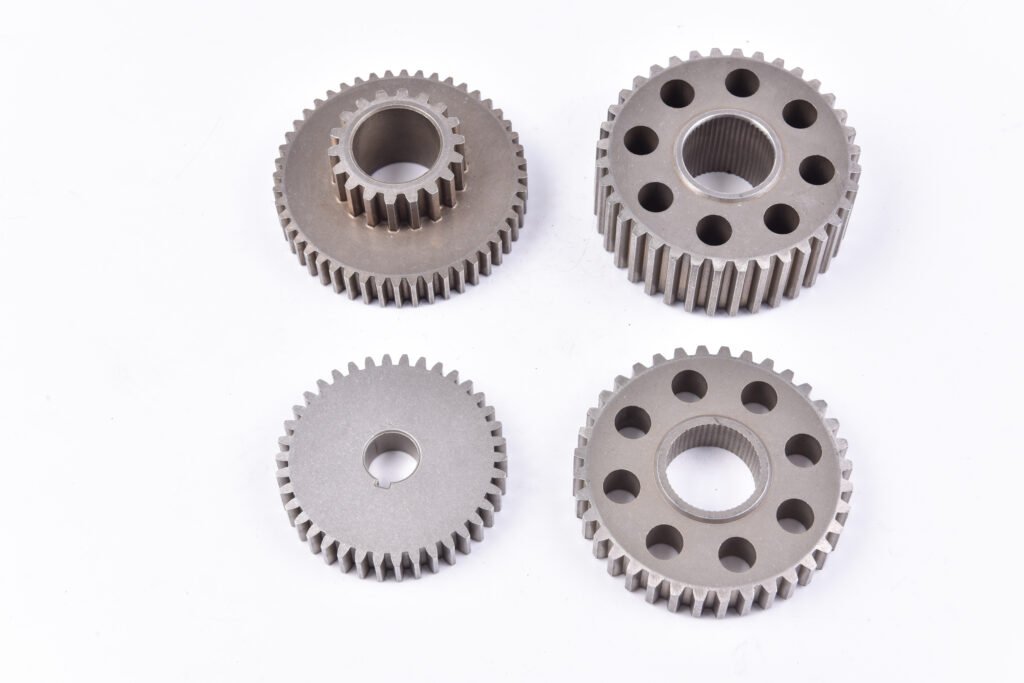
Iron-Based PM Parts: Materials, Properties, Applications & Manufacturing
A complete engineering guide to iron-based powder metallurgy (PM). Learn how iron, iron-carbon, copper-steels, and low-alloy PM materials perform in high-volume, precision structural applications—and how to source them efficiently from JH PM.
Quick Summary (Key Engineering Data)
- Material Coverage: Pure Fe, Fe-C, Fe-Cu-C, Fe-Ni-Cu-Mo (MPIF Standard 35 compliant), Stainless Steel PM, and High-Alloy PM steels.
- Mechanical Envelope: Densities from 6.4 to 7.4 g/cm³; Tensile strengths up to 850+ MPa; Apparent hardness up to HRC 60 (case-hardened).
- Primary Applications: Automotive timing gears, oil pump rotors, self-lubricating bearings, power tool gearboxes, sprockets, and hydraulic components.
- Manufacturing Capabilities (JH PM): 19 PM compaction presses (6–1,000 tons), 2 continuous sintering lines, 3 ZEISS CMMs, 25-day tooling lead time, 35-day T0 trial samples.
What Is Iron-Based PM?
Iron-based powder metallurgy (iron-based PM) is a precision manufacturing branch that converts elemental iron powders and custom master alloys into solid, complex metallic components. Instead of melting metal down or cutting away chips from bar stock, iron-based PM utilizes mechanical pressure to compact powders inside precision dies, followed by thermal bonding (sintering) at temperatures below the primary melting point (typically 1,120 °C to 1,180 °C).
The flexibility of iron-based PM stems from the sheer diversity of alloy systems available:
- Pure Iron Powders: High compressibility and excellent soft-magnetic behavior; ideal for electrical relays and magnetic cores.
- Iron-Carbon Systems: Formed by blending elemental iron with natural graphite; provides tuneable strength and response to heat treatment.
- Pre-Alloyed & Diffusion-Alloyed Powders: Iron atomized with Nickel (Ni), Copper (Cu), and Molybdenum (Mo); offers uniform microstructures and exceptional fatigue resistance.
- Low-Alloy PM Steels: Designed for heavy structural duty (e.g., MPIF 35 FC-0208, FN-0208, FL-4405) with high hardenability.
- Stainless Steel PM: Austenitic (300 series) and Martensitic (400 series) formulations engineered for severe chemical or marine environments.
Iron-Based PM Materials Family
Selecting the correct material family is critical to balancing mechanical performance against piece-part cost. The table below details standard iron-based powder metallurgy formulations:
| Material Family | Typical Composition / Standard Grade | Typical Properties | Primary Applications |
|---|---|---|---|
| Pure Iron | Pure Fe (>99% Fe) / MPIF F-0000 | High compressibility, soft magnetic properties, high ductility, lower hardness | Electromagnetic armatures, sensor cores, magnetic pole pieces |
| Iron-Carbon (Fe-C) | Fe + 0.3–0.8% C / MPIF F-0008 | Balanced strength, good wear resistance, heat-treatable | Simple structural levers, low-load bushings, brackets |
| Iron-Copper-Carbon (Fe-Cu-C) | Fe + 1.5–3.0% Cu + 0.5–0.8% C / MPIF FC-0208 | Enhanced yield strength, excellent dimensional stability, good machinability | Gears, automotive oil pump rotors, sprockets, power tool components |
| Nickel-Steel PM (Fe-Ni-C) | Fe + 1.0–4.0% Ni + C / MPIF FN-0208 | High impact energy, high tensile strength, superior fatigue life | High-load transmission parts, connecting rods, heavy-duty cams |
| Diffusion / Pre-Alloyed Steels | Fe-Ni-Cu-Mo / MPIF FL-4405, FD-0405 | Maximum fatigue resistance, deep hardenability, heat-treatable up to HRC 60 | Automotive synchronizer rings, clutch hubs, planet carriers |
| Stainless Steel PM | 316L, 304L, 410L, 17-4PH PM | Corrosion resistance, cleanroom compatibility, moderate to high strength | Medical instruments, marine hardware, fluid control valves |
| High-Alloy Iron-Based | Tool Steel PM, High-Cr/Mo compositions | Extreme micro-hardness, severe abrasion resistance, elevated temperature stability | Valve seat inserts, wear plates, heavy industrial dies |
Properties of Iron-Based PM Parts
Unlike wrought steel components whose properties depend almost entirely on chemistry and rolling history, iron-based PM properties are a function of both chemical composition and structural density.
Density (6.4 – 7.4 g/cm³)
Density dictates almost every physical attribute in PM. Lower density (6.4–6.6 g/cm³) increases oil retention for bushings, while higher density (7.0–7.4 g/cm³) maximizes tensile strength and fatigue life.
Tensile & Yield Strength
Ranges from 200 MPa in pure iron to over 850 MPa in heat-treated pre-alloyed PM steel (e.g., FL-4405). Tensile strength increases exponentially as density approaches theoretical wrought steel limits (7.87 g/cm³).
Apparent Hardness
Measured via HRB or HRC scales. As-sintered parts typically register HRB 50–85. Case-hardened or sinter-hardened parts routinely reach HRC 55–60 on the surface, resisting sliding wear.
Wear Resistance
The combination of microstructural carbides, deliberate surface porosity (for holding lubricant films), and heat treatment gives iron-based PM parts exceptional wear characteristics in unlubricated or boundary-lubricated contacts.
Machinability & Surface Finish
PM near-net shapes eliminate most rough turning. When tapping or turning keyways is required, additives like manganese sulfide (MnS) or resin impregnation prevent tool chatter and improve chip control.
Dimensional Stability
Precision tooling produces tight lot-to-lot consistency. Linear dimensional tolerances of ±0.05 mm are routinely achieved as-sintered, with ±0.025 mm achievable through secondary sizing (re-pressing).
Iron-Based PM Parts: Common Applications
Iron-based powder metallurgy is the dominant choice across automotive, power tool, appliance, and general industrial sectors due to its ability to mold intricate geometry directly into the die.
Automotive Systems
Engine timing sprockets, oil pump gerotors, transmission synchronizer hub rings, ABS sensor rings, valve guides, and variable valve timing (VVT) rotors.
Power Tools & Hardware
Planetary gearboxes, bevel gears, armature drive gears, impact driver anvils, hammer drill selector cams, and outdoor power tool drives.
Industrial Pumps & Hydraulics
Gerotor pump elements, hydraulic valve end caps, wear plates, metering gear sets, and pneumatic actuator pistons.
Home Appliances & HVAC
Washing machine transmission gears, refrigerator compressor connecting rods, fan motor self-lubricating bearings, and door lock latch cams.
Electrical & Magnetic
Soft magnetic armatures, solenoid cores, pole pieces, ignition coils, and stepped magnetic housings requiring low coercivity.
Structural Hardware
Flanged self-lubricating bushings, mounting brackets, counterweights, pulley hubs, and multi-level stepped lock housings.
Why Use Iron-Based PM Instead of Machining?
For high-volume manufacturing, iron-based PM provides substantial cost, material, and geometric advantages over conventional bar-stock machining. However, production volume remains the key economic deciding factor.
| Factor | Iron-Based PM Parts | Conventional Steel Machining |
|---|---|---|
| Material Utilization | High (>95%) – Powder is compressed directly into die without chips. | Low (30–60%) – Significant material wasted as swarf/chips. |
| Production Rate | Fast (15–60 pcs/min) on automatic mechanical or hydraulic presses. | Moderate to Slow – Limited by spindle speed, tool changes, and index cycles. |
| Integrated Geometry | Excellent – Easily produces blind keyways, splines, dual gears, and flanged profiles in one press stroke. | Complex & Costly – Requires 5-axis milling, broaching, or EDM for non-round features. |
| Secondary Operations | Minimal – Most parts are ready after sintering and deburring. | High – Multiple setups required for turning, milling, and drilling. |
| Tooling Investment | Initial Tooling Required (hardened carbide dies and punches). | Low Initial Cost (standard CNC fixtures and cutting inserts). |
| Unit Cost at Volume | Substantially Lower for runs exceeding 2,000–10,000+ pieces. | Higher Unit Cost due to cumulative machining time and scrap loss. |
Engineering Insight: When to Pick PM vs. Machining
PM is ideal when your part geometry includes internal gears, blind splines, non-circular holes, or complex multi-level steps, and your annual volume exceeds 2,000 pieces. Conversely, low-volume prototypes (<500 pcs) or simple axisymmetric turned pins without keyways remain more economical via CNC lathe turning.
Iron-Based PM Manufacturing Process
Iron-based powder metallurgy relies on a tightly controlled six-step manufacturing process to guarantee density, dimensional stability, and metallurgical strength:
1. Powder Selection & Blending
Elemental iron powders are mixed with precise weight percentages of graphite, copper, nickel, lubricant (wax or metallic stearate), and machining aids.
2. Die Compaction
Mixed powder is fed into a precision tool cavity and compacted under 400–800 MPa of pressure on automatic presses to produce a cohesive “green” part.
3. Sintering
Green parts pass through a controlled-atmosphere furnace at 1,120–1,180 °C. Lubricants burn off, atom diffusion occurs, and solid metallurgical bonds form.
4. Secondary Operations / Sizing
If required, parts undergo sizing (re-pressing for tight ±0.025 mm tolerances), oil impregnation, steam treatment, or CNC tapping/milling.
5. Heat Treatment (Optional)
Parts are case-hardened, carburized, or sinter-hardened to raise surface hardness up to HRC 60 for severe wear applications.
6. Quality Inspection & Packing
Lot-based metallurgical and dimensional verification (density, crushing strength, CMM profile) prior to rust-preventative oiling and packing.
For more details on the complete manufacturing sequence, explore our dedicated guides on the Powder Metallurgy Sintering Process and overall PM Tolerances Capabilities.
Iron-Based PM Tolerances & Quality Control
Quality in iron-based PM parts is defined not just by dimensional boundaries, but by internal density distribution, microstructural cleanliness, and batch repeatability.
For precision iron-based PM components, dimensional requirements should be established together with material, density, hardness, and functional requirements. For deeper quality inspection protocols, refer to our comprehensive guide on Powder Metallurgy Quality Control.
| Inspection Parameter | Standard Test Method | Target Control Range / Benchmark |
|---|---|---|
| Density Verification | ASTM B962 (Archimedes Method) | 6.40 – 7.40 g/cm³ (Lot tolerance ±0.05 g/cm³) |
| Dimensional Integrity | ZEISS 3D CMM / Optical Comparator | Radial: ±0.03 to ±0.05 mm (As-sintered); ±0.025 mm (Sized) |
| Apparent Hardness | ASTM E18 (Rockwell HRB / HRC) | HRB 60–90 (As-sintered); HRC 55–62 (Heat treated) |
| Radial Crushing Strength | MPIF Standard 35 Test Methods | Verifies structural integrity on bushings & gears |
| Microstructure Analysis | Metallographic Cross-Sectioning | Verifies pearlite/ferrite ratio, pore morphology, and carbon depth |
| Lot Traceability | ISO / IATF Traceability System | 100% full raw material, furnace run, and press batch logging |
Why Source Iron-Based PM Parts from JH PM?
When sourcing iron-based PM components from China, engineering capability, press force flexibility, and quality control infrastructure dictate project success. **JH PM (Ningbo Jiehuang Chiyang Electronic Tech)** brings decades of specialized powder metallurgy experience to your supply chain.
19 PM Compaction Presses
Press capacity ranges from 6 tons up to 1,000 tons, enabling the production of tiny micro-gears as well as large, multi-level structural plates up to 150 mm in diameter.
Continuous Sintering Furnaces
Equipped with state-of-the-art continuous sintering furnaces featuring automated temperature zone monitoring and protective nitrogen-hydrogen atmospheres for stable density.
In-House ZEISS CMM Metrology
Quality lab houses 3 ZEISS 3D Coordinate Measuring Machines (CMM), optical projectors, gear profile testers, and metallographic prep equipment for fast lot sign-offs.
Rapid DFM & Tooling Lead Times
Tooling design and manufacture completed in 25 days. Initial T0 trial samples ready within 35 days, backed by detailed DFM analysis and MPIF grade guidance.
Flexible MOQ Structure
Minimum Order Quantity (MOQ) starts at 2,000 pcs, supporting pilot production phases through to million-piece annual automotive programs.
IATF 16949 Certified Quality
Operates under rigorous IATF 16949 automotive quality management standards, ensuring 100% material lot traceability, PPAP Level 3 documentation, and low PPM rates.
Frequently Asked Questions
What is iron-based PM?
Iron-based PM (powder metallurgy) refers to precision metal components manufactured by compacting iron, iron-carbon, or alloyed iron powders into dies and sintering them below their melting point. It enables net-shape production with minimal material waste.
What materials are used in iron-based PM?
Common material systems include pure iron (magnetic components), Fe-C (structural parts), Fe-Cu-C (gears, bushings), Fe-Ni-Cu-Mo (high-strength automotive parts per MPIF 35 FL-4405), stainless steel PM (corrosion resistance), and alloyed tool steels for extreme wear.
What are iron-based PM parts used for?
Iron-based PM parts are used in automotive transmission components, engine timing gears, oil pump rotors, self-lubricating bushings, power tool planetary gears, lawn equipment sprockets, and industrial hydraulic valve bodies.
Are iron-based PM parts strong?
Yes. Tensile strength ranges from 200 MPa for soft magnetic pure iron up to over 850 MPa for heat-treated low-alloy steel components (e.g., FN-0208 or FL-4405). Density and heat treatment directly dictate ultimate strength.
Can iron-based PM parts be machined?
Yes, though secondary machining (turning, drilling, tapping) is usually minimized due to PM’s near-net-shape capability. Additives like MnS or resin impregnation improve chip breaking and tool life during secondary operations.
Is iron-based PM suitable for automotive parts?
Extremely suitable. Automotive applications account for over 70% of global iron-based PM output due to strict dimensional repeatability, high fatigue strength, integrated keyways/gears, and favorable cost structures in mass production.
What is the difference between iron-based PM and steel machining?
Iron-based PM molds powdered metal into near-net shape with >95% material utilization and low unit cost at volume. Machining cuts away solid stock, resulting in higher material scrap and longer cycle times for complex geometries.
What production volume is suitable for iron-based PM?
Because PM requires dedicated tooling, production volumes of 2,000+ pieces per batch or annual volumes of 10,000 to 1,000,000+ pieces deliver the optimal total cost balance.
Ready to Optimize Your Iron-Based PM Component Design?
Send us your 2D drawings (PDF) or 3D STEP models along with your target volume, load requirements, and material preferences. JH PM’s engineering team will provide a formal DFM feedback report and a competitive quote within 48 hours.