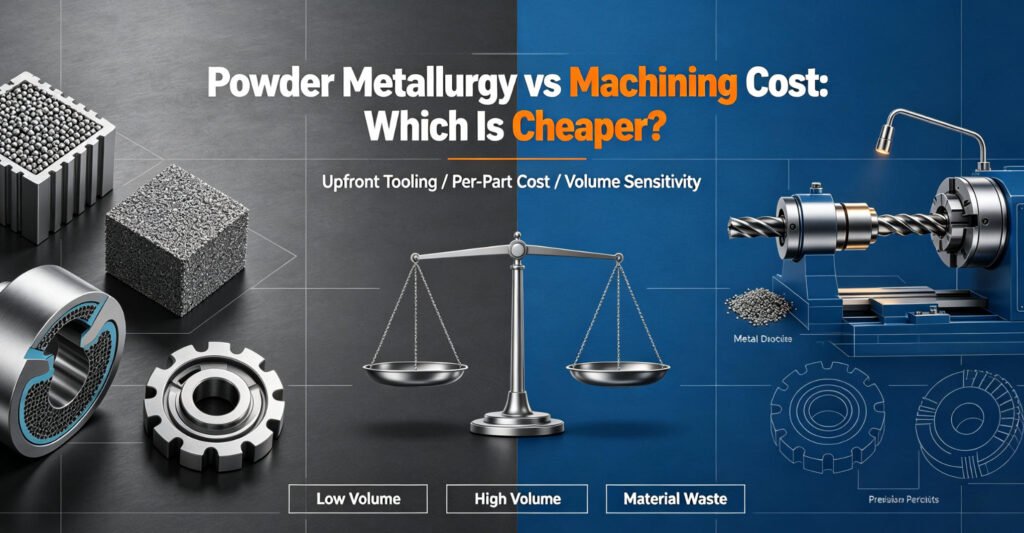
Powder Metallurgy vs Machining Cost: Which Is Cheaper?
Direct Answer: For production runs above roughly 2,000–5,000 pieces, powder metallurgy is usually cheaper than CNC machining. PM recovers 95%+ of raw material into the finished part and compacts each piece in 1–3 seconds, while CNC machining turns 40–70% of stock into chips and is limited by spindle time. Below about 2,000 pieces, machining wins because it needs no die-set tooling. The break-even is where amortized PM tooling cost dips under the lifetime machining-scrap and cycle-time cost.
The “PM vs machining” question is really a make-vs-buy decision that hinges on three numbers: your annual volume, how much raw material your geometry wastes, and how many seconds of machine time each part consumes. Answer those three and the cheaper route usually reveals itself.
The 4 Cost Levers That Decide the Winner
1. Material Utilization
This is the single largest structural advantage of powder metallurgy. A machined part is cut out of bar or billet, so everything that is not the finished shape falls away as scrap — typically 40–70% of the stock. Powder metallurgy compacts metal powder into a near-net shape, so 95% or more of what goes in comes out as a finished part. On a stainless or alloy part, that scrap difference is real money.
2. Tooling Amortization
CNC machining needs only fixtures, so its upfront cost is near zero and it is unbeatable for one-offs. PM needs a die set — a fixed investment that only pays off when spread across thousands of parts. The larger the lifetime volume, the smaller the per-part tooling cost becomes.
3. Machine Time and Cycle Rate
A CNC mill removes material one pass at a time, so cost scales directly with seconds of spindle time. A PM press compacts an entire part in a single stroke of 1–3 seconds, then sinters a full furnace load at once. At volume, the per-part processing cost of PM collapses.
3. Secondary Operations
Neither process is always one-step. PM parts may need sizing, tapping, or a bore reamed to spec; machined parts may need deburring, plating, or heat treatment. The honest comparison adds both sides’ secondary steps to the total landed cost, not just the headline process.
Powder Metallurgy vs CNC Machining: Cost Comparison
| Cost Variable | Powder Metallurgy (PM) | CNC Machining |
|---|---|---|
| Material Utilization | 95–98% (near-net shape) | 30–60% (chips) |
| Upfront Tooling | Die set (fixed cost) | Fixtures only (near zero) |
| Per-Part Cycle | 1–3 s press stroke | Minutes of spindle time |
| As-Produced Tolerance | ±0.05 mm (as-sintered) | ±0.01 mm or better |
| Best Volume | >2,000–5,000 pcs | <2,000 pcs / prototypes |
| Unit Cost at High Volume | Lowest | High (spindle-limited) |
Worked Example: A 50,000-Piece Steel Flange
Assume a small steel flange, 50,000 pieces per year, with a die set costing a notional $8,000 and a five-year program life of 250,000 pieces total.
That same flange, machined from solid bar, might lose roughly 50% of its stock weight to chips and consume several minutes of spindle time per piece. At a mid-range stock and machine rate, machining unit cost runs several times the PM cost — driven not by tooling but by scrap metal and cycle time.
Figures are illustrative mid-range values used only to show the mechanism. Your actual number depends on part weight, alloy, tolerance, and regional machine and tooling rates — send a drawing to JH PM for a real DFM-quoted figure.When Machining Still Wins
Powder metallurgy is not a universal answer. Machining remains the better route when:
- Volume is low — prototypes, one-offs, or runs under roughly 2,000 pieces, where a die set cannot be justified.
- Geometry resists pressing — deep undercuts, side features, thin tall walls, or true three-axis contours that a straight compaction stroke cannot form.
- Tolerances are extreme — features needing ±0.01 mm or better, where only machining can hold the spec.
- Parts are very large — components beyond practical press tonnage or furnace capacity.
Engineering Framework: Picking the Lower-Cost Route
- Estimate Annual Volume: pin down realistic annual and lifetime quantities; below ~2,000 pieces machining leads, above ~5,000 PM leads.
- Assess Geometry: confirm the part can be compacted in one press direction; undercuts and side holes push toward CNC.
- Set Tolerance Needs: check whether as-sintered ±0.05 mm or sized ±0.025 mm meets your drawing, or whether you need CNC-grade precision.
- Compare Material Utilization: estimate scrap — PM recovers 95%+ while machining wastes 40–70% of stock.
- Model Tooling Amortization: spread the PM die-set cost across lifetime volume and weigh it against total machining spindle time over the same run.
- Pick the Lower Total Cost: choose the route with the lower total landed cost after adding secondary operations, inspection, and finishing on both sides.
Which Is Cheaper? A Decision Summary
The short answer: machining wins for few parts; powder metallurgy wins for many parts of the same design. If your geometry is pressable and your annual volume is in the thousands, PM almost always undercuts machining on a total-cost basis — and it does so while holding the part in a single stroke instead of minutes of cutting.
Frequently Asked Questions
Is powder metallurgy cheaper than machining?
Yes, at production volumes above roughly 2,000 to 5,000 pieces. Powder metallurgy recovers 95% or more of raw material and compacts each part in 1-3 seconds, while CNC machining wastes 40-70% of stock as chips and is limited by spindle time.
At what volume does powder metallurgy beat CNC machining on cost?
The break-even is typically around 2,000 to 5,000 pieces per year. Below that, CNC machining is cheaper because it needs no die-set tooling; above it, tooling amortization spreads thin and near-net-shape compaction wins.
Why does CNC machining waste so much material?
CNC machining cuts finished parts out of solid bar or billet, turning material into chips. Depending on geometry, only 30-60% of the stock becomes a finished part, and the scrap value of mixed-alloy chips is far below raw stock cost.
Is CNC machining still better for prototypes?
Yes. For 1-100 piece prototypes, CNC machining is usually faster and cheaper because it needs no die set. Powder metallurgy tooling only pays off once volume justifies the upfront die investment.
Do PM parts need machining at all?
Most as-sintered PM parts need no machining, but tight features such as cross-threads, undercuts, or precision bores may require secondary CNC turning, tapping, or sizing to reach the final specification.
How do tolerances compare between PM and CNC machining?
CNC machining can hold tighter tolerances, often +/-0.01 mm or better. PM parts hold +/-0.05 mm as-sintered and +/-0.025 mm with a sizing step, which is sufficient for most structural components.
Which processes does powder metallurgy replace?
Powder metallurgy commonly replaces CNC machining, stamping plus machining, investment casting, and multi-piece assemblies by consolidating several machined parts into one near-net-shape PM component.
When does machining beat powder metallurgy on cost?
Machining beats PM at low volumes, for very large or thin-walled parts that are hard to press, for geometries that need deep undercuts or true three-axis features, and for one-off or low-repeatability parts.
PM or Machining? Get a Real DFM Answer
Send your 2D/3D drawing, material, and target annual volume to JH PM. We compare the powder metallurgy route against machining on total landed cost and return a DFM assessment with a formal quotation within 48 hours.
Compare My Part in 48 HoursReferences
- MPIF Standard 35 — Materials Standards for PM Structural Parts. Metal Powder Industries Federation.
- MPIF — Intro to PM: Why Powder Metallurgy. Metal Powder Industries Federation.
- MPIF — Intro to PM: Economics / Cost Considerations. Metal Powder Industries Federation.