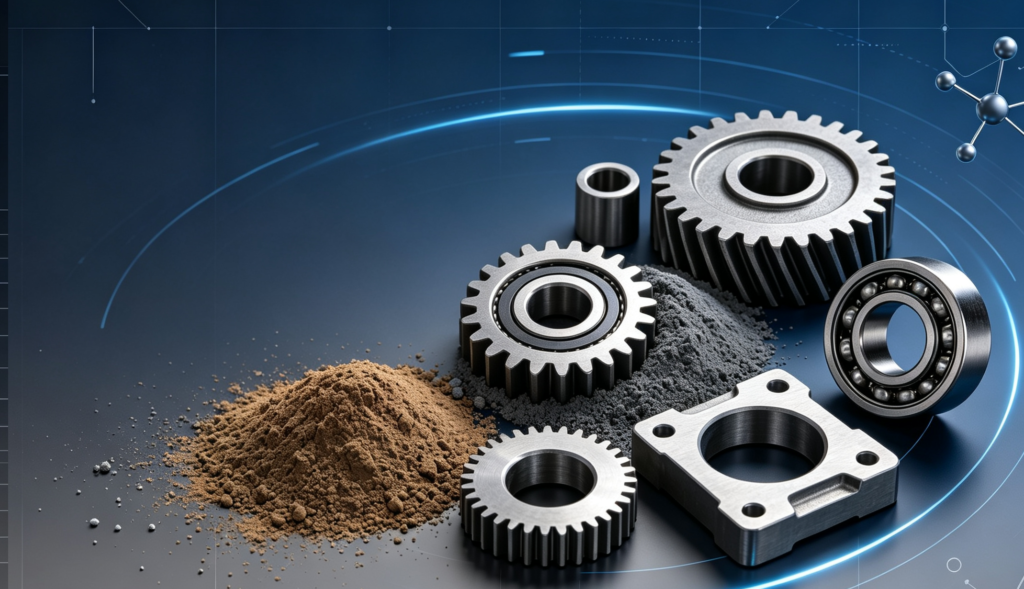
Powder Metallurgy Material Properties: A Complete Engineering Guide
In wrought steel, properties are set by the chemistry of the melt and the rolling that follows. In powder metallurgy, two parts from the same nominal blend can behave very differently – because density, pore shape, sintering temperature and heat treatment are all process variables, not constants. This is the guide to reading those variables.
Key takeaways
- Density is the dominant variable – every structural property follows it.
- Porosity is a design feature in bearings and filters, a defect in fatigue parts.
- High-temperature sintering rounds pore edges and lifts fatigue life without adding weight.
- Sinter hardening reaches 60 HRC surface hardness in the same furnace pass.
The four properties that decide a PM part
1. Sintered density and porosity
Density is the single dominant predictor of a structural PM part’s performance. On the shop floor it is tracked with four numbers, aligned to ASTM B962:
- Green density – the compact’s density after ejection from the die but before sintering, typically 6.4 to 7.1 g/cm³.
- Sintered density – the final mass-to-volume ratio set by atomic diffusion in the furnace.
- Theoretical density – the alloy’s 100% solid density, with no voids.
- Relative density – the actual sintered density as a percentage of theoretical.
Density is measured by Archimedes displacement, with the pores sealed by oil before immersion so the shape of the voids does not skew the reading.
2. Tensile and yield strength
Tensile strength in PM does not rise linearly with density – as porosity falls, the load-bearing cross-section grows and the stress concentration at each pore edge drops, so strength climbs faster than the density gain would suggest. An iron-copper grade such as MPIF FC-0208 delivers yield strength around 250 to 450 MPa; a sinter-hardened grade such as MPIF FLC-4608 with nickel, molybdenum and manganese reaches tensile strength above 850 to 1,100 MPa after rapid furnace cooling.
3. Fatigue strength and pore morphology
Under cyclic load, pores act as starting points for micro-cracks. What matters is not only average density but pore shape and roundness. High-temperature sintering at 1200 to 1250 °C drives enough diffusion to round the sharp pore edges, lifting cyclic fatigue limits by up to 30% versus a standard 1120 °C belt cycle – with no change in part weight.
4. Hardness, apparent and micro
PM hardness needs two measurements kept apart:
- Apparent hardness – read across both the solid matrix and the pores, on the Rockwell B or C scale. This is the bulk resistance to indentation.
- Micro-hardness – read inside individual grains on the Vickers or Knoop scale. This is the local wear resistance that matters at a contact surface.
Sinter hardening builds a rapid-cooling zone straight into the furnace, quenching a hardenable powder alloy into martensite without a separate oil-quench step.
Density vs. mechanical property matrix
A working reference for what each density band buys you, aligned to MPIF Standard 35 guidance.
| Sintered density | Relative density | Tensile strength | Typical use | Functional edge |
|---|---|---|---|---|
| 5.8 – 6.4 g/cm³ | 74 – 82% | 120 – 250 MPa | Self-lubricating sleeve bearings, bronze bushings | 18 – 22% oil held in interconnected pores |
| 6.5 – 6.9 g/cm³ | 83 – 88% | 250 – 450 MPa | Light brackets, sensor rings, cams | Best balance of cost and moderate strength |
| 7.0 – 7.3 g/cm³ | 89 – 93% | 500 – 850 MPa | Timing gears, oil-pump rotors, sprockets | High fatigue life and dimensional accuracy |
| 7.4 – 7.6+ g/cm³ | 94 – 97%+ | 850 – 1,200+ MPa | Heavy-duty transmission gears, connecting rods | Approaches wrought steel strength and fatigue |
Powder metallurgy material families
1. Iron and carbon steel (F-0000, FC-0208, FN-0205)
Ferrous alloys make up roughly 80% of structural PM output. Elemental copper at 1.5-3.0% strengthens through a liquid phase during sintering; pre-alloyed nickel and molybdenum add hardenability for power-transmission parts.
2. Stainless steel (316L, 17-4 PH)
Austenitic 316L and precipitation-hardening 17-4 PH resist atmospheric and chemical corrosion. Sintered in vacuum or high-purity hydrogen, they turn up in medical instruments, food-processing machinery and valve bodies.
3. Copper and bronze (SAE 841)
Bronze alloys – copper with about 10% tin – are tuned for a low coefficient of friction and long wear life in rotating sleeves. The interconnected pore network is the reservoir that keeps them lubricated without an external supply.
4. Soft magnetic composites (SMC)
Iron particles coated with an insulating layer compact into three-dimensional magnetic cores. SMC cuts eddy-current loss at high frequency, which is why it appears in high-efficiency electric motors and solenoids.
Powder metallurgy vs. wrought steel properties
| Property | Press-and-sinter PM | Wrought steel |
|---|---|---|
| Material utilization | 95 – 98% (near-net shape) | 30 – 60% (machining scrap) |
| Density flexibility | Engineered from 5.8 to 7.5 g/cm³ | Fixed ~7.85 g/cm³ |
| Yield strength | 200 to 1,100 MPa | 300 to 1,400 MPa |
| Self-lubrication | Yes – oil held in pores | No – needs external lubrication |
| Tolerance | ±0.05 mm as-sintered, ±0.025 mm sized | Needs a full machining pass |
| High-volume unit cost | Low – 1 to 3 seconds per part | Higher – CNC cycle-time bound |
PM trades a little unnotched impact toughness and elongation for near-net shape and material economy. If the part is loaded mostly in tension or compression rather than impact, the gap closes quickly at high density.
How PM material properties are process-engineered
- Powder characterization and blending. Select the base iron, bronze or stainless powder and blend it with a solid lubricant plus the alloying graphite or copper the grade calls for.
- Die compaction. Press the blend in hardened tool-steel or carbide dies at 400 to 800 MPa to hit the target green density.
- High-temperature sintering. Run green compacts through continuous belt furnaces at 1120 to 1250 °C in a controlled atmosphere to form solid-state bonds.
- Secondary sizing and densification. Repress sintered parts in sizing dies to collapse surface voids, lifting local density and tightening dimensions to ±0.025 mm.
- Heat treatment and oil impregnation. Apply quench hardening, sinter hardening or vacuum oil impregnation depending on whether the part needs wear resistance or self-lubrication.
- Property verification. Confirm Archimedes density, test macro- and micro-hardness, and run a CMM audit before the batch ships.
JH PM manufacturing and metrology capabilities
JH PM runs the press-and-sinter line under one roof at the production site in China, so the density, sintering and inspection steps answer to the same plan.
In-house equipment and terms
- Compaction: 19 automatic presses from about 6 to 1,000 tons.
- Sintering: 2 continuous furnaces with automated atmosphere control.
- Inspection: 3 Zeiss CMMs, density balances, gear-profile and micro-hardness testers, under IATF 16949:2016 and ISO 9001:2015 traceability.
- Terms: MOQ from 2,000 pieces; tooling in about 25 days; T0 first-article samples within 35 days; DFM review within 48 hours.
FAQ – Powder Metallurgy Material Properties
What are the main powder metallurgy material properties?
The main properties are density, porosity percentage, tensile and yield strength, hardness, fatigue strength, ductility, impact toughness, wear resistance, thermal and electrical conductivity, and magnetic permeability. Density is the single biggest lever – every structural property follows it.
Are powder metallurgy parts as strong as forged or wrought parts?
High-density PM parts (7.2-7.5 g/cm³) made from alloy steels and sinter-hardened can match or exceed standard wrought structural steels in tensile strength and hardness. Unnotched impact toughness and elongation stay lower because of residual pores, so the comparison depends on the loading mode.
How does porosity affect powder metallurgy properties?
Porosity lowers tensile strength, fatigue life, ductility and conductivity by acting as internal stress raisers. Controlled interconnected porosity is deliberately engineered for self-lubricating bearings, which hold 18-22% oil by volume, and for porous metal filters.
Does higher density improve PM material properties?
Yes. Higher density increases the load-bearing cross-section and reduces pore-edge stress concentration. Tensile strength, yield strength and fatigue resistance scale sharply – near exponentially – with sintered density.
What is the typical density of powder metallurgy parts?
Structural steel PM parts typically run 6.8 to 7.4 g/cm³, about 86% to 94% of theoretical. Self-lubricating bronze bearings run lower – 5.8 to 6.6 g/cm³ – to preserve the pore volume that stores oil.
Are PM materials suitable for fatigue-critical applications?
Yes, provided density is high (above 7.2 g/cm³) and sintering rounds the pore edges. High-temperature sintering around 1250 degrees C and surface rolling are the standard ways to lift dynamic bending fatigue life in automotive gears.
Can PM parts be heat treated?
Yes. PM steel parts take carburizing, carbonitriding, induction hardening and sinter hardening – rapid furnace cooling – to reach surface hardness up to 60 HRC.
Which PM material is the strongest?
Sinter-hardened steel grades such as MPIF FLC-4608 and diffusion-alloyed steels such as MPIF FD-0208 reach tensile strengths above 850 to 1,100 MPa after secondary heat treatment.
What factors affect powder metallurgy material properties?
The starting powder, compaction pressure, green-density distribution, sintering temperature and atmosphere, pore morphology, cooling rate and secondary operations such as repressing or sizing. Change any one and the same nominal alloy behaves differently.
How do you test powder metallurgy material properties?
Density follows ASTM B962 by the Archimedes method, tensile properties follow ISO 6892-1, hardness uses the Rockwell scales, and microstructure is read metallographically under an optical or SEM microscope – all aligned to MPIF Standard 35.
Need a Material Spec, Not a Guess?
Send the drawing, the loading mode and the annual volume. Within 48 hours you get a written DFM note that ties density, grade and heat treatment to your strength and fatigue targets – and prices the part. IATF 16949:2016, 19 presses, 2 continuous sintering furnaces, 3 Zeiss CMMs.