Powder Metallurgy: Process, Materials & When to Choose PM
Direct Answer: Powder metallurgy (PM) is a metal-forming process in which fine metal powder is compacted in a rigid die under high pressure, then heated in a controlled-atmosphere furnace below the metal’s melting point so the particles bond into a near-net-shape part. The process is fast (1–3 second press cycle), material-efficient (>95% utilization), and economical at annual volumes above roughly 2,000 pieces. It is the right call when the part can be pressed in one direction, the design tolerates as-sintered tolerance of ±0.05 mm, and the project volume justifies die-set tooling.
This page is the starting point for evaluating whether PM is the right process for your part. The detailed guides on cost, material properties, quality control, applications, and PM-vs-machining live as separate pages — linked from the cluster index below.
What Powder Metallurgy Is
Powder metallurgy is one of the few near-net-shape metal-forming processes: the part emerges from the press close to its final geometry, rather than being cut out of a solid block. The process is built around three things — metal powder as the raw material, a rigid die and press as the forming tool, and a controlled-atmosphere furnace for the thermal bond. Tool steel dies give PM its long production runs; the furnace gives the part its mechanical properties.
What the process is not: it is not metal 3D printing (which fuses powder point by point) and it is not MIM (which mixes much finer powder with a binder and injects it into a mold). MIM is a sibling process, not a synonym — see the FAQ below.
Materials, Tolerances & Dimensional Behavior
PM works with most common engineering metals as long as they can be atomized into powder. The most-used families are:
- Iron and low-alloy steel — the workhorse family, including FC-0208 (iron-copper) and FN-0205 (iron-nickel) per MPIF Standard 35.
- Stainless steel — 316L and 17-4 PH for corrosion and strength.
- Copper and bronze — high electrical and thermal conductivity grades.
- Aluminum — used in selected grades, more common in die casting than in PM.
On dimensions, the standard as-sintered tolerance is roughly ±0.05 mm; a sizing step can bring critical features to ±0.025 mm. Linear sintering shrinkage runs 0.2–0.5%, so the tooling is pre-scaled to compensate.
The full material, density, and mechanical-property picture lives in the dedicated material guide:
When to Choose PM (and When Not To)
The decision is rarely about whether PM is the “best” process — it is about whether it is the most economical fit for your specific part, volume, and tolerance. Run these five checks before talking to a PM supplier.
- Estimate annual volume: identify the realistic annual and lifetime quantity. PM tooling is a fixed cost; below 2,000 pieces the math usually fails, above 5,000 it usually wins.
- Check pressability: confirm the part can be compacted in a single press direction. Undercuts, side holes, thin tall walls, or multi-level features push the answer toward CNC, casting, or MIM.
- Set tolerances honestly: as-sintered plus or minus 0.05 mm covers most structural parts. If your drawing needs plus or minus 0.01 mm on several features, budget for secondary machining or pick a different process.
- Compare material economics: PM recovers more than 95% of stock; machining wastes 40–70% as chips. On stainless, alloy steel, or copper parts, the scrap saving alone can decide the process.
- Request a DFM review: send your drawing, material spec, target annual volume, and critical tolerances to a PM supplier. A 48-hour DFM review will tell you whether PM is feasible and what the realistic unit cost is for your part.
PM Compared With Neighboring Processes
PM is one of several near-net-shape and machining-based options a buyer has for a precision metal part. The honest comparison depends on the part, but the table below is a defensible starting point.
| Process | Best fit | Trade-off vs PM |
|---|---|---|
| PM (press & sinter) | High volume, simple-to-moderate geometry, as-sintered tolerances | Lower tooling cost than forging; faster cycle than machining |
| MIM | Small, complex parts needing injection-mold-like features | Higher per-part cost; smaller parts; tighter tolerances possible |
| CNC machining | Low volume, prototypes, tight tolerances, complex 3D features | Higher material waste; longer cycle; no tooling amortization to win at volume |
| Investment casting | Medium volume, complex shapes, larger parts | Slower cycle; less precise dimensions; more post-machining |
| Stamping | Thin-walled sheet-metal parts at very high volume | Limited to 2.5D geometry; not a substitute for PM on 3D structural parts |
The full economic head-to-head against CNC lives on the dedicated comparison page:
How JH PM Runs Powder Metallurgy Production
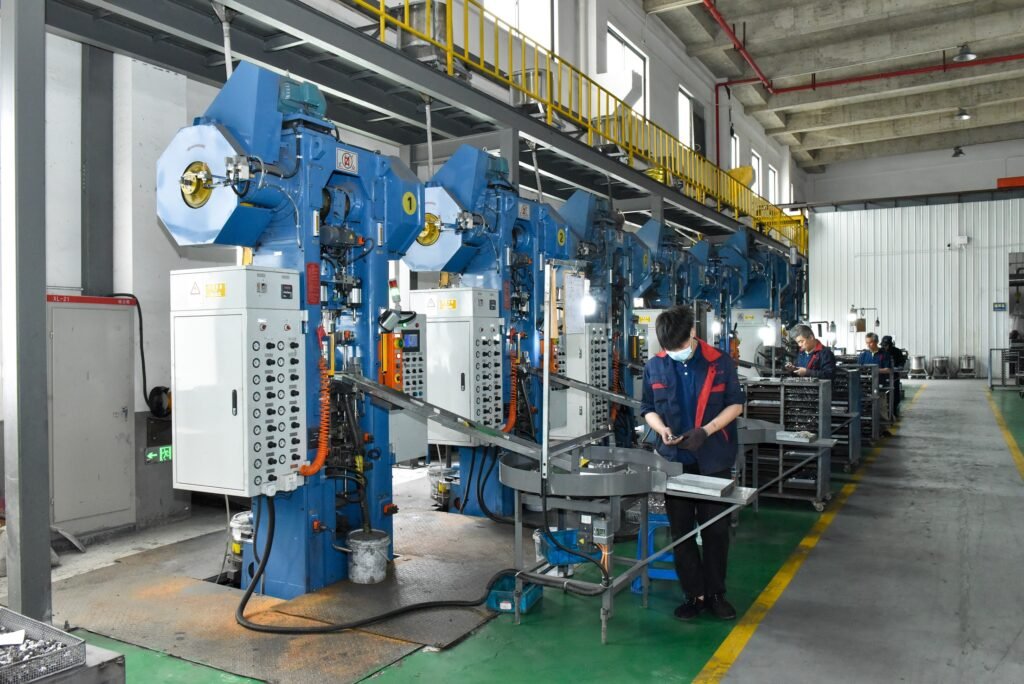
JH PM is a custom PM manufacturer based in Shaoxing, China, with a press line from 6 to 1,000 tons and continuous sintering capacity. The standard commercial envelope:
- Pressing: 19 PM presses (6–1,000 t)
- Sintering: 2 continuous sintering furnaces, controlled atmosphere
- Metrology: 3 Zeiss CMMs, Archimedes density balance, MPIF-aligned methods
- MOQ: from 2,000 pieces
- Lead times: 25 working days for tooling; 35 working days for T0 first article
- DFM response: within 48 hours
- Certifications: IATF 16949:2016, ISO 9001:2015; PPAP and MPIF-aligned practice
For the company’s specific tolerance, density, and material capabilities, see the PM tolerance capability page.
Frequently Asked Questions
What is powder metallurgy?
Powder metallurgy (PM) is a metal-forming process in which fine metal powder is compacted in a rigid die under high pressure, then heated (sintered) in a controlled-atmosphere furnace below the metal’s melting point to bond the particles into a near-net-shape part. Material utilization is above 95% and press cycle times are 1 to 3 seconds per stroke.
Is powder metallurgy the same as sintering?
Sintering is the heating step inside the powder metallurgy process, not a separate process. Press-and-sinter PM compacts the powder first, then sinters it; the two stages together produce a finished part.
What materials can powder metallurgy use?
PM commonly uses iron and low-alloy steel, stainless steels (316L, 17-4 PH), copper and bronze, aluminum in some applications, and select titanium and high-alloy grades. Material choice is set by MPIF designations such as FC-0208 (iron-copper) and FN-0205 (iron-nickel).
What tolerances can powder metallurgy hold?
As-sintered parts typically hold plus or minus 0.05 mm. A sizing or coining step can tighten critical features to plus or minus 0.025 mm. For tighter tolerances than that, secondary machining is usually required.
When should I choose powder metallurgy?
PM is usually the right call when the part can be pressed in one direction, the annual volume is above roughly 2,000 pieces, raw material is expensive (so the 95%+ utilization matters), and the design does not need deep undercuts, side holes, or sub plus or minus 0.01 mm tolerances.
When should I not use powder metallurgy?
PM is usually the wrong call for very low volumes (under 1-2,000 pieces where the die cost cannot be amortized), very large parts that exceed press tonnage or furnace capacity, geometries needing deep undercuts or true three-axis features, and applications needing plus or minus 0.01 mm or better tolerances across many features.
What is the difference between powder metallurgy and metal injection molding?
Both use metal powder and sintering, but PM compacts coarser powder (typically 50-150 micrometers) in a rigid die, while MIM mixes much finer powder (under 22 micrometers) with a binder, injects it into a mold like plastic, then debinds and sinters. MIM can produce smaller and more complex features; PM is generally cheaper for larger, simpler parts at high volume.
Is powder metallurgy cheaper than CNC machining?
At production volumes above roughly 2,000 to 5,000 pieces, yes – because PM recovers over 95% of raw material and cycles in 1-3 seconds per part, while CNC machining wastes 40-70% of stock as chips and is limited by spindle time. Below that volume, CNC is usually cheaper because it needs no die-set tooling.
The PM Topic Cluster: Where to Go Next
Use the pages below to go deeper on whichever question you actually need answered. Each one is written for the engineer or buyer who already knows the basics of PM.
Evaluating PM for Your Part?
Send your 2D/3D drawing, material spec, target annual volume, and critical tolerances to JH PM. The engineering team returns a DFM assessment and a formal quotation within 48 hours.
Request a 48-Hour DFM ReviewReferences
- MPIF Standard 35 — Materials Standards for PM Structural Parts. Metal Powder Industries Federation.
- MPIF — Intro to PM: Why Powder Metallurgy. Metal Powder Industries Federation.
- ASM Handbook Volume 7: Powder Metallurgy. ASM International.