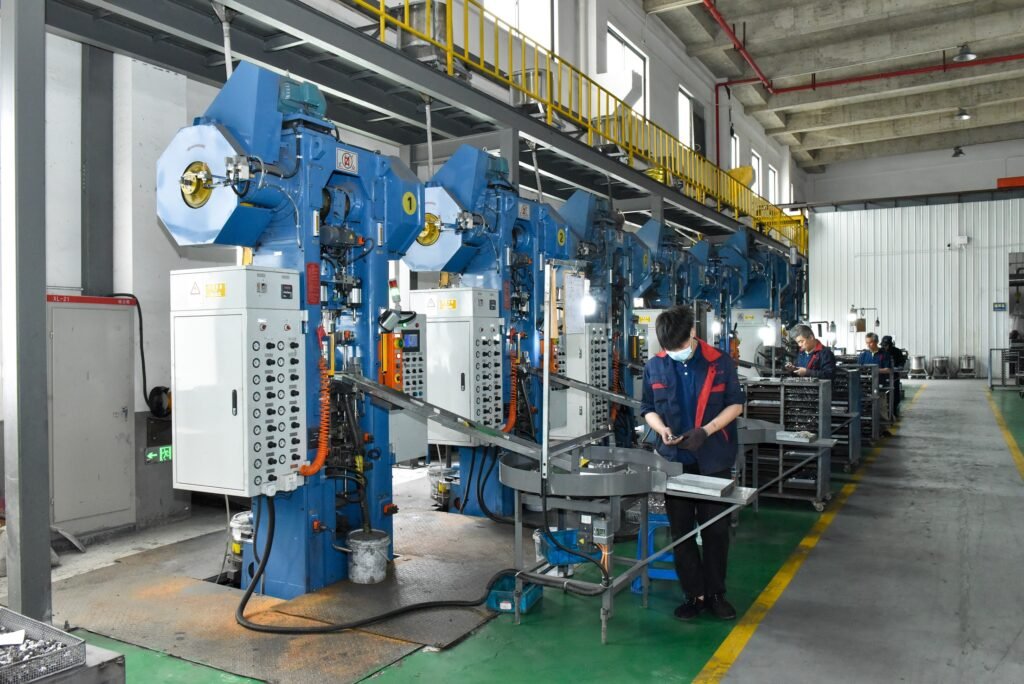
Sintered Gear Manufacturer China for Custom Powder Metallurgy Gears
A sintered gear manufacturer in China produces gears by compacting metal powder in a precision die, sintering the compacted part, and applying secondary operations when required. For buyers, the key selection factors are gear geometry, material, density, tooth accuracy, dimensional control, tooling capability, inspection equipment, production capacity, and lot-to-lot consistency, not simply the supplier’s quoted unit price.
What Is a Sintered Gear Manufacturer?
What “Sintered Gear” Means
A sintered gear is produced through powder metallurgy: metal powder is blended with lubricants and alloying elements, compacted in a precision die at high pressure to form a “green” gear, then sintered at elevated temperature (typically 1,120 to 1,180°C for ferrous grades) in a controlled atmosphere to metallurgically bond the particles. Sizing or coining corrects dimensional shrinkage, and secondary operations such as machining, heat treatment, or surface finishing may follow.
A sintered gear’s final performance is not determined by compaction alone. It is the combined result of:
- Powder composition and particle characteristics
- Compaction pressure and density distribution
- Sintering temperature, time, and atmosphere
- Tooth geometry and ejection constraints
- Dimensional correction (sizing/coining)
- Secondary processing (machining, heat treatment, surface treatment)
What a Manufacturer Actually Controls
A sintered gear manufacturer is responsible for controlling the complete chain from incoming material to finished part. The critical control points a buyer should examine are:
| 01 | Powder and material control (chemistry, particle size, batch consistency) |
|---|---|
| 02 | Tooling and die design (tooth-form geometry, shrinkage compensation, ejection) |
| 03 | Compaction (press tonnage, filling, density distribution) |
| 04 | Sintering (temperature profile, atmosphere, furnace type) |
| 05 | Dimensional correction (sizing, coining, secondary machining) |
| 06 | Gear inspection (profile, lead, runout, pitch, tooth thickness) |
| 07 | Final quality control (density, hardness, metallography, traceability) |
Why Choose Sintered Gears for Volume Production?
OEMs select sintered gears when the combination of annual volume, geometry complexity, and per-unit cost makes PM more economical than machining from solid stock. The decision is not automatic; it depends on production volume, gear geometry, material, accuracy requirements, and secondary operations.
| Factor | Sintered Gear | Machined Gear |
|---|---|---|
| High-volume production | Strong fit | Suitable |
| Material utilization | High (near-net-shape) | More material removed |
| Complex hub geometry | Good (compacted in one step) | Requires multiple setups |
| Internal features | Possible in die | Depends on geometry |
| Tooling cost | Higher upfront | Lower or none |
| Unit cost at volume | Often competitive | Often higher |
| Design flexibility | Die-dependent | High |
| Precision finishing | Secondary machining available | Broad capability |
What Types of Sintered Gears Can a China Manufacturer Produce?
Spur Gears
The most common sintered gear type. Teeth are parallel to the gear axis, making compaction and ejection straightforward. Applications include small transmission systems, actuators, home appliances, and automotive mechanisms. Typical modules range from 0.5 to 3.0 for compacted gears.
Helical Gears
Teeth are cut at an angle to the axis, providing smoother mesh and higher load capacity than spur gears of the same size. Manufacturing considerations include helix angle constraints (typically limited to 15 to 30 degrees for compaction), increased axial force in service, greater tooling complexity, and ejection requirements. Not all PM manufacturers can produce helical gears to tight lead tolerance.
Sintered Pinions
Small-diameter gears with few teeth, typically used as driving members in gear trains. Compact geometry makes them well suited to PM. The key challenge is maintaining tooth form accuracy at small module sizes (0.3 to 0.8 module).
Planetary Gears
Planet gears, sun gears, and ring gears for epicyclic gear sets. PM excels here because each component can be compacted to near-net shape with integrated features (hubs, splines, mounting bores) that would require multiple machining operations from solid stock.
Gears With Hubs, Bosses, and Integrated Features
One of PM’s strongest advantages: gears can be compacted with integral hubs, bosses, counterbores, keyways, and mounting features in a single compaction step. This eliminates secondary machining operations and reduces assembly part counts, which is the primary economic driver for choosing PM over machining for many gear applications.
Materials Used for Sintered Gears
Material selection is driven by gear performance requirements, not by catalog convenience. The table below maps common PM material families to the performance needs that typically drive their selection.
| Fe-C (iron-carbon) | General mechanical gears; low cost; moderate strength |
|---|---|
| Fe-Cu-C (copper-steel) | Improved strength and hardenability; widely used for automotive gears |
| Fe-Ni-C (nickel-steel) | Higher fatigue strength and impact resistance; heat-treatable |
| Stainless steel PM | Corrosion resistance (316L, 410L); food, medical, marine |
| Copper-based PM | Electrical conductivity, thermal applications, low wear |
| Pre-alloyed steel | Controlled mechanical properties; consistent alloy distribution |
| High-density PM | Higher load capacity; double-pressed/double-sintered or forged PM |
Material Selection Depends On
- Tooth load and bending stress
- Contact stress and wear resistance
- Corrosion and operating environment
- Required density (6.4 to 7.4 g/cm³ for most structural gears)
- Heat treatment response
- Operating temperature range
Buyers should specify material by performance requirement (e.g., “minimum 350 MPa bending fatigue strength”) rather than by generic PM grade alone, allowing the manufacturer to recommend the most suitable alloy system.
Sintered Gear Manufacturing Process in China
The process chain determines gear geometry, density, accuracy, and cost. Each step is a control point where deviations can compound through subsequent operations.
Gear Design and DFM Review
The manufacturer reviews tooth profile, module, pressure angle, face width, hub geometry, internal features, draft and ejection requirements, and density distribution. This step determines whether the gear geometry is compatible with compaction and what shrinkage compensation the tooling requires. Ask whether the supplier can review the gear design before tooling is committed.
Powder Selection and Mixing
Base powder (iron, stainless, copper), alloying elements (Cu, Ni, C, Mo), and lubricant are selected and blended. Particle size distribution and apparent density directly affect fill consistency and green density. Batch-to-batch powder consistency is critical for dimensional repeatability.
Tooling and Die Manufacturing
Gear tooling is one of the critical determinants of final gear geometry. The die, punches, and core components must account for sintering shrinkage (typically 0.5 to 2.0% linear depending on material and density), tooth-form clearance, and ejection draft. Tooling design and fabrication capability directly affect tooth profile accuracy and tooling longevity. Ask whether tooling is made in-house or outsourced.
Powder Compaction
Metal powder is compacted at controlled pressure in the die to form the green gear. Press tonnage must match the gear’s projected area and required compaction load. A wide press range allows the manufacturer to match press capacity to part size and geometry. Key variables: filling uniformity, compaction pressure, density distribution through the tooth, and green strength for safe ejection.
Sintering
Green gears are sintered in a controlled atmosphere at high temperature. Sintering conditions (temperature, time, atmosphere composition, furnace configuration) determine the metallurgical bond, density, dimensional shrinkage, and mechanical properties. Temperature uniformity across the furnace belt is critical for consistent gear dimensions within a lot and between lots.
Sizing and Secondary Operations
Sizing (re-pressing) corrects sintering shrinkage and tightens critical dimensions such as bore diameter and tooth profile. Not every sintered gear needs the same secondary operation: common options include coining, CNC machining of tight-tolerance bores or tooth profiles, heat treatment (carburizing, quenching, tempering), surface treatment (steam bluing, plating), and oil impregnation for self-lubrication.
Gear Inspection
Gear tooth measurement includes profile, lead, runout, pitch variation, tooth thickness, and bore dimensions. A manufacturer with a dedicated gear measuring instrument can verify profile and lead independently of a general-purpose CMM. Buyers should ask: “Do you have a dedicated gear measuring machine? Can you measure profile and lead? Can you provide inspection reports for each shipment?”
How to Evaluate a Sintered Gear Manufacturer in China
What should an overseas buyer verify before placing an order? The framework below addresses the control points that separate a capable gear manufacturer from a general PM parts maker.
Tooling Capability
- Is tooling made in-house or outsourced?
- Does the supplier have gear tooling experience (not just simple bushings)?
- Is a DFM review provided before tooling commitment?
- Can tooling be modified after T0 if dimensions need adjustment?
- What is the tool maintenance protocol?
Pressing Capability
- What is the press tonnage range?
- Maximum part diameter and projected area?
- Multi-level pressing capability?
- Can the supplier compact helical or bevel gear geometries?
Sintering Capability
- What furnace type and atmosphere are used?
- Is temperature uniformity monitored and recorded?
- Can the supplier provide sintering records per lot?
- Is batch traceability maintained from powder to finished gear?
Gear Measurement Capability
- Does the manufacturer have a dedicated gear measuring machine?
- Can profile and lead be measured independently?
- Are inspection reports provided per shipment?
- How is tooth-to-tooth variation controlled?
Quality System
- IATF 16949 or ISO 9001 certification?
- Lot traceability from powder batch to shipment?
- Incoming powder inspection (chemistry, particle size, apparent density)?
- In-process inspection (compaction pressure, green density, sintering records)?
- Final inspection (CMM, gear measurement, density, hardness)?
Sintered Gear Accuracy: What Should Buyers Specify?
Requesting “high precision” without defining what that means leads to mismatched expectations. Buyers should specify the following parameters in their RFQ:
| Module | Gear module (metric) or diametral pitch (imperial) |
|---|---|
| Pressure angle | Typically 20°; confirm with application |
| Number of teeth | Drives pitch diameter and gear ratio |
| Tooth width | Face width of the gear tooth |
| Helix angle | For helical gears; 0 for spur |
| Bore tolerance | Critical for shaft fit; typically H7 or tighter after sizing |
| Outside diameter | With tolerance |
| Tooth thickness | Span measurement or over-pin measurement |
| Profile tolerance | Tooth form deviation |
| Lead tolerance | Tooth alignment deviation |
| Runout | Radial composite or single-flank |
| Gear accuracy grade | Per ISO 1328, DIN 3967, or AGMA 2000 |
| Hardness | HRB, HRA, or HV; specify if heat-treated |
| Density | Typically 6.4 to 7.4 g/cm³ depending on load |
Standards Reference
- ISO 1328 (cylindrical gears, accuracy)
- DIN 3967 (gear tolerances)
- AGMA 2000 (gear classification and tolerance)
Sintered Gears vs. CNC Machined Gears
A practical comparison for procurement teams evaluating process selection.
| Factor | Sintered Gear | CNC Machined Gear |
|---|---|---|
| Dedicated tooling | Required (compaction die) | Usually lower tooling cost |
| Material utilization | High (near-net-shape) | Lower (chip removal) |
| High-volume economics | Often favorable | Depends on geometry |
| Integrated features | Strong (hubs, bosses, splines in one step) | Machining time increases |
| Design changes | Tooling changes can be costly | Usually easier (program change) |
| Very low volume | May be less attractive | Often practical |
| Precision finishing | Secondary machining available | Broad capability |
When Sintered Gears May Not Be the Right Choice
- Very low annual volume (below 2,000 pieces)
- Frequent design changes during development
- Extremely tight gear accuracy requirements (AGMA 4 or better) without secondary machining
- Geometry unsuitable for axial compaction and ejection
- Very large gears exceeding press capacity
- Applications where forged or machined gears are proven and economical
An honest sintered gear manufacturer will tell you when PM is not the right process for your gear, rather than accepting every inquiry regardless of fit.
How Much Do Sintered Gears Cost in China?
Quoting a universal price range for sintered gears is misleading because cost is driven by many variables. Instead of a per-piece price, consider the cost structure.
Main Cost Drivers
| Material | Powder grade, alloy content, market price of base metals |
|---|---|
| Gear size | Larger projected area requires higher tonnage press |
| Tooling | Die complexity, number of levels, tooth-form intricacy |
| Annual volume | Tooling amortization; higher volume lowers per-piece cost |
| Pressing cycle | Compaction speed, fill time, ejection complexity |
| Sintering | Furnace time, atmosphere consumption, belt loading |
| Secondary ops | Sizing, machining, heat treatment, surface treatment |
| Inspection | Gear measurement requirements, CMM time, reporting |
| Logistics | Packaging, shipping, customs |
Break-Even: PM vs. Machining
Sintered gears typically have higher upfront tooling costs but lower recurring material-removal costs at sufficient production volume. The break-even point can be modeled as:
where $C_{\text{tool}}$ is the PM tooling cost, $c_{\text{pm}}$ is the per-piece PM cost, and $c_{\text{mc}}$ is the per-piece machining cost.
When annual volume $Q > Q^*$, PM is typically the lower-cost option. When $Q < Q^*$, machining from solid stock may be more economical because no dedicated tooling investment is required.
The exact break-even depends on gear complexity, material, secondary operations, and tooling longevity. A capable manufacturer will provide this analysis as part of the DFM review.
Why Source Sintered Gears From China?
China’s PM manufacturing ecosystem offers scale, tooling availability, and competitive production cost. However, sourcing from China requires verifying the same capabilities you would verify from any supplier, regardless of location.
Potential Benefits
- Large PM manufacturing ecosystem with established powder supply chain
- Tooling availability and shorter tooling lead times than many regions
- Competitive per-unit production cost at volume
- Engineering support and DFM capability
- High-volume production capacity for appliance and automotive programs
- Export experience and English-language documentation (varies by supplier)
What Buyers Still Need to Verify
- Communication quality and technical documentation in your language
- Quality consistency (lot-to-lot and within-lot)
- Tooling ownership and maintenance responsibility
- Inspection reports and gear measurement data per shipment
- Traceability from powder batch to finished gear
- Change-control procedures for design or process modifications
- Packaging, export logistics, and delivery reliability
JH PM as a Sintered Gear Manufacturer in China
JH PM evaluates each gear according to geometry, material, required density, accuracy, annual volume, and secondary operations before confirming production feasibility. We do not accept every gear inquiry; we confirm the ones we can deliver to specification.
| PM forming presses | 19 presses, 6T to 1,000T range |
|---|---|
| Sintering | 2 continuous furnaces with atmosphere control |
| CMM | 3 Zeiss coordinate measuring machines |
| Gear inspection | 1 dedicated gear measuring instrument |
| Quality system | IATF 16949:2016, ISO 9001:2015 |
| Traceability | MES lot-level from powder batch to shipment |
| MOQ | 2,000 pcs per part number |
| Tooling lead time | ~20 working days |
| T0 sample | ~25 working days from tooling completion |
| DFM feedback | 24 to 48 hours |
| Manufacturing base | Shaoxing, China |
Sintered Gear Manufacturing: Buyer Checklist
Send Your Gear Drawing for DFM Review
The right sintered gear manufacturer is not simply the supplier offering the lowest price. The key is whether the manufacturer can control the complete chain from gear DFM and tooling to compaction, sintering, dimensional correction, gear measurement, and production traceability.