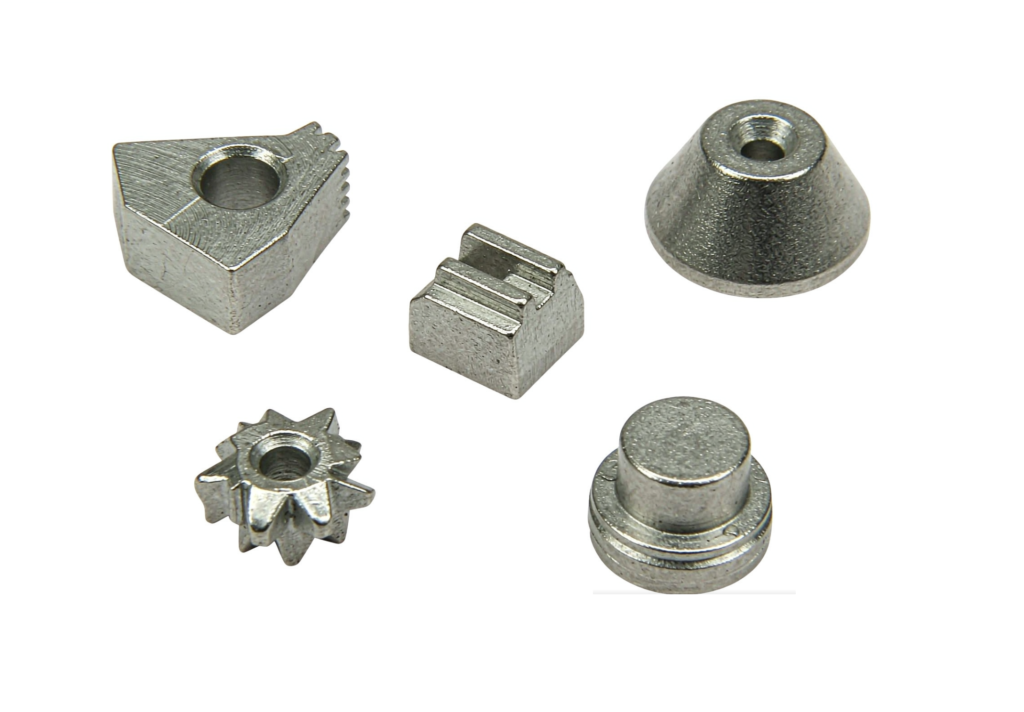
Sintered Parts Plating: A Practical Engineering Guide
Sintered parts can be plated — zinc, zinc-nickel, electroless nickel, and decorative nickel-chrome all work. The catch is porosity. Powder metal parts retain open, interconnected pores after sintering, and those pores trap plating solution that later bleeds out and destroys the coating. Seal the pores first, usually by resin impregnation, and plated sintered parts perform comparably to plated wrought steel.
Five things to know before you specify plating.
Sintered parts plating is standard practice in the PM industry, but it almost always requires pore sealing first. Resin impregnation is the most common method; copper infiltration and steam treatment are alternatives.
Unsealed plating is the single biggest cause of blisters, staining, and adhesion failure on powder metal parts.
Electroless nickel gives the most uniform coverage on porous geometry; zinc and zinc-nickel are the cost-effective corrosion options for iron-based parts.
Plating adds 5 to 25 µm of thickness. On parts with tight tolerances, that thickness has to be planned, not discovered.
Sometimes the right answer is not plating at all — steam treatment, Dacromet, or switching to a sintered stainless alloy can be cheaper for the same corrosion target.
Why plating sintered parts is different
A wrought steel part is solid. A sintered part is not. Structural powder metallurgy parts typically leave the furnace with 5 to 15% porosity — an industry reference range for standard press-and-sinter grades, not a fixed number. Your actual porosity depends on compaction pressure, powder grade, and sintering practice.
Those pores are interconnected, and many are open to the surface. That creates three problems the moment a part enters a wet plating line:
Solution entrapment
Acid pickles, plating baths, and rinse water wick into the pore network. Hours or days later the trapped chemistry bleeds back out through the coating. The result is staining, blistering, and corrosion that starts under the deposit — where you cannot see it until the part fails in the field.
Surface condition
As-sintered surfaces run rougher than machined metal, often cited in the Ra 0.8 to 3.2 µm range as a practical reference. Deposit thickness builds unevenly across peaks and valleys, so a nominal 8 µm coating is not 8 µm everywhere.
Residual oil
Many PM parts — especially bearings — are oil-impregnated. Oil sitting in the pores prevents both sealing resin and plating chemistry from doing their jobs. These parts need thorough degreasing, typically a bake-out, before anything else.
None of this makes plating impossible. It makes preparation non-negotiable.
The standard plating process for sintered parts
A well-run plating sequence for powder metal parts looks like this. Details vary by shop and by finish, but the logic holds:
Parts are baked (commonly around 200 to 300°C for roughly an hour, as a process guideline) to drive oil and volatile contaminants out of the pores.
Resin impregnation under vacuum fills the interconnected pore network with a thermoset resin, which is then cured. This is the step that turns a sponge into a solid surface. Alternatives are covered below.
Alkaline cleaning removes surface residues, followed by a short, carefully controlled acid activation. One caution from plating shops: aggressive electrocleaning and long pickling can re-open sealed pores. Stronger acid for less time is often the safer trade.
Near-neutral or mildly alkaline baths are preferred. Acid zinc in particular is hard on PM surfaces when sealing is marginal.
Ultrasonic rinsing helps flush blind features. A final bake around 100°C drives off moisture from any residual porosity.
Skip step 2 and the rest does not matter. That is not opinion — it is the failure mode plating shops see most often on PM work.
Pore sealing options before plating
| Method | How it works | Strengths | Limitations |
|---|---|---|---|
| Resin impregnation | Vacuum draws liquid thermoset resin (typically anaerobic acrylate or polyester) into pores; heat or chemistry cures it | Reliable seal; enables any wet plating; improves machinability as a side benefit; no dimensional change | Service temperature limited to roughly 150 to 200°C depending on resin; cured resin is non-conductive, so exposed resin specks won’t take coating |
| Copper infiltration | Molten copper wicks into pores during a secondary furnace pass | Fills pores with metal; raises density, strength, and conductivity; no temperature limit issue | Adds cost and a furnace cycle; copper’s galvanic couple with iron can limit corrosion performance in some environments, as corrosion studies have shown |
| Steam treatment | Superheated steam (typically ~510 to 570°C) grows a Fe₃O₄ layer that closes surface pores | Cheap batch process; corrosion testing on nickel-plated iron PM has shown steam-treated specimens outperforming other sealing routes in some studies | Iron-based parts only; adds an oxide layer of roughly 1 to 3 µm; black appearance if plating coverage is incomplete |
| High density, no sealing | Parts compacted and sintered to very high density have few open pores left | No extra step, no added cost | Some shops plate parts above roughly 7.3 to 7.4 g/cm³ without sealing — but treat this as a supplier capability to verify with trials, not an industry rule |
For most structural parts, resin impregnation is the default. It is proven, available everywhere, and compatible with every common plating chemistry. Copper infiltration earns its cost when the part also needs higher strength or conductivity. Steam treatment is the budget option for iron parts — and worth testing before you assume resin is necessary.
Plating options for sintered parts, compared
The corrosion figures below are representative ranges from salt spray testing per ASTM B117. They are process capability references, not guarantees — actual performance depends on deposit thickness, passivate type, sealing quality, and the test profile. Treat them as a basis for comparison, not specification.
| Finish | Thickness | Salt spray (repr.) | Cost | Where it fits |
|---|---|---|---|---|
| Zinc electroplating (with passivate) | 5 to 15 µm | ~72 to 240+ h | Low | Fasteners, brackets, general corrosion protection on iron parts; high-volume, lowest cost |
| Zinc-nickel (12 to 16% Ni) | 5 to 15 µm | ~500 to 1,000 h | Medium | Automotive and industrial parts needing serious corrosion life without EN cost |
| Electroless nickel (EN) | 5 to 25 µm | ~200 to 1,000+ h (P-content dependent) | Medium-high | Complex geometry and internal features — EN coats uniformly without current-density issues; also adds hardness (45 to 65 HRC as-plated) |
| Decorative nickel-chrome | 10 to 25 µm total | Appearance-driven | High | Visible consumer-facing surfaces; demands the best sealing and surface prep |
| Mechanical zinc | 5 to 25 µm | Similar to zinc | Low-medium | Small parts and fasteners where impregnation isn’t specified — a dry process, so no solution entrapment risk |
Two selection notes worth more than the table. First, electroless nickel’s uniform deposition makes it the forgiving choice on porous, complex PM geometry — no current-density shadows in recesses. Second, if the requirement is ordinary indoor corrosion protection on an iron part, plain zinc is usually the right economic answer. Zinc-nickel and EN are for when the salt spray requirement or the service environment justifies them.
Common failure modes — and what causes them
Trapped solution or air expands during post-plate baking or in service, lifting the coating. Root cause is almost always inadequate sealing or skipped bake-out.
Bleed-out. Acid or salts migrating out of unsealed pores through the deposit. Same root cause.
Either residual oil, or pores re-opened by aggressive electrocleaning or over-pickling after impregnation.
Under-deposit corrosion that started before the part ever shipped. On critical parts this is the dangerous one — the part looks fine until it isn’t.
Acid baths on porous, higher-hardness steel parts can charge hydrogen into the structure. For hardened or high-strength sintered steels, discuss baking relief with your plater; mechanical zinc sidesteps the issue entirely.
Notice the pattern: four of the five trace back to pores and preparation. The plating chemistry is rarely the problem.
Cost and economics
Anyone quoting you a single per-part price for sintered parts plating without seeing the part is guessing. The real cost drivers are:
- Sealing requirement — resin impregnation is an extra batch process with its own per-part cost
- Finish choice — zinc is cheap, zinc-nickel less so, EN more still
- Thickness and salt spray target — thicker deposits cost more and take longer
- Part size and racking vs. barrel processing
- Volume — setup and line time amortize poorly on small lots
There is also a substitution question engineers should ask before specifying plating at all. For low volumes or aggressive corrosion targets, switching the base material to a sintered stainless steel (316L, for example) can beat plating an iron part on total cost: you pay more for powder but skip sealing, plating, and the yield losses that come with them. For high volumes of simple parts, plated iron almost always wins. The break-even sits where your volumes, corrosion requirement, and scrap sensitivity say it sits — run the numbers for your part rather than adopting anyone’s universal threshold.
Design and specification guidelines
What you put on the drawing determines what you get back. For plated sintered parts, the drawing or PO should state:
- The part is powder metallurgy. Platers treat PM differently — or should. Specify it explicitly. “Resin impregnation required prior to plating” belongs in the notes.
- Finish, thickness, and standard. e.g., zinc per ISO 2081 / ASTM B633 with passivate type, or EN per ASTM B733 with phosphorus grade.
- Salt spray requirement with test method (ASTM B117), so “corrosion resistant” has a number attached.
- Dimensional scheme accounting for coating thickness. A 5 to 25 µm deposit matters on ±0.05 mm features. Decide whether tolerances apply before or after plating, and say so.
- Critical surfaces and masking needs. Bearing bores, press-fit surfaces, and threads may need to stay uncoated.
- Whether the part is oil-impregnated. Self-lubricating bearings follow different rules entirely — see below.
When should you NOT plate sintered parts?
Plating is a tool, not a default. Skip it — or choose something else — when:
- The part is a self-lubricating bearing. The porosity you would seal is the product’s function. Oil-impregnated bearings generally should not be plated on functional surfaces; the oil and the plating prep fight each other at every step.
- Mild indoor corrosion protection is enough. Steam treatment plus oil costs a fraction of plating and covers a large share of real-world iron PM applications.
- The corrosion target is extreme and volume is low. Revisit the base material. Sintered stainless may be the more honest engineering answer.
- Tolerances are at the tight end and thickness variation is unacceptable. If ±0.025 mm features cannot absorb 5 to 25 µm of plating buildup, plating fights the design. Size after plating, mask, or choose a different finish.
- The service temperature exceeds the resin limit. Resin-sealed parts above roughly 150 to 200°C are living on borrowed time; copper infiltration or mechanical zinc becomes the safer route.
- You need a cosmetic finish on a rough surface. Decorative chrome over as-sintered Ra rarely looks decorative. Expect polishing or copper underlayers — and cost — or reconsider powder coating.
Also worth naming: Dacromet and similar zinc-flake coatings are not plating, but for pure corrosion performance on PM parts they are often the better specification — no solution entrapment risk and strong salt spray performance. Keep them in the comparison before defaulting to electroplating.
How to decide if plating is right for your part
Hours of salt spray, or years of service in a defined environment? Get a number.
Iron at 6.8 g/cm³ and stainless at 7.3 g/cm³ are different conversations.
Bearings and filters: stop here, do not plate.
Check the tightest feature first.
High volume favors plated iron; low volume with high corrosion targets favors stainless or coating alternatives.
Confirm their PM experience and sealing route before committing.
What to ask your PM supplier
Plating quality on sintered parts is decided jointly by the parts maker and the finisher. Questions worth asking your supplier:
- Do you manage plating in-house or through qualified finishers — and who owns the sealing step?
- Which sealing method do you recommend for my material and finish, and why?
- Can you provide salt spray data from previous plated PM work?
- How do you handle dimensional verification on plated features — CMM before or after coating?
- What is the yield expectation on plated lots, and how are bleed-out defects screened?
A supplier who answers these without hesitation has plated PM parts before. One who tells you plating is “no problem, same as steel” has not.
Frequently asked questions
Can sintered parts be plated?
Do sintered parts always need sealing before plating?
What is the best plating for sintered parts?
Can you plate oil-impregnated sintered bearings?
Does plating change the dimensions of sintered parts?
Is plating or stainless steel better for corrosion-resistant PM parts?
Why do plated sintered parts blister or stain?
Sources and standards
- SinterWorks, “Can Powder Metallurgy Parts Be Plated or Coated?” and “PM Surface Treatment Selection Guide” — sinterworks-pm.com
- “Surface treatment and nickel plating of iron powder metallurgy parts for corrosion protection,” Materials & Design (2009) — comparative corrosion study of copper infiltration, resin impregnation, and steam treatment before nickel plating
- ASTM B117 — Standard Practice for Operating Salt Spray (Fog) Apparatus
- ISO 2081 / ASTM B633 — electrodeposited zinc coatings; ASTM B733 — electroless nickel-phosphorus coatings
- MPIF Standard 35 — Materials Standards for PM Structural Parts
Get an engineering review before you specify.
If you have a sintered part that needs corrosion protection, wear resistance, or a specific appearance, the finish decision belongs in the DFM review — not in a footnote after tooling is cut. Send us the part drawing, material, annual volume, and the corrosion or appearance requirement. We will tell you whether plating, steam treatment, a coating alternative, or a different base material makes the most engineering and economic sense — including when the answer is not plating at all.
Have a part in mind? Send a drawing and get a DFM review within 48 hours.
Request a quote →