PM Tooling Cost: What Powder Metal Dies Really Cost — US, Europe and China Compared
An engineering breakdown of powder metallurgy die-set pricing, core rod EDM expenses, multi-level punch kinematics, and realistic break-even amortization for high-volume programs.
- Tier 1 (Simple 1-level, e.g., Bushings/Washers): US/Europe $4,000–$10,000 | China (JH PM) $1,000–$2,000.
- Tier 2 (Moderate 2-level, e.g., Straight Gears/Flanges): US/Europe $10,000–$25,000 | China (JH PM) $2,000–$3,000.
- Tier 3 (Complex Multi-level/Helical/Split-die): US/Europe $25,000–$120,000+ | China (JH PM) $3,000–$10,000.
- The Cost Anchor: Pricing represents complete hardened die-sets including punches, core rods, and tungsten carbide die inserts. In-house tool fabrication at JH PM delivers typical tooling savings of 60% to 75% compared to Western quotes, completed in 20 working days.
What You’re Paying For: PM Tooling Anatomy
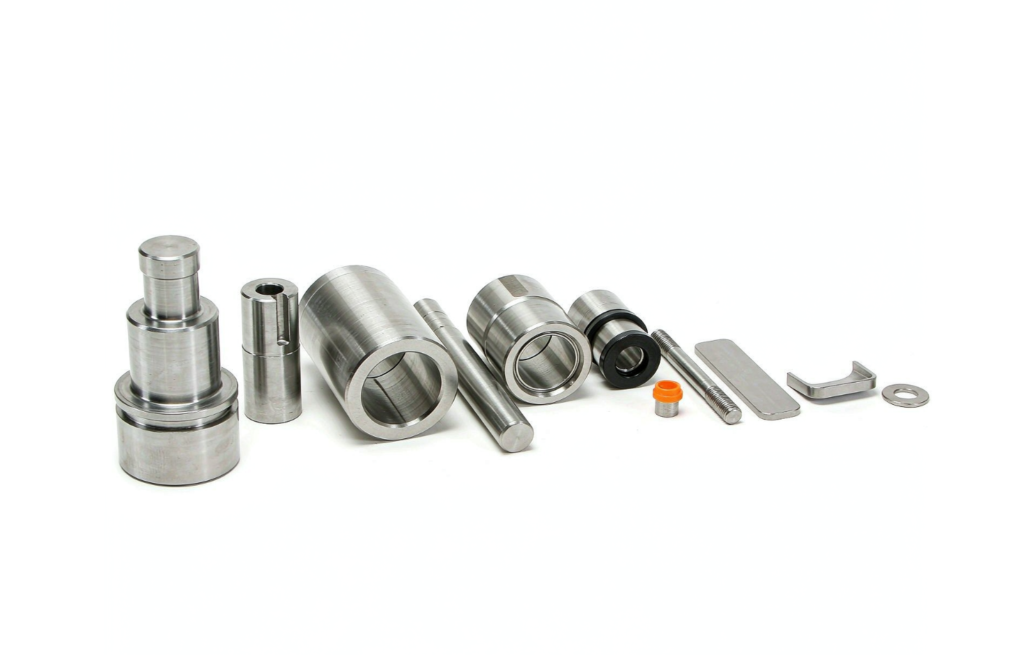
In structural press-and-sinter powder metallurgy, tooling is a high-precision, dynamic mechanical assembly subjected to compaction pressures between 400 and 800 MPa under cyclic fatigue. A complete PM tool set contains four core components:
| Tooling Component | Typical Material | Share of Tooling Cost | Engineering Function & Precision Demands |
|---|---|---|---|
| Die Cell / Cavity Insert | Tungsten Carbide (WC-Co) or D2 / M2 Tool Steel | 35% – 45% | Forms radial part profiles (OD, gear tooth forms). Requires mirror-polish wire EDM to Ra ≤ 0.2 μm to withstand ejection friction without galling. |
| Upper & Lower Punches | CPM 10V, M2, or High-Carbon High-Chrome Steel | 30% – 40% | Transfers compaction tonnage to powder. Multi-level parts require independent, telescoping punch segments moving under CNC hydraulic control. |
| Core Rods (Mandrels) | High-toughness Shock Steel or Solid Carbide | 15% – 20% | Forms through-holes, keyways, and splines. Operates under intense column buckling stress during powder transfer and green part ejection. |
| Adaptor Clamping Rings | High-tensile 4140 or H13 Holder Plates | 5% – 10% | Locates inserts within the press die-set adapter. Standardized in-house adapters eliminate recurring holder charges for buyers. |
For more details on how raw material choices interact with pressing physics, review our engineering reference on Powder Metallurgy Material Properties.
The 4 Factors That Move the Quoted Number
1. Number of Compaction Levels (Punch Kinematics)
Each independent axial transition or step on a part requires its own dedicated upper or lower punch to ensure uniform green density distribution. A flat washer has 1 level. A double-stepped gear has 3 levels. Adding a compaction level increases toolroom machining hours by 40% to 60% due to micro-clearance fits (0.005 to 0.012 mm) between concentric sliding punches.
2. Part Projected Area and Die Envelope
Compaction tonnage dictates tool outer diameter. A 25 mm diameter component uses a compact tool insert. A 120 mm outer diameter gear compacted at 600 MPa exerts nearly 700 tons of bursting force against die walls, requiring a prestressed shrink-fit retention ring (H13 tool steel outer ring shrunk over a thick tungsten carbide inner sleeve).
3. Die Material Selection: Tool Steel vs. Tungsten Carbide
Specifying tool steel (D2 or M2) yields the lowest initial invoice cost and is suitable for 100,000 to 200,000 parts. For abrasive alloy powders and annual volumes exceeding 500,000 units, solid tungsten carbide inserts are mandatory. Carbide increases upfront tooling investment by 25% to 40%, but delivers a 5x extension in tool wear life.
4. Secondary Sizing and Coining Dies
When engineering drawings specify tolerances of ±0.025 mm on critical bores or outer profiles, the as-sintered part must undergo secondary sizing. This requires a secondary sizing die set, adding 40% to 60% to total project tooling capex. For dimensional capability limits, refer to Powder Metallurgy Tolerances: What PM Can and Cannot Hold.
Regional Cost Comparison: US vs. Europe vs. China
The table below provides audited price ranges for complete production-grade PM tooling sets across key manufacturing hubs:
| Tooling Complexity Tier | Typical Components | United States | Western Europe | China (JH PM In-House) |
|---|---|---|---|---|
| Tier 1: Simple (1-Level) | Self-lubricating sleeve bushings, simple spacers, flat thrust washers | $4,000 – $10,000 | $5,000 – $12,000 | $1,000 – $2,000 |
| Tier 2: Moderate (2-Level) | Spur gears, flanged bearings, timing sprockets, eccentric cams | $10,000 – $25,000 | $12,000 – $30,000 | $2,000 – $3,000 |
| Tier 3: Complex (3+ Level) | Multi-level transmission hubs, synchronizer rings, helical oil pump gears | $25,000 – $120,000+ | $30,000 – $140,000+ | $3,000 – $10,000 |
The Regional Pricing Advantage
Because JH PM maintains an integrated in-house toolroom equipped with high-precision wire EDM and internal standardized adapter shoes, tooling pricing in China ranges from $1,000 up to $10,000, eliminating Western domestic outsourcing markups while maintaining full ±0.005 mm electrode clearances.
Tooling Amortization vs. CNC Break-Even Math
To determine whether paying upfront PM tooling is economically rational compared to zero-tooling CNC machining, use the break-even model explained in our guide on Powder Metallurgy vs. Machining Cost:
Break-Even Volume (Q*) = C_tooling / (C_unit_CNC – C_unit_PM)
Worked Example (Automotive Flange Bushing – Tier 2 Tooling):
- CNC machining from 1045 steel bar: $4.50 / piece ($0 tooling capex).
- PM unit price (Fe-Cu MPIF FC-0208): $1.40 / piece.
- JH PM in-house tooling quote: $2,500.
- Break-Even Volume ($Q^*$):
$2,500 / ($4.50 - $1.40) = 806 pieces.
Because the in-house die cost is only $2,500, tooling amortizes well before reaching our standard 2,000-piece MOQ. For overall piece-price logic, explore Powder Metallurgy Cost Factors.
5 Ways Design Engineers Can Cut PM Tooling Cost
- Minimize Independent Axial Steps: Merging two shallow steps into a single tapered face eliminates an entire sliding lower punch mechanism.
- Utilize Standard Module Gears: Specifying standard involute tooth profiles allows tooling EDM electrodes to be cut with existing wire-EDM macros, reducing tool programming fees.
- Add Generous Fillets (≥0.5 mm): Sharp internal punch corners crack under high compaction pressure. Adding generous radii prevents premature punch chipping.
- Reserve Sizing for Critical Interfaces: Avoid tolerancing non-mating outer diameters at
±0.025 mm. Specifying standard as-sintered tolerances (±0.05 mm) avoids building a secondary sizing die altogether. - Leverage Factory Modular Bolsters: Confirm that your supplier can adapt inserts into their internal die-shoes rather than quoting dedicated, stand-alone hydraulic adapters.
Supplier Questions to Ask Before Comparing Tooling Quotes
- 1. Does the quote include tungsten carbide inserts or tool steel? A $1,500 tool steel die that wears out at 150,000 shots is more expensive long-term than a carbide die that runs 1,000,000 shots without maintenance.
- 2. Who pays for die replacement when the tool wears out? Clarify whether the supplier offers a lifetime maintenance guarantee. At JH PM, replacement punches and die inserts are covered by the factory for the duration of the agreed production contract.
- 3. Does the tooling quote cover CMM First Article Inspection (FAI) and PPAP? Verify that full dimensional reports from Zeiss CMM and material test certificates per MPIF Standard 35 are included without separate laboratory charges.
- 4. Is secondary sizing tooling included? Ensure the quote covers both compaction tooling and sizing tooling if drawing tolerances demand repressing.
JH PM In-House Toolroom Capabilities & Lead Times
Located in Shaoxing, Zhejiang, JH PM (Ningbo Jiehuang Chiyang Electronic Tech) operates an internal tooling development center directly connected to our mass-production pressing floor:
- Dedicated Toolroom Equipment: High-precision CNC slow-walk wire-EDM, mirror-spark die-sinking EDM, and precision surface grinders maintaining ±0.005 mm punch-to-die clearances.
- Production Compaction Floor: 19 automated PM presses ranging from 6 to 1,000 tons, accommodating both small high-speed gears and multi-level structural parts.
- Sintering & Quality Footprint: 10 industrial sintering furnaces (including 2 continuous mesh-belt lines with 3,000+ tons annual capacity), 3 German Zeiss CMM inspection labs, certified to IATF 16949:2016 and ISO 9001:2015.
- Commercial Production Terms: Standard project MOQ is 2,000 pieces; custom tooling fabrication in 20 working days; first-article T0 trial samples in 25 working days; and formal engineering DFM reviews within 48 hours.
Frequently Asked Questions
Get an In-House PM Tooling Quote & DFM Review in 48 Hours
Send your 2D engineering drawings and 3D CAD models (STEP/IGES) to JH PM. Our tooling engineers will evaluate punch kinematics, recommend cost-reduction geometry tweaks, and deliver a formal tooling and piece-price quotation within 48 hours.