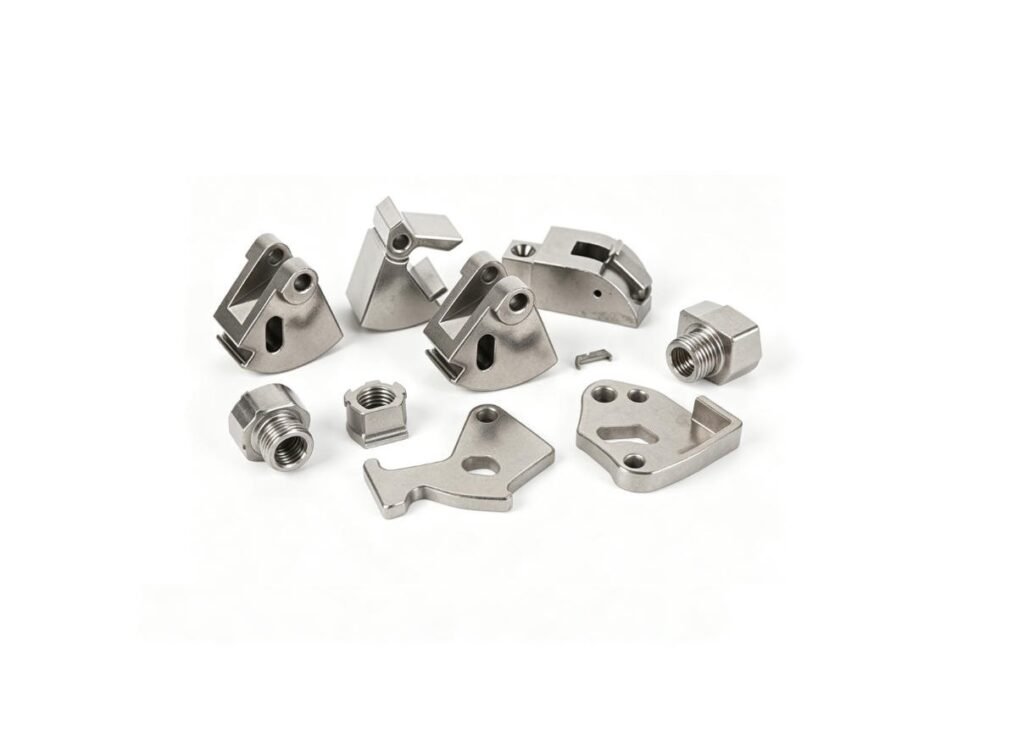
Powder Metallurgy Cost: Pricing, Tooling & Cost per Part
Evaluating powder metallurgy cost means looking past the raw powder price per kilogram. In press-and-sinter manufacturing, the unit price is an engineered output of component weight, die-set complexity, batch size, and post-sintering processing — not a commodity quote.
Powder Metallurgy Unit Cost Framework
Where: W = net part weight; P = powder price per kg; η = material yield (≈95–98%); Ctooling = die-set cost; V = total lifetime volume; Cpress / sinter / secondary / qa = per-part operational costs.
Note: Material dominates at volume; exact percentages shift with alloy system and post-processing requirements.
8 Key Factors Driving Powder Metallurgy Cost
1. Raw Powder Material Cost
Metal powder price is set by alloy chemistry and atomization route (water vs. gas). Plain iron powder is the most economical base. Adding elemental or pre-alloyed copper (FC-0208) or nickel (FN-0205) lifts mechanical properties and material cost together. Stainless powders (316L, 17-4 PH) carry a premium from chromium/nickel content and strict vacuum sintering.
2. Part Weight vs. Geometric Complexity
Weight sets how much powder you consume, but geometry sets how efficiently the press works. A heavier, simple cylindrical bush often costs less to actually produce than a light multi-level gear with thin webs and steeped profiles that demand tighter compaction control.
3. Tooling Design and Die Complexity
PM tooling is a matched set of upper/lower punches, die cell, and core pins in D2/M2 tool steel or tungsten carbide inserts. Single-level parts need a simple die set; multi-level gears need multi-punch tooling to hold uniform density through every step.
4. Production Volume & Tooling Amortization
Tooling is a fixed upfront cost, so volume drives unit cost down sharply. Amortize a die set over 100,000 parts and tooling becomes negligible; spread the same set over 500 parts and PM turns uneconomical next to CNC.
5. Compaction Press Tonnage
Compaction pressure runs roughly 400–800 MPa. Larger parts demand higher-tonnage presses (500–1,000 t), which bill at higher hourly rates than a 20-ton high-speed mechanical press.
6. Sintering Atmosphere and Temperature
Standard mesh-belt sintering around 1120 °C in endothermic gas is energy-efficient. High-temperature (1250 °C) or vacuum sintering raises energy and gas cost but buys higher density, pore rounding, and better fatigue resistance.
7. Secondary Operations
As-sintered parts are the cheapest state. Every secondary step adds cost:
- Sizing / coining: re-pressing to hold ±0.025 mm.
- Secondary machining: tapping cross-threads or cutting undercuts that can’t be pressed.
- Heat treatment: carburizing, induction hardening, or sinter hardening.
- Plating / oil impregnation: vacuum impregnation for self-lubricating bronze bearings.
8. Quality Inspection Specifications
Over-tolerancing non-functional dimensions inflates inspection time and quality overhead. Keeping tolerances strictly to functional need avoids extra sizing and 100% optical-sort charges.
Process Cost Comparison: PM vs. CNC vs. Casting
| Cost / Process Variable | Powder Metallurgy (PM) | CNC Machining | Investment Casting |
|---|---|---|---|
| Material Utilization | 95–98% (near-net shape) | 30–60% (high chip scrap) | 70–85% (gates & risers) |
| Initial Tooling Cost | Moderate to high (die sets) | Minimal / none (fixtures only) | High (wax-injection dies) |
| Unit Cost at High Volume | Lowest (1–3 s cycle) | High (spindle-time limited) | Moderate (labor intensive) |
| Secondary Machining Need | Minimal to none | Full machining required | Moderate to high |
| Break-Even Volume | >2,000–5,000 pcs | <500 pcs (prototypes) | >1,000 pcs |
Engineering Framework: Estimating PM Part Cost
- Calculate Net Material Cost: Take finished part mass and multiply by the raw powder price per kg, applying a 95–98% material-utilization yield factor.
- Amortize Upfront Tooling: Divide the total die-set investment by expected lifetime production volume to get tooling cost per part.
- Evaluate Compaction & Sintering Machine Time: Compute hourly machine rates from press tonnage (6–1,000 t) and furnace atmosphere loading.
- Factor In Secondary Processing: Add post-sintering steps — sizing, heat treatment, CNC machining, plating, or oil impregnation.
- Include Quality Assurance & Packaging: Add dimensional CMM inspection, cleanliness testing, corrosion protection, and export packaging overhead.
- Apply Volume Learning: Adjust against order batch size and annual volume — higher volume amortizes tooling and cuts per-part cost.
6 Practical Ways to Reduce PM Part Cost
- Design for straight-line pressing: avoid undercuts, reverse tapers, and side holes that force split tooling or extra machining.
- Use dual tolerance specs: hold ±0.025 mm only on critical mating surfaces; leave the rest at standard as-sintered ±0.05 mm.
- Choose standard MPIF grades: stock iron-copper alloys (e.g., MPIF FC-0208) skip custom-blend surcharges.
- Use sinter hardening: sinter-hardened steels combine densification and hardening in one furnace pass, cutting the oil-quench step.
- Consolidate assemblies: merge several stamped or machined parts into one multi-level PM part to remove assembly labor.
- Optimize batch sizes: align order batches with furnace loading to maximize energy and setup efficiency.
JH PM Powder Metallurgy Cost Evaluation
At JH PM, cost evaluation starts with a DFM (design-for-manufacturability) pass to land the lowest total part cost:
- Compaction: 19 automatic PM presses from 6 to 1,000 tons, covering small and large multi-level geometries at high speed.
- Sintering: 2 continuous sintering furnaces with controlled-atmosphere loading.
- Metrology & quality: 3 Zeiss CMMs, Archimedes density balances, and IATF 16949:2016 / ISO 9001:2015 certified control with PPAP and MES batch trace.
- Commercial terms: MOQ from 2,000 pieces; 25-day tooling; 35-day T0 first article; 48-hour DFM and cost quote.
Frequently Asked Questions
Request a Material & Cost DFM Review
Send your 2D/3D drawings, material spec, target annual volume, and critical tolerances to JH PM. Our engineering team returns a full DFM feasibility assessment and a formal quotation within 48 hours.
Submit Drawing for 48-Hour QuoteRelated Reading
- Powder Metallurgy Material Properties: Mechanical & Physical Guide
- Powder Metallurgy Tolerances: What PM Can Hold
- Benefits of Powder Metallurgy: What You Save
- Powder Metallurgy Uses: Where It Wins
- Powder Metallurgy Quality Control & Inspection
- Sintered Structural Parts: Brackets & Housings
References
- MPIF Standard 35 — Materials Standards for PM Structural Parts. Metal Powder Industries Federation.
- MPIF — Intro to PM: Why Powder Metallurgy. Metal Powder Industries Federation.
- MPIF — Intro to PM: Economics / Cost Considerations. Metal Powder Industries Federation.