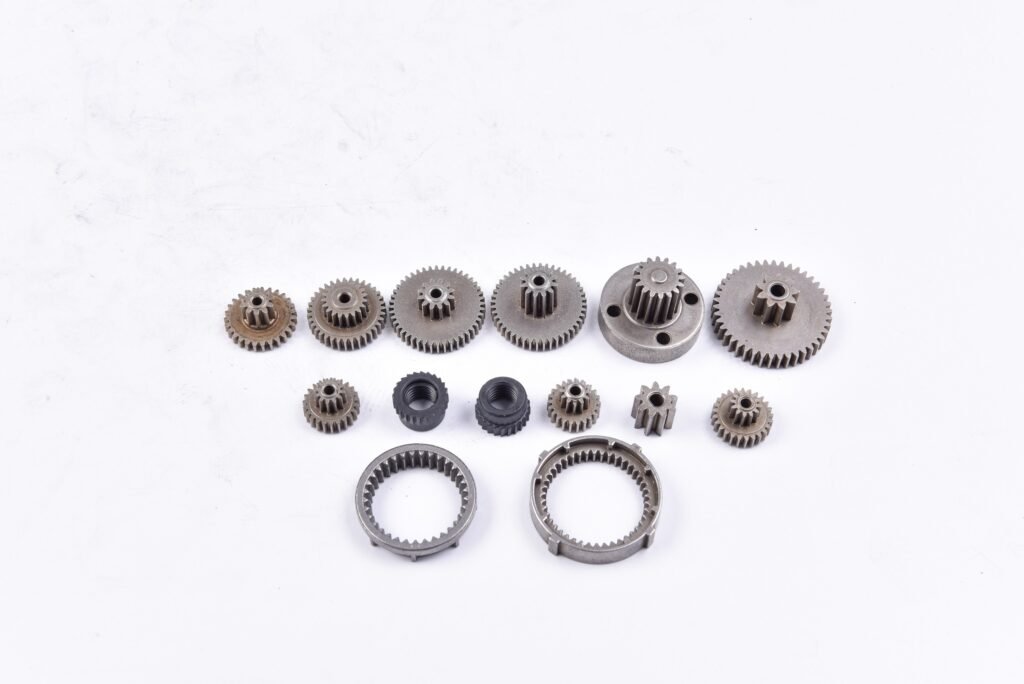
Sintered Parts Heat Treatment: What Works, What Seals the Pores Shut
A quote came back last month on a sintered steel sprocket with a note from the customer’s metallurgist: “Quench and temper to 58 HRC, carburize case 0.8 mm.” We did not refuse the job. We re-routed it, because the carburize callout on a plain-iron sintered part would have pushed carbon through a network of open pores and turned the whole section into a case, with no core left to harden against. The fix cost the customer nothing: we quoted a prealloyed low-carbon steel, through-hardened it, and the part shipped on time with the hardness map he actually wanted.
That note is the daily reality of heat treating powder metal parts. Sintered parts heat treat differently than wrought steel, in four ways at once: they are porous, they are often lower carbon than a drawing assumes, they are alloyed with powders that respond fast to furnace carbon, and they can go through the same furnace that already made them. A heat treatment spec copied off a wrought-steel print will usually “work” in the sense that the part comes out hard, and quietly fail in the sense that it is brittle, leaking, or distorted. Here is what each treatment actually does to a sintered part, what it costs, and what to specify instead.
Heat treatment is also the most price-sensitive secondary operation we run, because it is where a drawing error costs the most to find late. Last updated 1 Sep 2026. Here is what we hold on a press-and-sinter line.
| Metric | Value |
|---|---|
| Sintering (itself a heat treatment) | Iron-base: 1120 to 1150 °C, atmosphere-controlled, continuous or vacuum |
| Through-hardening (quench + temper) | Up to HRC 40 on sinter-hardening grades; HRC 25 to 35 conventional |
| Carburizing | Case to HRC 55 to 60; only on sealed or low-porosity sections |
| Steam treatment | Magnetite layer 3 to 10 µm; seals pores; +2 to 4% weight |
| Nitrocarburizing / salt bath | Surface hardening without quench distortion; low-pressure friendly |
| Induction hardening | Local case on sized or machined faces only |
| Hardness reporting | Per lot, with density and carbon data, MES traceable |
| MOQ | From 2,000 pcs |
| Certifications | IATF 16949, ISO 9001 |
Sintering is already a heat treatment, and most buyers underuse it
Start where the process starts, because the distinction buyers miss is between sintering and heat treatment proper. Sintering is a furnace cycle: it bonds the powder into a part, and it also sets the microstructure the part ships with. A plain-iron part coming out at 1120 °C under controlled atmosphere has already been through a normalizing-type cycle. There is nothing to add for most brackets, bushings, and low-load gears; the as-sintered structure is the heat treatment.
The underused move is sinter-hardening. Certain prealloyed powders (with nickel, molybdenum, and manganese balanced so the hardenability comes from the alloy and not from a quench) transform to martensite as they cool inside the sintering furnace. The part exits the furnace already hard, HRC 30 to 40 depending on section and temper, with no separate quench operation, no second furnace pass, and, critically, no quench distortion. For gear and sprocket work this is usually the cheapest route to a hard part, and it is invisible to a buyer who specs “quench and temper” because they do not know to ask whether the powder can harden itself. Our press-and-sinter process page covers how the alloy choice threads into furnace control.
The pore problem: why porous parts heat treat differently
Everything specific to heat treating sintered parts traces back to one fact from our porosity and density page: the part is 8 to 15% open, interconnected porosity. That network behaves like a sponge in every furnace operation, and each treatment interacts with it differently.
Quenching
Oil or polymer quenchants wick into open pores and contaminate the part, and the pore network locally slows the quench, so the surface you think you are hardening is cooling slower than a wrought section would. Gas quenching in vacuum, or sinter-hardening in the furnace itself, sidesteps both problems. This is why we route hardening through vacuum or in-furnace rather than a conventional oil quench on porous parts.
Carburizing and carbon control
Gas carburizing feeds carbon into the surface, and on an unsealed porous part it feeds carbon everywhere: the case runs deep into the network and there is no low-carbon core left. The counters are real but each has a price: infiltrate or steam-treat to seal the surface first, buy a prealloyed powder with carbon already controlled in the melt, or use a powder grade that develops its case through the alloy chemistry instead of a gas reaction. Carbon potential in our sintering atmospheres is controlled to the hundredth of a percent, because the sintering cycle itself is where most PM carbon is set; it is far harder to fix carbon after the part is porous than to set it right at the source.
Decarburization
The same surface chemistry runs both ways: a sintered part held too long at temperature in the wrong atmosphere will lose surface carbon, and a part specified at 0.6% C can exit the furnace at 0.4% with the hardness to match. This is why atmosphere control is the single most important variable in PM heat treatment, and why the furnace logs ship with the lot data on hardness-critical parts. The lot report discipline on our quality page is the same one we apply to critical-dimension tolerance reporting.
Steam treatment
The odd one out, and the one worth understanding properly. Superheated steam at around 550 °C grows a magnetite (Fe3O4) layer that fills the near-surface pores. It is not a hardening treatment, and the hardness gain is modest, a few points on the HRB scale, but it does three things buyers usually want separately: it seals the pores (which stops plating solution and quench oil wicking in later), it adds corrosion resistance, and it gives a uniform black finish. It is the cheapest pore-sealing operation we run, and it is the treatment our surface finish page described as “not its job to smooth the surface.”
Nitrocarburizing and salt bath
Because these treatments diffuse nitrogen into the surface without a quench, they harden a porous part with almost no distortion and no quenchant going into the pores. Salt bath nitrocarburizing in particular is the workhorse for sintered gears and sprockets that need wear resistance at moderate cost: a thin, hard compound layer over a diffusion zone, with fatigue benefit that pure carburizing on a porous section cannot match. For power-metal drive trains, see how this threads into our sintered power-tool parts line.
Left: oil or polymer quenchant wicks into the open pore network and contaminates the part. Center: carburizing gas penetrates deep, so the case has no defined transition into a low-carbon core. Right: steam treatment grows a magnetite (Fe3O4) layer at around 550 °C that fills the near-surface pores and seals the surface for later plating or quench steps.
Which treatment does which job
| Treatment | What it delivers | Watch out for |
|---|---|---|
| Sinter-hardening | HRC 30 to 40 straight from the furnace | Alloy-specific powders; section size limits |
| Quench + temper | Predictable core hardness to HRC 25 to 35 | Quenchant in pores; use vacuum gas quench |
| Carburizing | HRC 55 to 60 case for wear | Case runs into pores unsealed; seal or prealloy first |
| Nitrocarburizing | Wear layer, minimal distortion | Compound layer thin; not a deep case |
| Steam treatment | Pore sealing, corrosion, black finish | Not a hardening treatment; +2 to 4% weight |
| Induction hardening | Local case on specific features | Works only on sized or machined (closed-surface) zones |
Two rows need the honest caveats spelled out.
Carburizing on sintered parts is the most common spec error we see, and the failure is silent: the part measures to hardness on the surface, passes the incoming check, and the case has no defined transition into the core because there effectively is no core. If a drawing calls carburizing on a PM part, the DFM question is always the same, and it is the same one the porosity and density page opens with: is the surface sealed (infiltrated, steam-treated, or high-density at that face), and is the alloy a prealloyed grade with carbon under control? If neither, the treatment is being bought and not delivered.
Induction hardening has the opposite constraint: it needs a closed surface to couple to, so it works on bores and faces that were sized, coined, or machined, exactly the functional zoning idea from the porosity page. A sized bearing journal can be induction hardened locally while the rest of the part stays as-sintered, which is the cheapest possible answer to “hard where it touches, tough where it does not.” We size critical features to ±0.025 mm selected critical, then induction-harden the contact face only.
What heat treatment changes beyond hardness
Buyers spec hardness and get three side effects they did not order, so the DFM lists them up front.
Distortion. Quenching moves a sintered part more than a dense one, because the pore network lets sections transform unevenly. Sinter-hardening (quench-free) and nitrocarburizing (quench-free) are the distortion-avoidance levers; when a quench is unavoidable, sizing after the treatment recovers the dimensions at secondary-operation cost.
Porosity closure, in one direction only. Steam treatment seals the near-surface pores. Nothing else “closes” porosity except mechanical work (sizing, honing) or infiltration. A drawing note like “heat treat to close porosity” has no operation behind it, and we flag it rather than quote it. Our porosity and density page walks the five density bands and the cost rung of each.
Corrosion behavior shifts. Quench oil left in pores and salt from salt-bath lines both need a wash-and-dry protocol after treatment; a part that measured clean before treatment can arrive rusty from inside its own pores if that protocol is skipped. It is a process detail, not a property, but it is the difference between a part that rusts in the box and one that does not.
How to specify heat treatment on a PM print
The checklist we walk buyers through, the same five-step logic as the porosity page:
- Name the function, not just the hardness. “Wear surface, sliding against steel” or “high-cycle gear tooth” tells us which of four routes fits. “HRC 40” alone lets us hit the number three different ways, at three different prices.
- Say where the hardness has to be, and where it must not be. PM parts often need zoned hardness: case on the tooth flank, tough core in the hub. A single hardness callout on the whole part usually costs more than the zoned version.
- Flag porous sections and sealing state. If a section will be carburized or quenched, tell us whether it will be sealed, infiltrated, or left open. The treatment route and the price both turn on this.
- Watch the carbon. Specify carbon content on the drawing if the heat treatment depends on it, because PM carbon is set in the sintering atmosphere and verified against the melt chemistry, not against a wrought-steel mill certificate.
- Ask what the lot report carries. Hardness per lot with density, carbon, and furnace data behind it, MES traceable. Hardness without provenance is a number on a certificate, not a property of your part.
Pick the duty first, then the treatment. Most spec errors we see come from starting at the hardness number and working backward through the wrong route.
How we control it
Sintering and heat treatment share one discipline: the furnace record. Continuous and vacuum furnace zones are thermocouple-mapped, atmosphere carbon potential is logged per run, and quench parameters are locked in the MES alongside the press setup that made the part. A hardness number on our lot report traces back to the furnace chart for the exact run the part went through, the same discipline as the density reporting on the porosity page, the surface data on the finish page, and the wall-thickness notes on the wall-thickness page. For automotive heat-treated components, see our automotive sintered parts line for transmission and engine applications.
Key takeaways
- Sintering itself is a heat treatment, and sinter-hardening grades let a part exit the furnace already at HRC 30 to 40 with no separate quench.
- Porosity is the reason sintered parts heat treat differently: it carries quench oil in, lets carburizing gas run deep, and makes a copied wrought-steel spec deliver the wrong case.
- Steam treatment seals pores but does not harden; nitrocarburizing hardens without distortion; induction works only on sized or machined closed surfaces.
- Carbon is set in the sintering atmosphere, which is why the furnace log matters as much as the hardness certificate.
The expensive mistake is not heat treating a sintered part. It is heat treating it like wrought steel. Send us the drawing with the wear surfaces and load zones marked, and we will tell you which treatment route meets the hardness where you need it, and what each route costs, inside 48 hours from a free DFM review.
Send the drawing, get a treatment plan
Tell us where the part wears, where it loads, and which sections are porous. We will mark which heat treatment fits, what it costs, and what to specify on the print. Reply within 48 hours from a free DFM review.
Request a DFM ReviewFrequently asked questions
- Can sintered steel parts be heat treated?
- Yes, and most are, starting with sintering itself, which is a furnace heat treatment. Sintered parts through-harden, carburize, nitrocarburize, steam treat, and induction harden, but the routes differ from wrought steel because the parts carry 8 to 15% open porosity. That pore network wicks up quench oil and lets carburizing gas penetrate deep, so treatment selection and sealing state matter more than they would on wrought steel.
- Can you carburize a sintered part?
- Yes, but only with preparation. On an unsealed porous part, carburizing gas feeds carbon deep into the pore network, so there is no low-carbon core left and the “case” has no defined transition. The workable routes are sealing or infiltrating the surface first, using a prealloyed powder with carbon controlled in the melt, or choosing a sinter-hardening grade so the case comes from the alloy chemistry instead of a gas reaction. Unsealed carburizing on porous parts is the most common spec error we see on PM prints.
- What is sinter hardening?
- A heat treatment that happens inside the sintering furnace itself. Sinter-hardening prealloyed powders are balanced so the part transforms to martensite as it cools, exiting the furnace at HRC 30 to 40 with no separate quench operation. The advantages are no quenchant wicking into pores, no quench distortion, and no second furnace pass, which usually makes it the cheapest route to a hard sintered part.
- Does steam treatment harden a sintered part?
- Not meaningfully. Steam treatment grows a magnetite layer at around 550 °C that fills near-surface pores, so hardness rises only a few HRB points. Its real jobs are sealing the pores (which stops later plating or quench chemicals wicking in), adding corrosion resistance, and giving a uniform black appearance. If the drawing needs hardness, steam treatment is not the operation that delivers it; nitrocarburizing or sinter hardening is.
- How does heat treatment affect the dimensional accuracy of sintered parts?
- Quenching moves a porous part more than a dense one, because the pore network lets sections transform unevenly. The distortion-avoidance routes are quench-free treatments: sinter hardening and nitrocarburizing. When a conventional quench is required, plan on sizing the critical dimensions afterward; sizing after heat treatment is a standard secondary operation we quote with the treatment, not a surprise added late.